Funding India’s Climate Future
#GS-3 #Economy #Infrastructure #Environment #Sustainable Development #Climate Change
Key takeaways
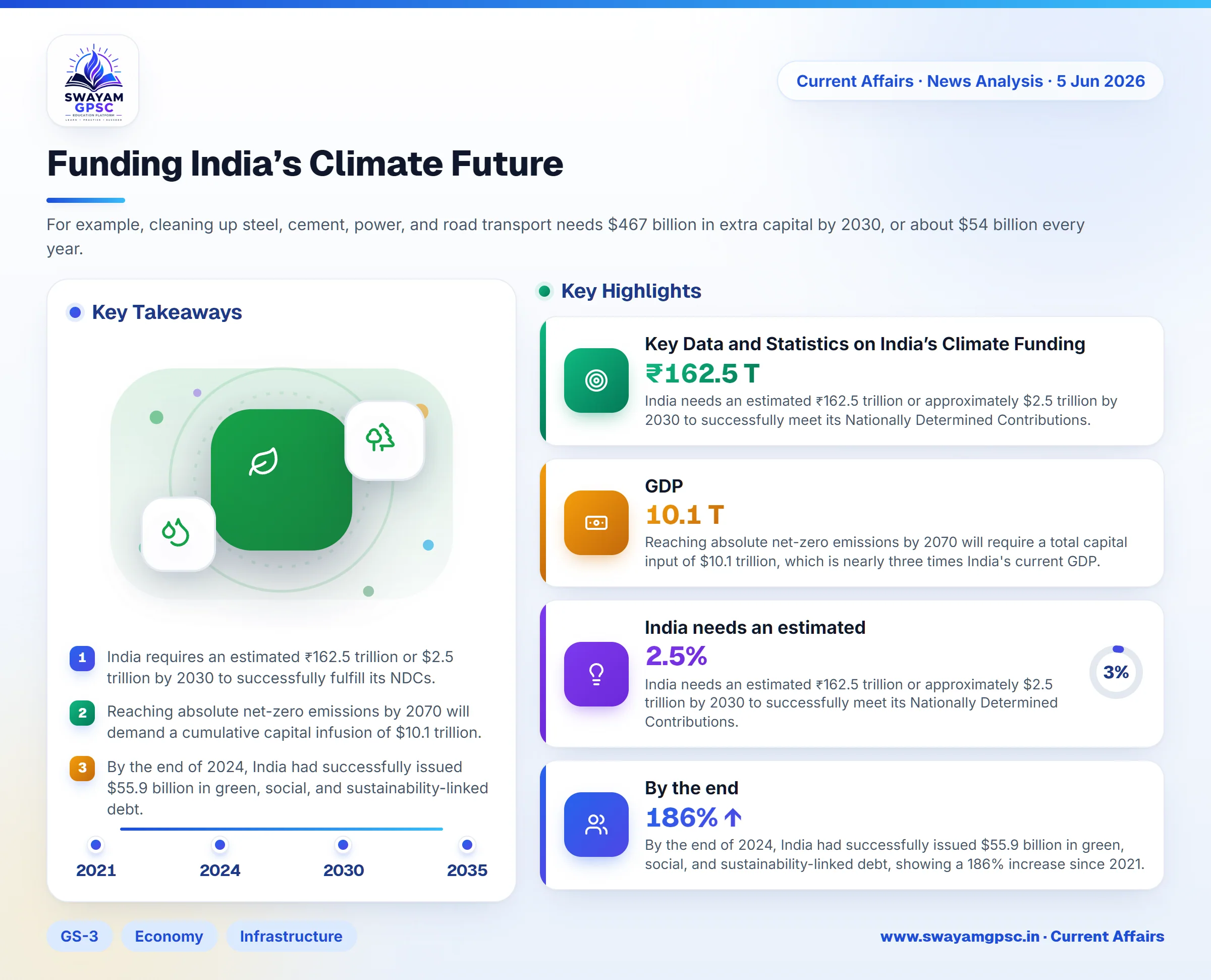
- India requires an estimated ₹162.5 trillion or $2.5 trillion by 2030 to successfully fulfill its NDCs.
- Reaching absolute net-zero emissions by 2070 will demand a cumulative capital infusion of $10.1 trillion.
- By the end of 2024, India had successfully issued $55.9 billion in green, social, and sustainability-linked debt.
- The Central Government has successfully issued ₹477 billion in sovereign green bonds to boost investor confidence.
About Funding India’s Climate Future
- Funding India's climate future means strategically collecting and spending public, private, and mixed money to reach national climate goals.
- This financial setup helps heavy industries cut down emissions, speeds up clean energy use, and pays for local climate adaptation projects.
Key Data and Statistics on India’s Climate Funding
- India needs an estimated ₹162.5 trillion or approximately $2.5 trillion by 2030 to successfully meet its Nationally Determined Contributions.
- Reaching absolute net-zero emissions by 2070 will require a total capital input of $10.1 trillion, which is nearly three times India's current GDP.
- The RBI estimates that the country must invest at least 2.5% of its GDP every year purely into green financing until 2030.
- By the end of 2024, India had successfully issued $55.9 billion in green, social, and sustainability-linked debt, showing a 186% increase since 2021.
The Imperative Need for Funding India’s Climate Future
- Heavy industries cannot switch to cleaner technologies without dedicated financial help because green alternatives are still too expensive on their own.
- For example, cleaning up steel, cement, power, and road transport needs $467 billion in extra capital by 2030, or about $54 billion every year.
- Rich countries have repeatedly failed to keep their global climate funding promises, which forces India to raise money from within the country.
- For instance, the Baku New Collective Quantified Goal commits only $300 billion by 2035 for all developing nations, which India considers too low.
- Money is needed immediately at the grassroots level to protect areas facing sudden environmental damage and extreme weather.
- Targeted funds are vital to build protection, such as saving coastal villages in Odisha from rising seas and protecting farmlands in Vidarbha from droughts.
- Financial institutions must build strong safety buffers to protect their loan portfolios from the systemic risks caused by climate change.
- Banks need clear risk rules to carefully check the sudden flood risks of loan portfolios in low-lying states like Bihar.
- High interest rates often stop private developers from investing in new green projects unless the state steps in to lower the risk.
- Strategic money is needed to run blended finance models so that green loans become cheaper for banks than dirty energy projects.
Initiatives Taken So Far
- The Central Government has successfully issued ₹477 billion in sovereign green bonds, setting clear market rules and boosting foreign investor trust.
- The RBI issued the Climate Finance and Management of Climate Change Risks Directions, making commercial banks include climate threats in their everyday lending.
- Eligible green energy and sustainable infrastructure projects are now officially part of the RBI's Priority Sector Lending framework, pushing banks to lend to green works.
- Sustainable finance tools have been added to the central bank's regulatory sandbox so financial institutions can test new green products safely.
Challenges
- Without an official, legal definition of what counts as a green project, the financial system remains open to fake green claims.
- The lack of a formal rulebook leaves green bonds unverified and makes it very hard to stop greenwashing in corporate portfolios.
- While climate damage happens locally, regional governments do not have the direct financial channels needed to tap into global green bond markets.
- Vulnerable states lack the independent borrowing power and institutional setups required to bring international climate money down to the grassroots.
- Public and concessional money is rarely mixed with private investments, leaving private lenders to handle all the high-risk projects alone.
- The lack of state-backed first-loss guarantees stops private venture capital from entering high-risk fields like offshore wind or green hydrogen.
- Turning old coal-powered factories into green units needs massive, long-term investments that give very slow financial returns.
- This harsh economic reality stops private firms from leading the transition in steel and cement without matching state subsidies.
- Traditional loan evaluation models fail to check long-term climate risks, leaving financial networks open to sudden environmental shocks.
Way Forward
- The Ministry of Finance must quickly finalize a clear, legally binding green taxonomy to set standard definitions and unlock foreign investments.
- The RBI should adjust capital rules based on climate risks, making carbon-heavy lending costlier and green projects more attractive for commercial banks.
- Launch a joint central fund backed by NABARD and global capital to help state governments access green debt markets for local adaptation projects.
- Rapidly scale up sovereign green bond issuances and let commercial banks count them toward their Statutory Liquidity Ratio rules to grow the domestic market.
- Use public funds to build blended finance models that offer first-loss guarantees to absorb early risks and attract private money for clean energy.