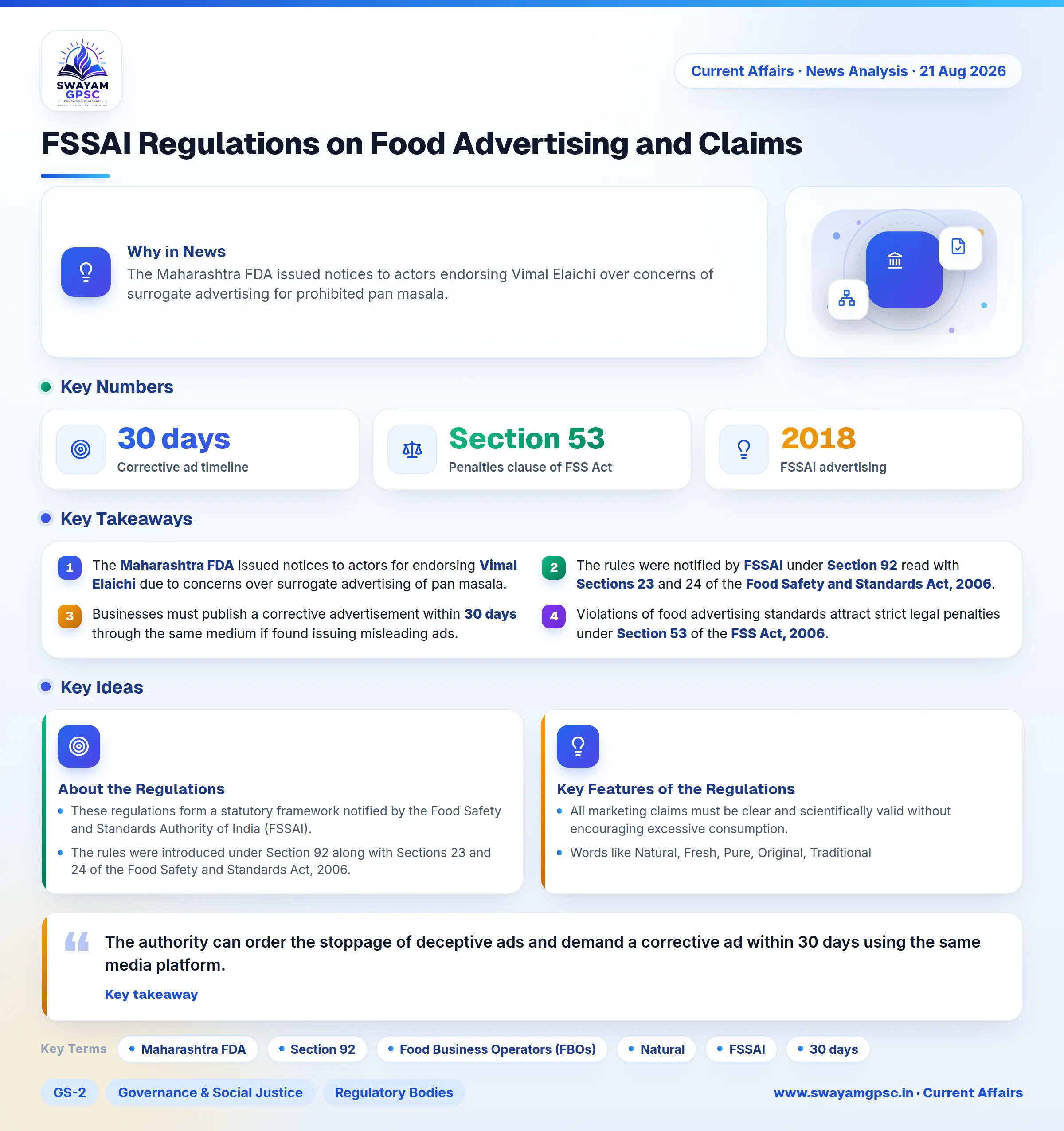
FSSAI Regulations on Food Advertising and Claims
#GS-2 #Governance & Social Justice #Regulatory Bodies #GS-3 #Economy #FSSAI #Current Events #National
Key takeaways
- The Maharashtra FDA issued notices to actors for endorsing Vimal Elaichi due to concerns over surrogate advertising of pan masala.
- The rules were notified by FSSAI under Section 92 read with Sections 23 and 24 of the Food Safety and Standards Act, 2006.
- Businesses must publish a corrective advertisement within 30 days through the same medium if found issuing misleading ads.
- Violations of food advertising standards attract strict legal penalties under Section 53 of the FSS Act, 2006.
Why in News
- The Maharashtra FDA issued notices to actors endorsing Vimal Elaichi over concerns of surrogate advertising for prohibited pan masala.
About the Regulations
- These regulations form a statutory framework notified by the Food Safety and Standards Authority of India (FSSAI).
- The rules were introduced under Section 92 along with Sections 23 and 24 of the Food Safety and Standards Act, 2006.
- They regulate how Food Business Operators (FBOs) promote food products and make health or nutritional claims.
- The main objective is to guarantee truthful food marketing and shield consumers from misleading claims and surrogate ads.
Key Features of the Regulations
- All marketing claims must be clear and scientifically valid without encouraging excessive consumption.
- Words like Natural, Fresh, Pure, Original, Traditional, or Authentic can only be used if products fulfill strict qualification rules.
- The regulations strictly forbid claiming that a food product can cure or prevent any specific disease.
- Advertisers cannot state that medical or health professionals approve or recommend their food product.
- Companies must support all nutritional content and health claims with laboratory tests and human research studies.
- Claims regarding no added sugar or salt must follow strict standards and declare naturally occurring sugars.
- Food businesses must secure formal prior approval from FSSAI before making any disease risk reduction claims.
- Companies are prohibited from using the FSSAI emblem as a marketing tool to claim product superiority.
- The authority can order the stoppage of deceptive ads and demand a corrective ad within 30 days using the same media platform.
- Violators of these standards face legal penalties under Section 53 of the FSS Act, 2006.