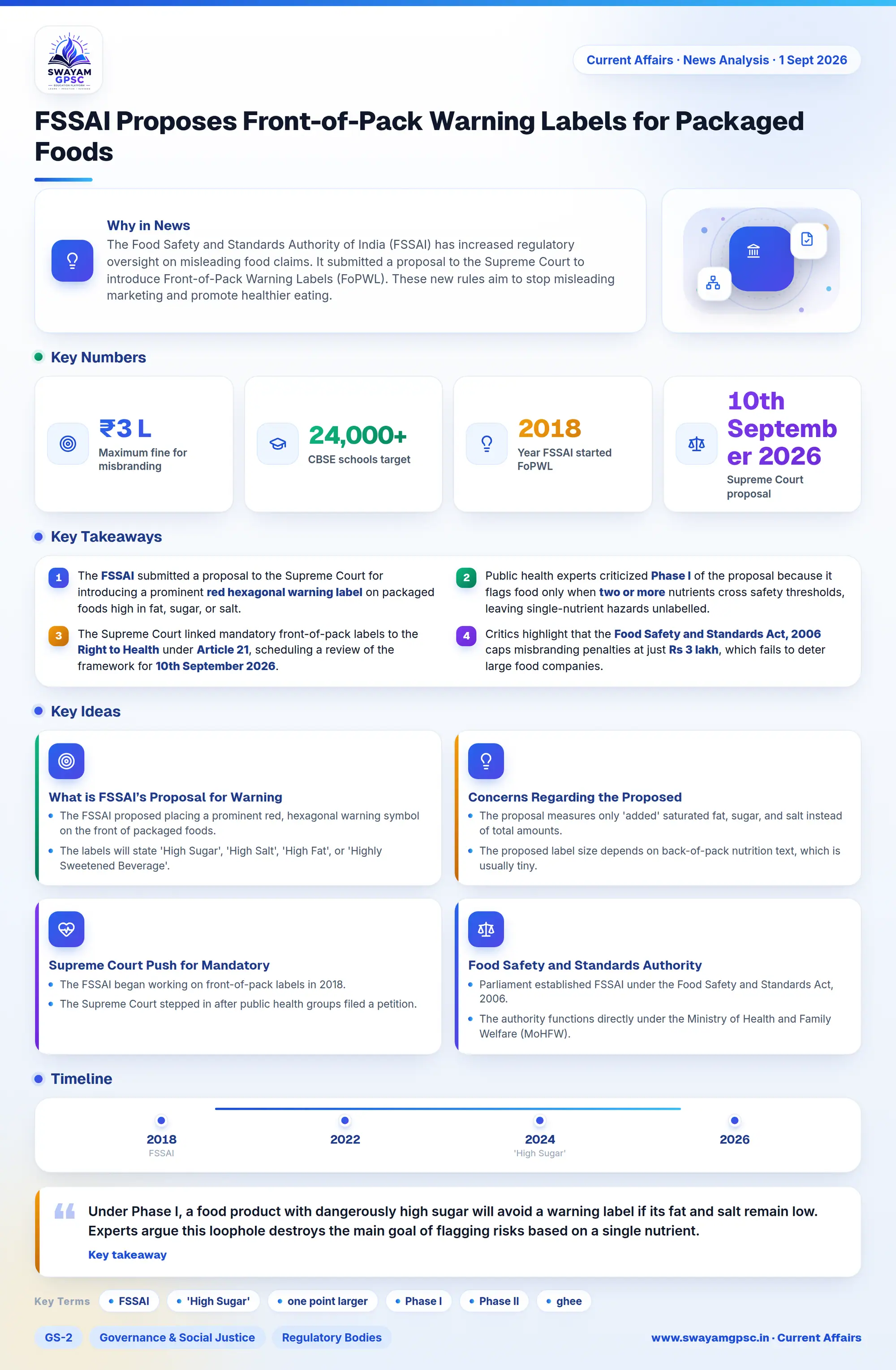
FSSAI Proposes Front-of-Pack Warning Labels for Packaged Foods
#GS-2 #Governance & Social Justice #Regulatory Bodies #Health #Current Events #National #GS-3 #Economy #Food Security
Key takeaways
- The FSSAI submitted a proposal to the Supreme Court for introducing a prominent red hexagonal warning label on packaged foods high in fat, sugar, or salt.
- Public health experts criticized Phase I of the proposal because it flags food only when two or more nutrients cross safety thresholds, leaving single-nutrient hazards unlabelled.
- The Supreme Court linked mandatory front-of-pack labels to the Right to Health under Article 21, scheduling a review of the framework for 10th September 2026.
- Critics highlight that the Food Safety and Standards Act, 2006 caps misbranding penalties at just Rs 3 lakh, which fails to deter large food companies.
- Experts recommend strengthening health awareness by scaling CBSE 'sugar boards' across more than 24,000 affiliated schools in India.
Why in News
- The Food Safety and Standards Authority of India (FSSAI) has increased regulatory oversight on misleading food claims. It submitted a proposal to the Supreme Court to introduce Front-of-Pack Warning Labels (FoPWL).
- These new rules aim to stop misleading marketing and promote healthier eating. However, health experts point out critical flaws that could let unhealthy foods avoid warning labels.
What is FSSAI’s Proposal for Warning Labels?
- The FSSAI proposed placing a prominent red, hexagonal warning symbol on the front of packaged foods. This symbol applies to items classified as High in Fat, Sugar, and/or Salt (HFSS).
- The labels will state 'High Sugar', 'High Salt', 'High Fat', or 'Highly Sweetened Beverage'. These labels depend on nutritional limits set by the Dietary Guidelines for Indians, 2024, created by the ICMR-NIN.
- The text on the warning label must use a font size that is one point larger than the text in the nutrition table on the back of the package.
- The plan uses a step-by-step approach. Phase I covers products that are high in two or more nutrients like added fat, added sugar, and salt, along with specific sweetened drinks.
- Phase II will expand the rule so that a warning label appears if a product is high in any one of these specified nutrients.
- The proposal exempts single-ingredient foods and items that naturally contain high fat, sugar, or salt, such as ghee, edible oil, salt, sugar, jaggery, and honey.
Concerns Regarding the Proposed Warning Labels
- Under Phase I, a food product with dangerously high sugar will avoid a warning label if its fat and salt remain low. Experts argue this loophole destroys the main goal of flagging risks based on a single nutrient.
- The proposal measures only 'added' saturated fat, sugar, and salt instead of total amounts. This dilutes the ICMR-NIN guidelines, which set standards based on total nutrient content per 100 grams.
- The proposed label size depends on back-of-pack nutrition text, which is usually tiny. Adding just one point to that font leaves the warning unreadable from a distance, so experts want label size tied to the Principal Display Area.
- The current proposal leaves out mandatory warnings in regional languages. Without requiring Hindi, English, and local languages, many consumers cannot understand the warnings.
- The affidavit fails to provide clear, binding deadlines for moving from Phase I to Phase II.
- The Food Safety and Standards Act, 2006 limits fines for misbranding to Rs 3 lakh. Critics say this fine is far too small to deter companies earning huge profits from deceptive ads.
Supreme Court Push for Mandatory Front-of-Pack Warning Labels
- The FSSAI began working on front-of-pack labels in 2018. In 2022, it drafted a Health Star Rating system, but strong opposition stopped its implementation.
- The Supreme Court stepped in after public health groups filed a petition. The Court stated that consumers need clear front-of-pack warnings to protect their Right to Health under Article 21, especially against childhood obesity.
- Following the Court's strict directive, FSSAI submitted an affidavit proposing the red hexagonal warning label. The Supreme Court will review this proposed system on 10th September 2026.
Food Safety and Standards Authority of India (FSSAI)
- Parliament established FSSAI under the Food Safety and Standards Act, 2006.
- The authority functions directly under the Ministry of Health and Family Welfare (MoHFW).
- The 2006 Act unified several older laws, such as the Prevention of Food Adulteration Act, 1954, the Fruit Products Order, and rules for meat and milk products.
- The body consists of a Chairperson and 22 members, and law requires at least one-third of members to be women.
- It includes representatives from agriculture, commerce, consumer affairs, food industry businesses, farmers, and state enforcement bodies.
- Specialized Scientific Panels set food safety standards, while the Central Advisory Committee coordinates enforcement with state governments.
Key Initiatives and Campaigns
- The Eat Right India Movement works alongside the National Health Policy to ensure safe, healthy food by encouraging people to cut down on salt, sugar, and fat.
- The State Food Safety Index (SFSI) ranks Indian states every year across five parameters, including human resources, compliance, testing infrastructure, training, and consumer empowerment.
- The RUCO (Repurpose Used Cooking Oil) campaign collects used cooking oil with high Total Polar Compounds and converts it into biodiesel, keeping harmful oil out of food.
- The Clean Street Food Hub initiative improves sanitation among street vendors, while BHOG enforces clean food handling at places of worship.
- The FoSCoS (Food Safety Compliance System) provides a digital cloud platform that replaced the older FLRS system to handle licensing and monitoring efficiently across India.
- The Heart Attack Rewind media campaign targeted the complete removal of industrially produced trans-fats from the food supply by 2022.
Measures Needed to Strengthen India’s Labelling Framework
- Regulations must trigger a warning label whenever any single nutrient like sugar, salt, or fat exceeds safety limits, instead of requiring multiple high nutrients.
- Limits must follow the ICMR-NIN Dietary Guidelines (2024) and the WHO SEARO model by measuring total sugars and fats to prevent loopholes.
- The red hexagonal warning must cover a fixed, prominent percentage of the Principal Display Area (PDA) so buyers can spot it instantly.
- Packaging with warning labels should not feature cartoon characters, toys, or endorsements aimed at children, and sales of such foods should be banned near schools.
- The government should launch public campaigns on hidden sugars, supporting the CBSE initiative to set up 'sugar boards' across 24,000+ affiliated schools.
Global Best Practices
- Countries like Chile, Mexico, and Peru mandate prominent black octagonal stop-signs on front packaging to flag high sugar, salt, and saturated fat.
- In Brazil, regulations require a high-contrast magnifying glass symbol on the front of packaging to highlight excessive nutrients clearly.
- The United Kingdom uses a traffic-light color system of red, amber, and green to help consumers compare healthiness at a glance.
- In Japan, official health seals provide positive incentives, paired with precise allergen limits to guide consumer decisions safely.