Foreign Currency Non-Resident Bank Accounts Explained
#GS-3 #Economy #Banking #Infrastructure #Current Events #National
Key takeaways
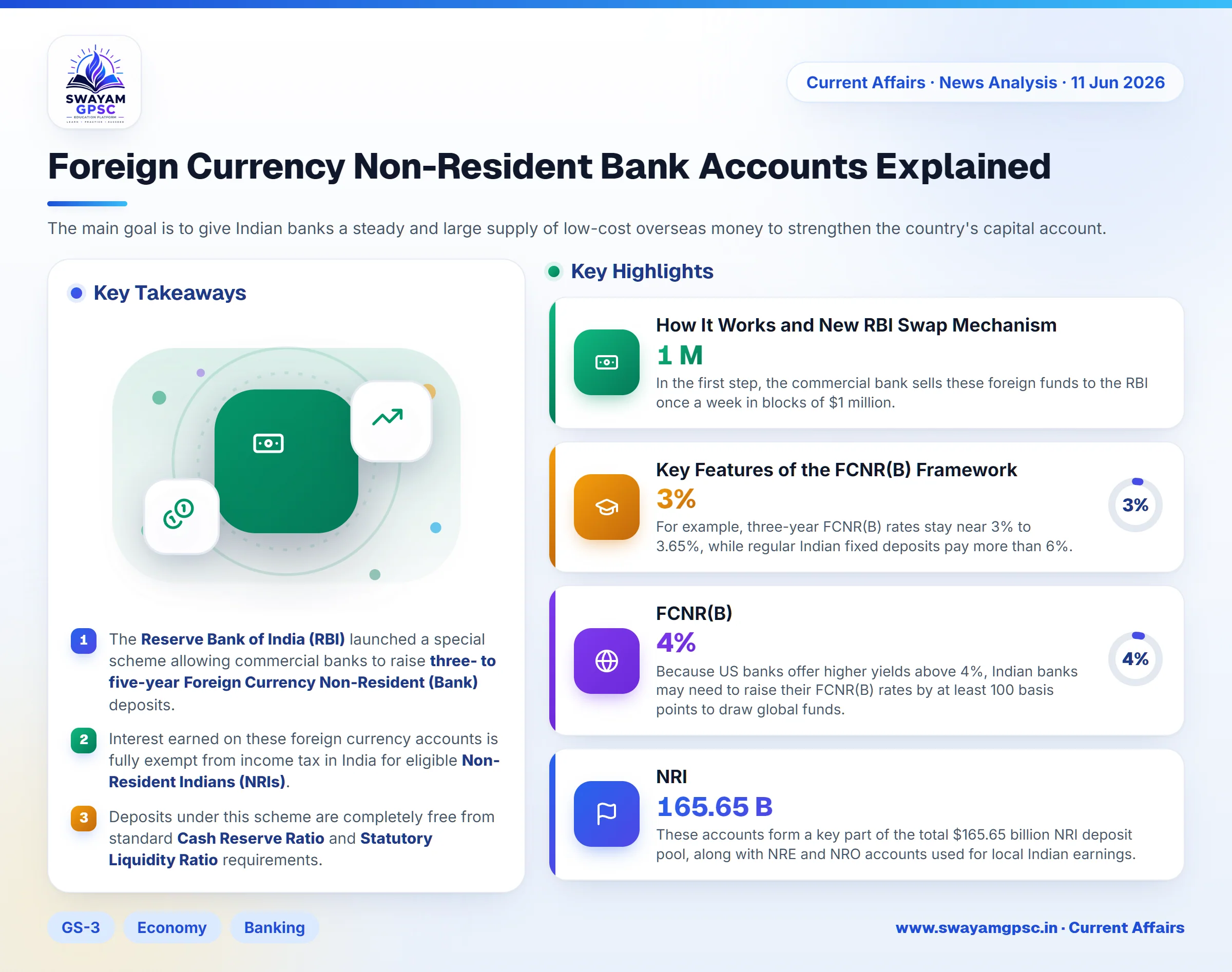
- The Reserve Bank of India (RBI) launched a special scheme allowing commercial banks to raise three- to five-year Foreign Currency Non-Resident (Bank) deposits.
- Interest earned on these foreign currency accounts is fully exempt from income tax in India for eligible Non-Resident Indians (NRIs).
- Deposits under this scheme are completely free from standard Cash Reserve Ratio and Statutory Liquidity Ratio requirements.
- These specialized accounts form a vital portion of the total $165.65 billion NRI deposit base in the country.
Why in News
- The Reserve Bank of India (RBI) recently introduced a special facility to help commercial banks collect fresh three- to five-year Foreign Currency Non-Resident (Bank) deposits.
About Foreign Currency Non-Resident Bank
- These deposits are special fixed-term foreign currency bank accounts in India for Non-Resident Indians (NRIs), Overseas Citizens of India (OCIs), and Persons of Indian Origin (PIOs).
- Normal NRI accounts convert foreign money into Indian Rupees automatically, but FCNR(B) deposits let overseas Indians keep their savings in global currencies.
Aim
- The main goal is to give Indian banks a steady and large supply of low-cost overseas money to strengthen the country's capital account.
- For account holders, it offers a safe way to earn tax-free profits in India without worrying about the local currency losing value.
How It Works and New RBI Swap Mechanism
- An NRI deposits money into an Indian bank in accepted foreign currencies like the US Dollar ($), Pound Sterling (£), Euro (€), Japanese Yen (¥), Australian Dollar (A), or Canadian Dollar (C).
- In the first step, the commercial bank sells these foreign funds to the RBI once a week in blocks of $1 million.
- This trade happens at the official daily FBIL Reference Rate issued by Financial Benchmarks India Private Limited.
- In the second step, the bank agrees to buy back the exact same foreign money from the RBI when the three- to five-year term ends.
- Because the buyback uses the exact same exchange rate, the RBI covers all future hedging costs and removes extra expenses for the bank.
Key Features of the FCNR(B) Framework
- All interest earned on these deposits is completely free from income tax in India as long as the person stays a non-resident under tax rules.
- To help banks make more profit, these new deposits do not have to maintain the Cash Reserve Ratio or the Statutory Liquidity Ratio.
- Interest rates follow global market standards, and they are usually 250 to 300 basis points lower than normal domestic Rupee fixed deposits.
- For example, three-year FCNR(B) rates stay near 3% to 3.65%, while regular Indian fixed deposits pay more than 6%.
- Because US banks offer higher yields above 4%, Indian banks may need to raise their FCNR(B) rates by at least 100 basis points to draw global funds.
- These accounts form a key part of the total $165.65 billion NRI deposit pool, along with NRE and NRO accounts used for local Indian earnings.