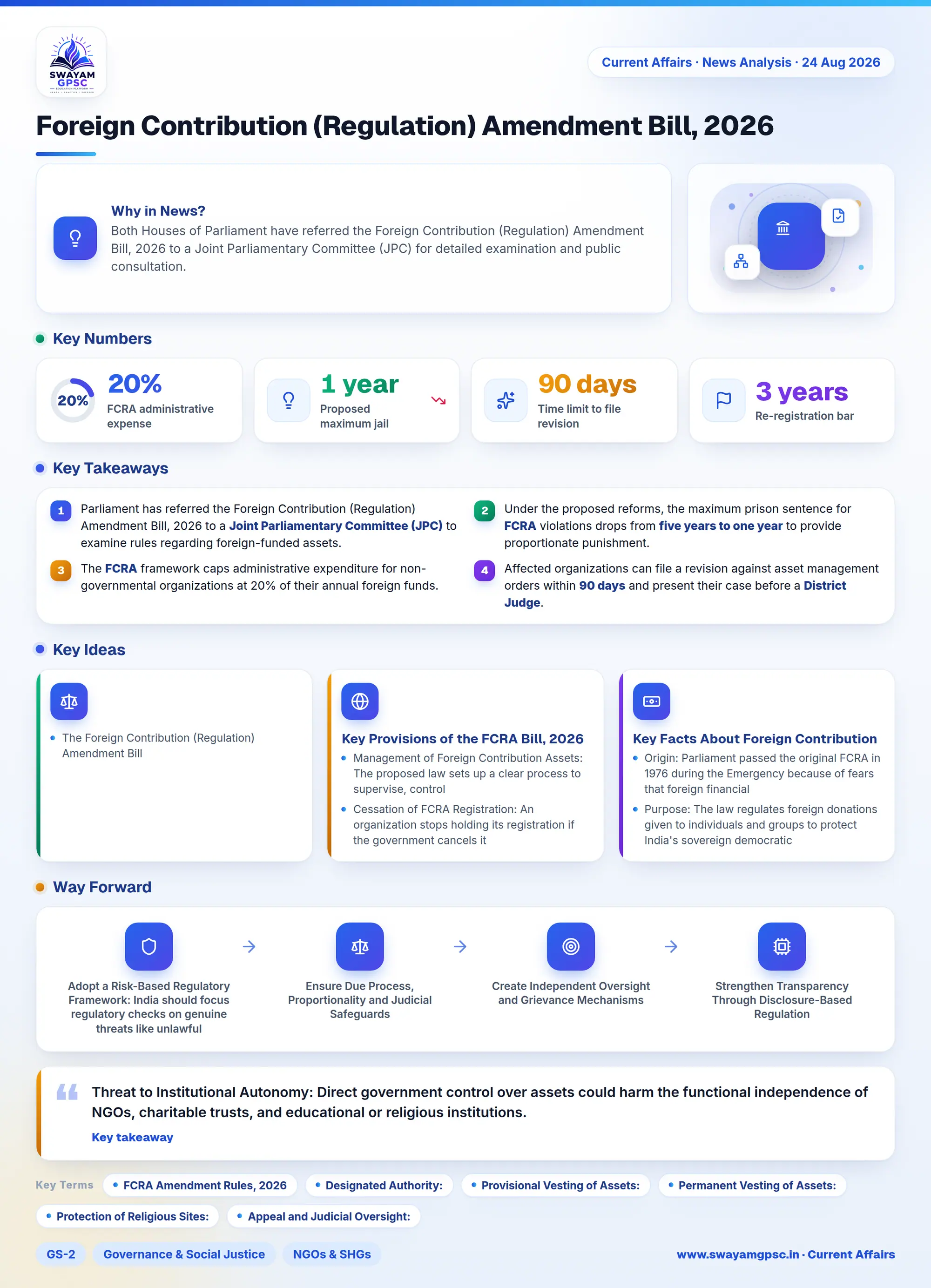
Foreign Contribution (Regulation) Amendment Bill, 2026
#GS-2 #Governance & Social Justice #NGOs & SHGs #Good Governance #Regulatory Bodies #Government Policies & Interventions #Transparency & Accountability
Key takeaways
- Parliament has referred the Foreign Contribution (Regulation) Amendment Bill, 2026 to a Joint Parliamentary Committee (JPC) to examine rules regarding foreign-funded assets.
- Under the proposed reforms, the maximum prison sentence for FCRA violations drops from five years to one year to provide proportionate punishment.
- The FCRA framework caps administrative expenditure for non-governmental organizations at 20% of their annual foreign funds.
- Affected organizations can file a revision against asset management orders within 90 days and present their case before a District Judge.
- Once the government cancels an NGO's registration, the organization faces a three-year waiting period before it can re-apply.
Why in News?
- Both Houses of Parliament have referred the Foreign Contribution (Regulation) Amendment Bill, 2026 to a Joint Parliamentary Committee (JPC) for detailed examination and public consultation.
- This decision follows the Ministry of Home Affairs notifying the FCRA Amendment Rules, 2026, which aim to boost transparency and accountability among NGOs and associations receiving foreign funds.
Summary
- The Foreign Contribution (Regulation) Amendment Bill, 2026 creates a legal framework to manage foreign assets after an organization loses its registration.
- It sets up a Designated Authority to oversee and sell foreign-funded assets, introduces activity-based registration, strengthens reporting norms, and reduces criminal penalties.
- However, civil society groups worry about executive overreach, fair legal procedure, NGO independence, and protecting legitimate social work.
Key Provisions of the FCRA Bill, 2026
- Management of Foreign Contribution Assets: The proposed law sets up a clear process to supervise, control, and sell assets bought with foreign funds when an NGO loses its FCRA status.
- Cessation of FCRA Registration: An organization stops holding its registration if the government cancels it, if the group surrenders it willingly, or if its renewal request is missed or rejected.
- Designated Authority: The Bill creates a Designated Authority to take custody of and manage foreign assets after cancellation, fixing a procedural gap in Section 15 of FCRA, 2010.
- Provisional Vesting of Assets: When an organization loses its registration, its foreign-funded assets go into temporary custody of the Designated Authority and are returned if registration is restored.
- Permanent Vesting of Assets: If registration is not restored within the set timeframe, the assets permanently belong to the Authority for public welfare, with sale proceeds going to the Consolidated Fund of India.
- Protection of Religious Sites: The Designated Authority must protect the religious character of places of worship and cannot alter or secularize these holy places.
- Appeal and Judicial Oversight: Affected organizations can ask for a review of the Authority's order within 90 days and can also file an appeal before a District Judge.
- Automatic Cessation of Registration: Under the proposed Section 14B, an FCRA registration ends automatically if the renewal process is not completed before the expiry date.
- Rationalised Punishment: The maximum jail term for FCRA violations will drop from five years to one year to ensure punishments fit the offense.
- Coordinated Investigations: State agencies must get Central Government approval before starting any FCRA investigation to prevent duplicate or conflicting inquiries.
Key Facts About Foreign Contribution (Regulation) Act, 2010
- Origin: Parliament passed the original FCRA in 1976 during the Emergency because of fears that foreign financial support could interfere in India's internal governance.
- Purpose: The law regulates foreign donations given to individuals and groups to protect India's sovereign democratic framework.
- FCRA Registration: Groups engaged in cultural, economic, educational, religious, or social activities must get an FCRA registration before receiving money from abroad.
- Legal Compliance: Registration ensures that NGOs handle foreign money transparently and follow all Indian laws strictly.
- Prohibited Activities: Applicants cannot represent fictitious entities or participate in religious conversion, communal disharmony, or sedition.
- Prohibited Categories: Candidates, journalists, media companies, judges, government servants, politicians, and political organisations cannot receive foreign donations under FCRA rules.
- Validity and Renewal: An FCRA registration remains valid for five years, and NGOs must apply for renewal within six months before it expires.
- Cancellation Rules: The government can cancel a registration for rule breaches or if an NGO shows no reasonable activity in its field for two consecutive years.
- Re-registration Bar: Once the government cancels an NGO's registration, that group cannot re-apply for three years.
- Designated FCRA Account: Every organization must receive foreign donations into a single specified account at the State Bank of India, New Delhi Main Branch.
- Utilisation and Expense Limits: NGOs must use foreign funds only for declared goals, administrative costs cannot exceed 20% of total annual foreign donations, and groups must submit annual returns in Form FC-4.
Key Concerns Regarding the FCRA Amendment Bill, 2026
- Threat to Institutional Autonomy: Direct government control over assets could harm the functional independence of NGOs, charitable trusts, and educational or religious institutions.
- Natural Justice Concerns: Taking over assets without giving organizations a fair hearing violates principles of procedural fairness and legal due process.
- Property Rights and Proportionality Issues: Seizing assets permanently damages legal property rights, raising doubts about whether penalties match minor procedural faults.
- Minority Institution Concerns: Minority-run educational, healthcare, and social institutions relying on foreign support worry about harsh effects on their community work.
- Lack of Judicial Oversight: Giving broad asset management power to an administrative body without early judicial review limits independent oversight.
- Federalism Concerns: State governments feel that major changes to social and charitable institutions require broader consultation between the Centre and states.
- Chilling Effect on Civil Society: Fear of sudden asset loss and regulatory uncertainty might stop honest NGOs from carrying out community welfare projects.
- Risk of Excessive Executive Discretion: Granting unguided administrative power over asset transfers increases the risk of arbitrary or unfair enforcement.
Way Forward
- Adopt a Risk-Based Regulatory Framework: India should focus regulatory checks on genuine threats like unlawful activities, political interference, and national security, while protecting honest non-profit groups.
- Ensure Due Process, Proportionality and Judicial Safeguards: Regulatory actions must respect natural justice through advance notice, formal hearings, reasoned orders, and access to judicial review.
- Create Independent Oversight and Grievance Mechanisms: Setting up an independent tribunal would resolve dispute delays, lower administrative bias, and build trust between NGOs and regulators.
- Strengthen Transparency Through Disclosure-Based Regulation: India can create a public digital registry for foreign funding inspired by global systems like the US FARA, Australia's Foreign Influence Transparency Scheme, and Canada's foreign influence framework.
- Apply Targeted Scrutiny Instead of Blanket Restrictions: Authorities should monitor high-risk entities closely instead of placing heavy compliance loads on all charitable organizations.
- Promote Cooperative Federalism and Protect Social Welfare Activities: The Union Government should consult states and civil society leaders so essential health, education, and relief work runs smoothly.
- Improve Compliance Support and Regulatory Efficiency: Regulators should offer clear guidelines, time-bound approvals, and training programs to help non-profits satisfy rules easily.
Frequently Asked Questions (FAQs)
- What is FCRA?: The Foreign Contribution (Regulation) Act regulates how Indian citizens, NGOs, trusts, and firms receive and spend foreign money.
- Which ministry administers FCRA?: The Ministry of Home Affairs administers and enforces all FCRA laws and regulations.
- Does FCRA ban foreign donations?: No, it permits foreign donations as long as entities register, disclose funding sources, use designated bank accounts, and submit audited annual reports.
- What is the designated FCRA account?: All foreign contributions must enter India through a dedicated account at the State Bank of India, New Delhi Main Branch.
- What is the administrative expense limit under FCRA?: Non-profit organizations cannot spend more than 20% of their annual foreign contributions on administrative costs.