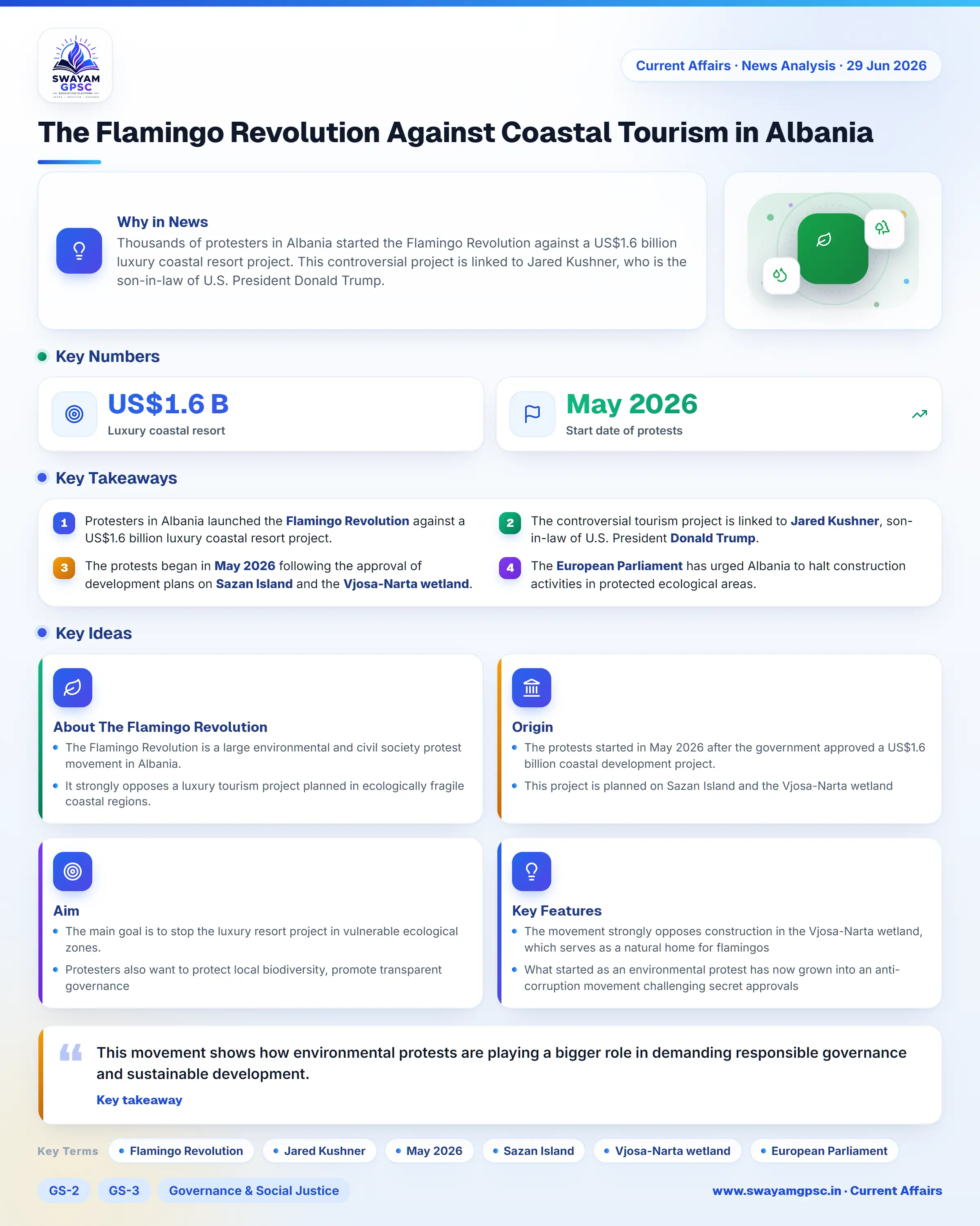
The Flamingo Revolution Against Coastal Tourism in Albania
#GS-2 #GS-3 #Governance & Social Justice #Environment #Current Events #International Relations #Sustainable Development #Biodiversity #Good Governance
Key takeaways
- Protesters in Albania launched the Flamingo Revolution against a US$1.6 billion luxury coastal resort project.
- The controversial tourism project is linked to Jared Kushner, son-in-law of U.S. President Donald Trump.
- The protests began in May 2026 following the approval of development plans on Sazan Island and the Vjosa-Narta wetland.
- The European Parliament has urged Albania to halt construction activities in protected ecological areas.
Why in News
- Thousands of protesters in Albania started the Flamingo Revolution against a US$1.6 billion luxury coastal resort project.
- This controversial project is linked to Jared Kushner, who is the son-in-law of U.S. President Donald Trump.
About The Flamingo Revolution
- The Flamingo Revolution is a large environmental and civil society protest movement in Albania.
- It strongly opposes a luxury tourism project planned in ecologically fragile coastal regions.
Origin
- The protests started in May 2026 after the government approved a US$1.6 billion coastal development project.
- This project is planned on Sazan Island and the Vjosa-Narta wetland, and it is connected to Jared Kushner's investment group.
- Public anger grew because the government did not consult citizens properly, risked severe environmental damage, and changed protected-area laws to allow construction.
Aim
- The main goal is to stop the luxury resort project in vulnerable ecological zones.
- Protesters also want to protect local biodiversity, promote transparent governance, and fight corruption in public decisions.
Key Features
- The movement strongly opposes construction in the Vjosa-Narta wetland, which serves as a natural home for flamingos, sea turtles, and Mediterranean monk seals.
- What started as an environmental protest has now grown into an anti-corruption movement challenging secret approvals and the misuse of public resources.
- Protesters use flamingo cut-outs as a powerful symbol for protecting nature and resisting harmful development.
- The movement has gained international support from environmental groups, and the European Parliament has asked Albania to stop construction in protected areas.
Significance
- This movement shows how environmental protests are playing a bigger role in demanding responsible governance and sustainable development.
- It highlights the growing global clash between massive infrastructure investments and the protection of fragile ecosystems.