FCRA Bill: Expanding State Control Over Civil Society
#GS-2 #Governance & Social Justice #Good Governance #Economy #Civil Services #Constitution
Key takeaways
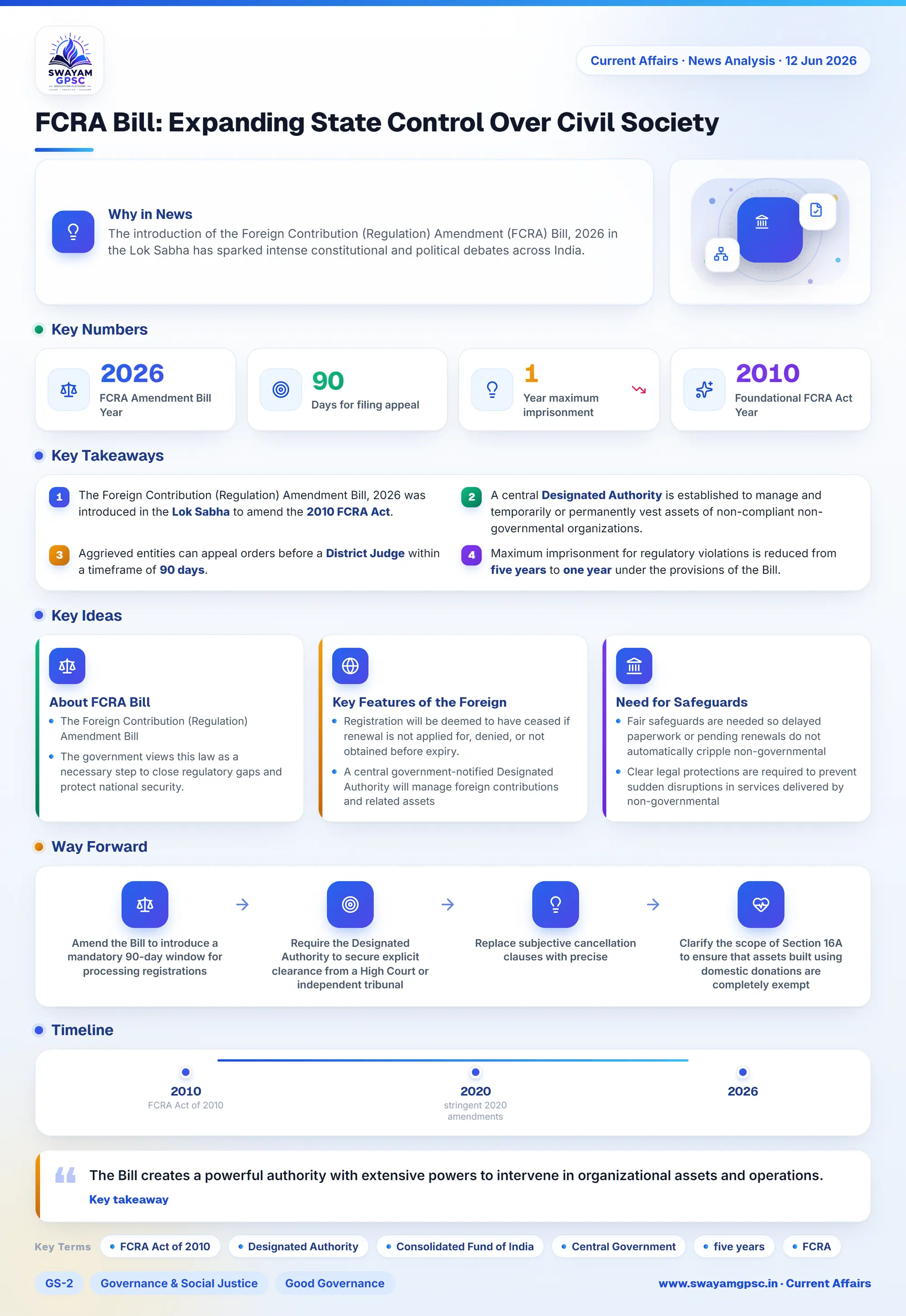
- The Foreign Contribution (Regulation) Amendment Bill, 2026 was introduced in the Lok Sabha to amend the 2010 FCRA Act.
- A central Designated Authority is established to manage and temporarily or permanently vest assets of non-compliant non-governmental organizations.
- Aggrieved entities can appeal orders before a District Judge within a timeframe of 90 days.
- Maximum imprisonment for regulatory violations is reduced from five years to one year under the provisions of the Bill.
Why in News
- The introduction of the Foreign Contribution (Regulation) Amendment (FCRA) Bill, 2026 in the Lok Sabha has sparked intense constitutional and political debates across India.
About FCRA Bill
- The Foreign Contribution (Regulation) Amendment Bill, 2026 amends the foundational FCRA Act of 2010 to manage foreign funds.
- The government views this law as a necessary step to close regulatory gaps and protect national security.
- Civil society groups view the legislation as a structural mechanism that expands executive power significantly.
Key Features of the Foreign Contribution (Regulation) Amendment Bill, 2026
- Registration will be deemed to have ceased if renewal is not applied for, denied, or not obtained before expiry.
- A central government-notified Designated Authority will manage foreign contributions and related assets after cancellation, surrender, or cessation of registration.
- Foreign contributions and assets created wholly or partly from foreign funds will temporarily vest in the Designated Authority for supervision and maintenance.
- Unutilized foreign contributions and assets may be returned if registration is renewed, restored, or a fresh registration is granted.
- Assets and foreign contributions may permanently vest in the Designated Authority if registration is not restored within the prescribed period or the entity becomes defunct.
- Permanently vested assets may be transferred to government bodies or disposed of, with proceeds credited to the Consolidated Fund of India.
- Organizations and key functionaries must provide access to records, preserve assets, and operate under the supervision of the Designated Authority.
- Aggrieved persons may appeal against orders of the Designated Authority before a District Judge within 90 days.
- The Central Government may exempt certain persons or entities from vesting provisions in the public interest.
- The ban on accepting foreign contributions is extended to any person engaged in news production, publication, or broadcasting of current affairs.
- Maximum imprisonment for violations is reduced from five years to one year, while retaining provisions for fines.
- Any investigation into offences under the Act will require prior approval from the Central Government.
- The vesting provisions now explicitly include assets created partly through foreign contributions.
- The Bill centralizes management, monitoring, investigation, and disposal powers relating to foreign-funded entities and their assets.
Need for Safeguards
- Fair safeguards are needed so delayed paperwork or pending renewals do not automatically cripple non-governmental organizations without proven wrongdoing.
- Clear legal protections are required to prevent sudden disruptions in services delivered by non-governmental organizations to vulnerable communities.
- Stable regulatory timelines help non-governmental organizations plan and execute multi-year development projects with confidence.
- Objective standards are essential to prevent selective scrutiny of minority-run educational and charitable institutions.
- Asset seizure should occur only after independent judicial scrutiny to safeguard constitutional protections.
Key Initiatives and Pre-Existing Frameworks
- The original FCRA was enacted in 1976 during the Emergency to regulate foreign funding and protect national sovereignty.
- The consolidated 2010 Act strengthened oversight of foreign contributions received by social, educational, and cultural organizations.
- The stringent 2020 amendments reduced administrative expenditure limits and imposed stricter controls on fund utilization.
- The MHA Digital Dashboard serves as a centralized portal that tracks registrations, annual filings, compliance records, and cancellation updates of non-governmental organizations.
Challenges
- The Bill creates a powerful authority with extensive powers to intervene in organizational assets and operations.
- Failure to regain registration may result in permanent transfer of organizational assets to the government.
- Broad and undefined public-interest clauses may permit arbitrary cancellation of registrations.
- Expanded compliance responsibilities expose trustees and board members to greater legal risks.
- Investigative authority is concentrated with the Union Government, reducing state-level autonomy.
Way Forward
- Amend the Bill to introduce a mandatory 90-day window for processing registrations, ensuring pending status does not result in automatic cessation.
- Require the Designated Authority to secure explicit clearance from a High Court or independent tribunal before taking physical control of an organization's assets.
- Replace subjective cancellation clauses with precise, legally defined categories to prevent the law from being used to suppress legitimate public advocacy or human rights work.
- Clarify the scope of Section 16A to ensure that assets built using domestic donations are completely exempt from provisional vesting, protecting schools, hospitals, and places of worship.
- Refer the 2026 Bill to a Joint Parliamentary Committee to gather feedback from civil society stakeholders, non-profits, and minority institutions before enactment.
Conclusion
- The Foreign Contribution (Regulation) Amendment Bill, 2026 marks a major shift from regulating foreign cash flows to introducing sweeping state control over civil society assets.
- By granting a centralized Designated Authority the power to seize properties without prior judicial review, the Bill risks creating a chilling effect that could disrupt essential healthcare and educational networks.