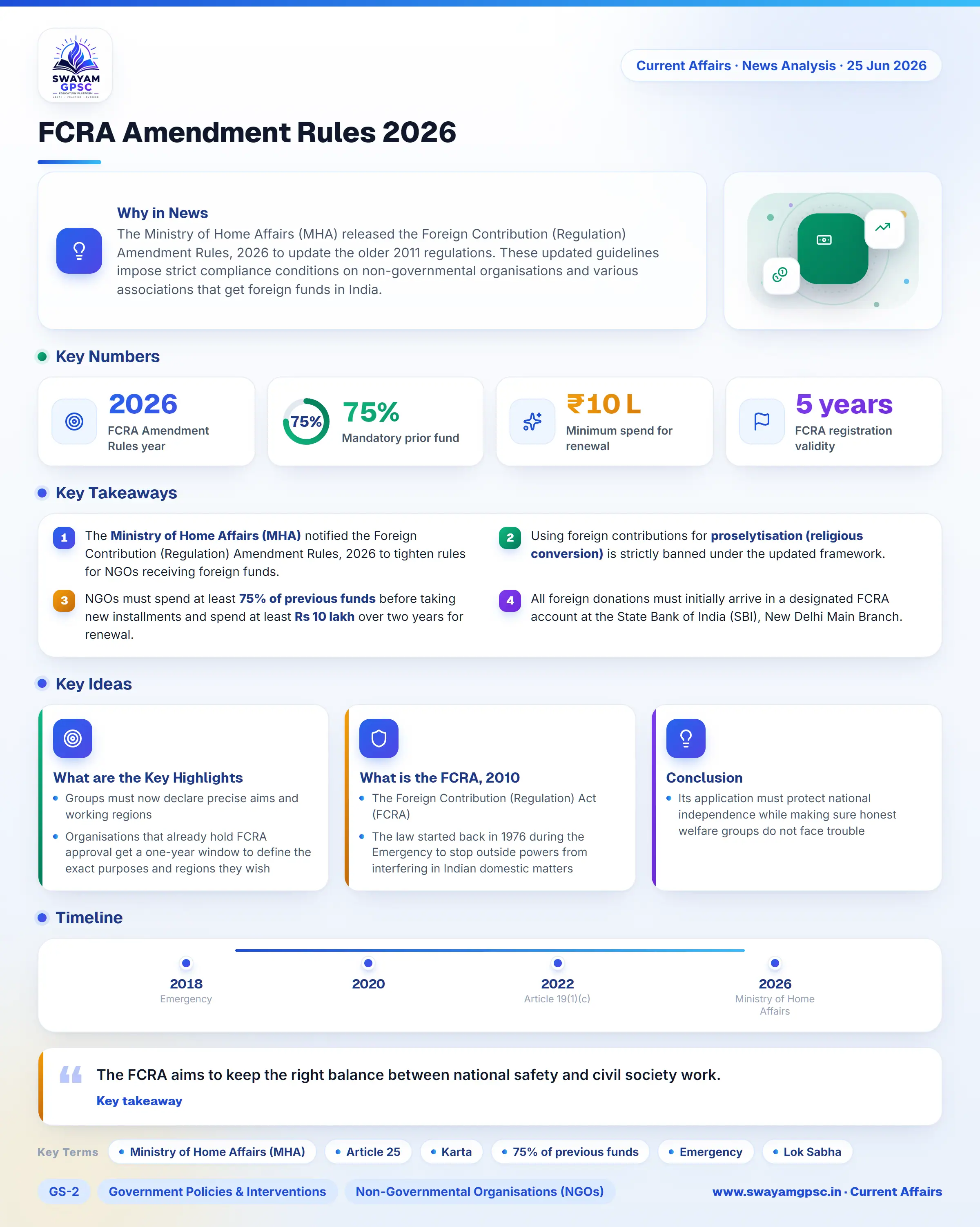
FCRA Amendment Rules 2026
#GS-2 #Government Policies & Interventions #Non-Governmental Organisations (NGOs) #Internal Security #Polity #Governance & Social Justice #Economy
Key takeaways
- The Ministry of Home Affairs (MHA) notified the Foreign Contribution (Regulation) Amendment Rules, 2026 to tighten rules for NGOs receiving foreign funds.
- Using foreign contributions for proselytisation (religious conversion) is strictly banned under the updated framework.
- NGOs must spend at least 75% of previous funds before taking new installments and spend at least Rs 10 lakh over two years for renewal.
- All foreign donations must initially arrive in a designated FCRA account at the State Bank of India (SBI), New Delhi Main Branch.
Why in News
- The Ministry of Home Affairs (MHA) released the Foreign Contribution (Regulation) Amendment Rules, 2026 to update the older 2011 regulations.
- These updated guidelines impose strict compliance conditions on non-governmental organisations and various associations that get foreign funds in India.
- The main goals are to increase openness, organize allowed activities properly, and stop any misuse of money coming from abroad.
What are the Key Highlights of the FCRA Amendment Rules 2026
- Groups must now declare precise aims and working regions, and they need to pay separate fees for every single activity type and state or union territory.
- Organisations that already hold FCRA approval get a one-year window to define the exact purposes and regions they wish to keep.
- Foreign money can fund worship, religious teaching, heritage protection, and community kitchens, but spending it on religious conversion is totally barred.
- The new rules repeatedly state that conversion work is excluded, while permitting theological study and the safety of traditional religious practices.
- Article 25 of our Constitution gives everyone freedom to follow and share their religion, but the Supreme Court ruled in the *Rev Stainislaus vs State of Madhya Pradesh (1977)* case that this freedom does not include a basic right to convert someone else.
- Associations with foreign citizens other than Persons of Indian Origin (PIOs) in top roles will usually not be approved for registration or prior permission.
- The meaning of a key official now covers directors, partners, trustees, and even the Karta of a Hindu Undivided Family.
- Organisations must spend at least 75% of previous funds before taking new money and must spend at least Rs 10 lakh on approved work over two years to qualify for renewal.
- Groups must share details about their final donors, official websites, social media pages, and publications to build better trust.
What is the FCRA, 2010
- The Foreign Contribution (Regulation) Act (FCRA), 2010 serves as an internal security law to control foreign donations given to people, groups, or companies in India.
- The law started back in 1976 during the Emergency to stop outside powers from interfering in Indian domestic matters before being replaced by the FCRA 2010 and changed further in 2016, 2018, and 2020.
- The Foreign Contribution (Regulation) Amendment Bill, 2026 presented in the Lok Sabha changes how foreign funds are handled when NGO licenses expire, get cancelled, or are given up.
- The Ministry of Home Affairs (MHA) handles and watches over this law as a national security tool rather than a simple money rule.
- The law ensures that foreign money does not harm Indian independence, internal safety, public good, or democratic systems.
- While Article 19(1)(c) lets citizens form groups, the Supreme Court stated in *Noel Harper v. Union of India (2022)* that the FCRA, 2010 is a fair limit under Article 19(4) to protect Indian safety and order.
- No group or person can take foreign donations without permanent FCRA registration or a prior permission letter for a specific grant from the central government.
- Eligible groups must be registered under the Societies Registration Act (1860), the Indian Trusts Act (1882), or the Companies Act, 2013.
- Groups working in cultural, economic, educational, religious, or social fields can take foreign funds after getting an FCRA registration valid for 5 years or special prior permission.
- Election candidates, lawmakers, political parties, judges, government staff, public sector workers, and media publishers or editors cannot take foreign money.
- In *Indian Social Action Forum (INSAF) v. Union of India (2020)*, the Supreme Court noted that only groups tied to active politics can be kept away from foreign donations.
- All foreign funds must land first in one designated FCRA account at the State Bank of India (SBI), New Delhi Main Branch.
- The Foreign Contribution (Regulation) Amendment Act, 2020 completely banned passing foreign money to any other person or group.
- FCRA registration lasts for 5 years, and renewal papers must go online at least 6 months before the expiry date.
Conclusion
- The FCRA aims to keep the right balance between national safety and civil society work.
- Its application must protect national independence while making sure honest welfare groups do not face trouble from heavy rules.