FATF Warns Against the Rise of Digital Hawala Networks
#GS-3 #Economy #Banking #Science & Technology #ICT #Artificial Intelligence #Cyber Security #GS-2 #Current Events #International #Digital Hawala #Money Laundering
Key takeaways
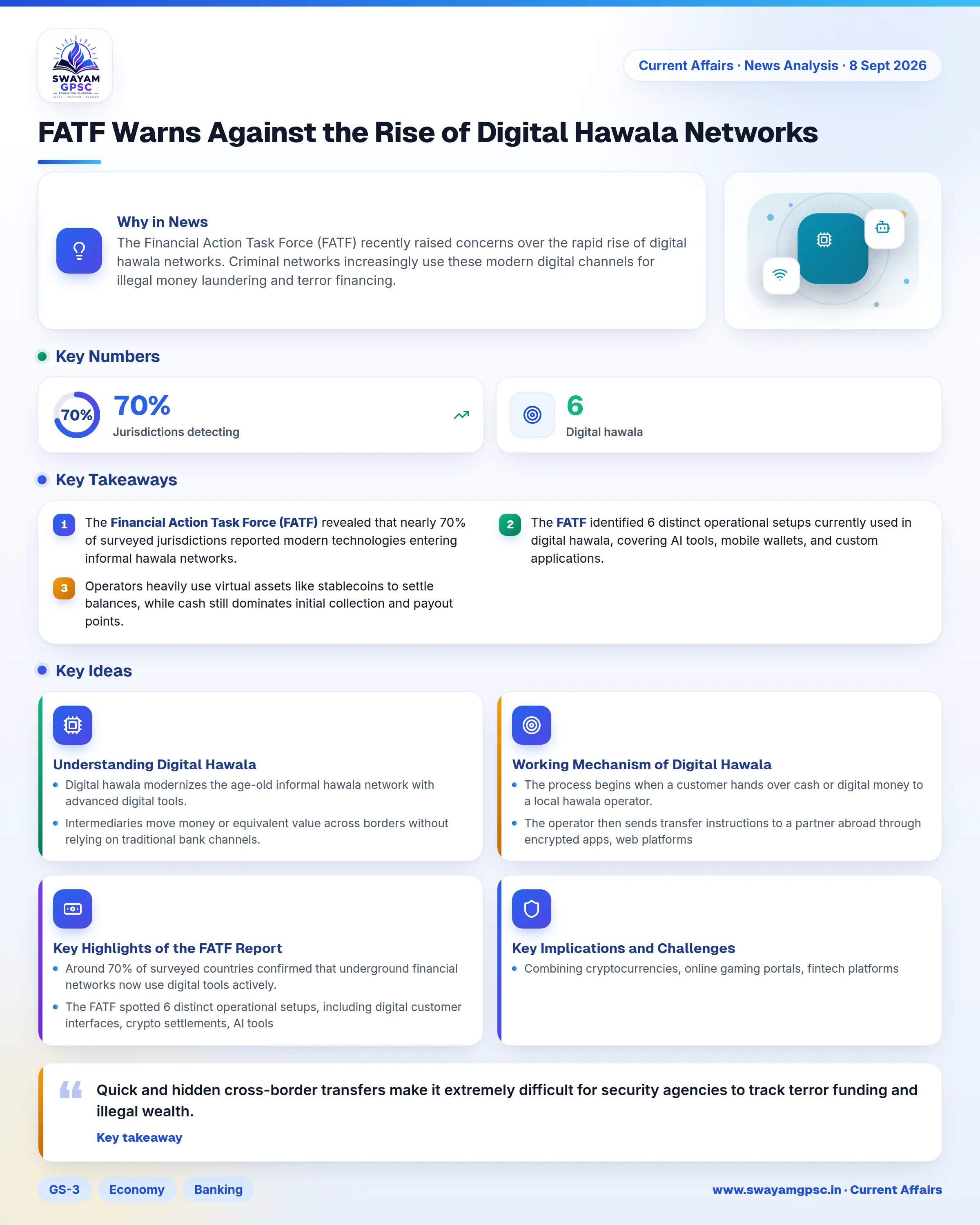
- The Financial Action Task Force (FATF) revealed that nearly 70% of surveyed jurisdictions reported modern technologies entering informal hawala networks.
- The FATF identified 6 distinct operational setups currently used in digital hawala, covering AI tools, mobile wallets, and custom applications.
- Operators heavily use virtual assets like stablecoins to settle balances, while cash still dominates initial collection and payout points.
Why in News
- The Financial Action Task Force (FATF) recently raised concerns over the rapid rise of digital hawala networks.
- Criminal networks increasingly use these modern digital channels for illegal money laundering and terror financing.
- According to the latest FATF report, nearly 70% of surveyed jurisdictions observed new technologies entering underground banking systems.
Understanding Digital Hawala
- Digital hawala modernizes the age-old informal hawala network with advanced digital tools.
- Intermediaries move money or equivalent value across borders without relying on traditional bank channels.
- This modern setup mixes old trust-based settlements with encrypted messaging, mobile wallets, fintech tools, AI programs, and virtual assets.
Working Mechanism of Digital Hawala
- The process begins when a customer hands over cash or digital money to a local hawala operator.
- The operator then sends transfer instructions to a partner abroad through encrypted apps, web platforms, or shared digital ledgers.
- The recipient receives the funds through cash, mobile wallets, fintech apps, or cryptocurrencies.
- Operators settle their accounts later through cash, trade invoices, standard banking channels, or stablecoins.
- To avoid detection, operators hide these money trails behind fake businesses, mule accounts, charities, and multiple digital transfers.
Key Highlights of the FATF Report
- Around 70% of surveyed countries confirmed that underground financial networks now use digital tools actively.
- The FATF spotted 6 distinct operational setups, including digital customer interfaces, crypto settlements, AI tools, and specialized hawala apps.
- Hawala brokers increasingly prefer stablecoins and digital tokens to clear their mutual account balances.
- Criminals now deploy Artificial Intelligence tools to automate transactions, route money through mule accounts, and quickly convert fiat money into crypto.
- Digital tools have enhanced traditional hawala rather than replaced it, so physical cash still dominates the initial collection and final payout points.
Key Implications and Challenges
- Quick and hidden cross-border transfers make it extremely difficult for security agencies to track terror funding and illegal wealth.
- Combining cryptocurrencies, online gaming portals, fintech platforms, and private chats makes anti-money laundering enforcement much harder and demands global cooperation.