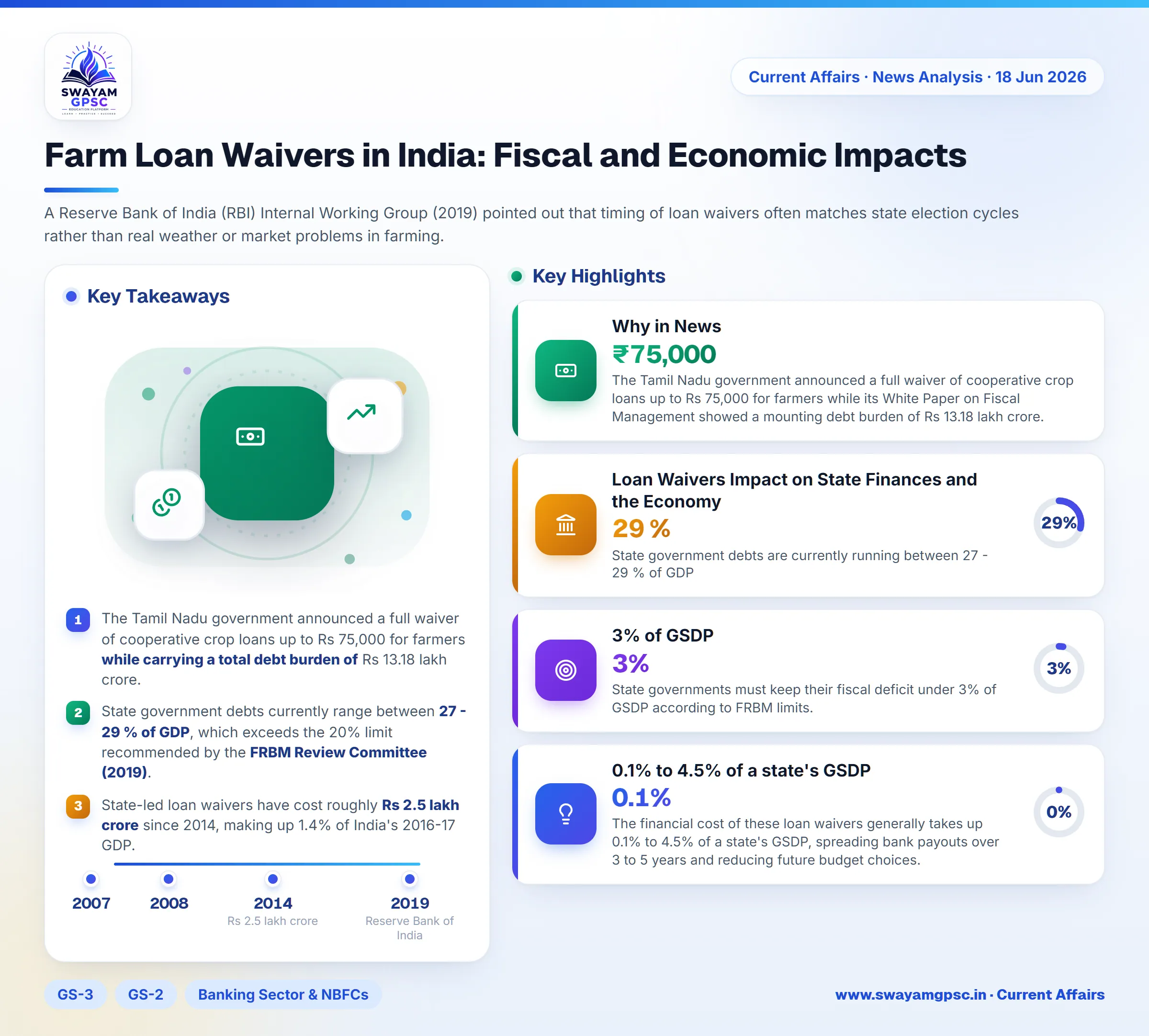
Farm Loan Waivers in India: Fiscal and Economic Impacts
#GS-3 #GS-2 #Banking Sector & NBFCs #Issues Relating to Development #Government Policies & Interventions #Economy #Agriculture #Infrastructure
Key takeaways
- The Tamil Nadu government announced a full waiver of cooperative crop loans up to Rs 75,000 for farmers while carrying a total debt burden of Rs 13.18 lakh crore.
- State government debts currently range between 27 - 29 % of GDP, which exceeds the 20% limit recommended by the FRBM Review Committee (2019).
- State-led loan waivers have cost roughly Rs 2.5 lakh crore since 2014, making up 1.4% of India's 2016-17 GDP.
- Direct income support programs like PM-KISAN, KALIA, and Rythu Bandhu offer a safer alternative to loan waivers by protecting rural credit health.
Why in News
- The Tamil Nadu government announced a full waiver of cooperative crop loans up to Rs 75,000 for farmers while its White Paper on Fiscal Management showed a mounting debt burden of Rs 13.18 lakh crore.
- This announcement restarts the discussion on balancing welfare-driven interventions such as farm loan waivers and the need for long-term fiscal discipline.
What are the Concerns Regarding Farm Loan Waivers in India
- A Reserve Bank of India (RBI) Internal Working Group (2019) pointed out that timing of loan waivers often matches state election cycles rather than real weather or market problems in farming.
- Loan waivers only help farmers who can borrow money from official banks and formal financial institutions.
- Vulnerable people like tenant farmers, landless laborers, and sharecroppers borrow money from local lenders who charge very high interest rates, and these groups receive no help from loan waivers.
- Regular loan waivers destroy the credit culture because honest farmers who pay their loans back feel cheated while people who refuse to pay get rewarded.
- This creates a bad habit where farmers stop paying their loans on purpose because they expect the government to cancel loans later.
Loan Waivers Impact on State Finances and the Economy
- State government debts are currently running between 27 - 29 % of GDP, which is much higher than the 20% limit suggested by the Fiscal Responsibility and Budget Management (FRBM) Review Committee (2019).
- State governments must keep their fiscal deficit under 3% of GSDP according to FRBM limits.
- When states spend money suddenly on loan waivers, they cut down spending on building long-term assets.
- Waiver programs usually cause a nearly 1/3rd cut in capital expenditure, which stops the farming sector from getting new irrigation systems, better village roads, and cold storage facilities.
- Paying for loan waivers pushes state budgets into revenue deficits because borrowing money for daily expenses traps states in heavy debt.
- The financial cost of these loan waivers generally takes up 0.1% to 4.5% of a state's GSDP, spreading bank payouts over 3 to 5 years and reducing future budget choices.
- To hide high debt, states borrow money outside normal budgets using Special Purpose Vehicles (SPVs) so they do not break official borrowing rules.
- Loan waivers encourage people to stop paying loans on time, which makes banks weaker and causes a sharp rise in agricultural NPAs in states that offer loan cancellations.
What are the Alternatives to Farm Loan Waivers
- Schemes like PM-KISAN (Pradhan Mantri Kisan Samman Nidhi), Odisha's KALIA, and Telangana's Rythu Bandhu offer direct cash to all farmers, including tenant farmers, without damaging the banking system.
- Expanding low-interest loans through the Kisan Credit Card helps farmers avoid borrowing from expensive local lenders.
- Improving the e-NAM (National Agriculture Market) platform, buying crops on time at Minimum Support Prices (MSP), and supporting Farmer Producer Organizations (FPOs) helps farmers earn better incomes.
- Expanding the Pradhan Mantri Fasal Bima Yojana (PMFBY) protects farmers from weather risks and crop failures before they fall into heavy debt.
- Moving money away from loan waivers into micro-irrigation (Per Drop More Crop), warehouses, and food processing will permanently improve farming productivity.
Farm Loan Waivers in India Overview
- Farm Loan Waivers are government programs where the state takes over agricultural loan debts and pays banks back on behalf of farmers.
- Governments use them as emergency relief when weather disasters, crop failures, or sudden price drops hurt farming communities.
- The Agriculture and Rural Debt Relief Scheme (ARDRS), 1990, offered relief up to Rs 10,000 per farmer with a total cost of around Rs 10,000 crore.
- The Agricultural Debt Waiver and Debt Relief Scheme (ADWDRS), 2008, was a massive pre-election relief package costing Rs 52,500 crore that focused on small and marginal farmers owning up to 5 acres.
- Over the last ten years, state governments have taken complete control of giving out loan waivers.
- States providing these waivers include Andhra Pradesh, Telangana, Uttar Pradesh, Maharashtra, Karnataka, Punjab, Madhya Pradesh, Chhattisgarh, Jharkhand, and Tamil Nadu.
- Since 2014, these state programs have cost a total of roughly Rs 2.5 lakh crore, which equaled 1.4% of India's GDP in 2016-17.
- The RBI Internal Working Group (IWG) to Review Agricultural Credit (2019) suggested switching to direct cash support, building better rural infrastructure, and using the e-NAM portal for fair prices.
- The Expert Group on Agricultural Indebtedness (2007) suggested giving formal loans to vulnerable farmers through Joint Liability Groups (JLGs).
Conclusion
- Farm loan waivers give quick financial relief, but they do not solve the deep economic problems facing Indian farming.
- To help farmers succeed over the long term, the government must stop using debt forgiveness for political gain and instead invest money in building permanent agricultural assets.