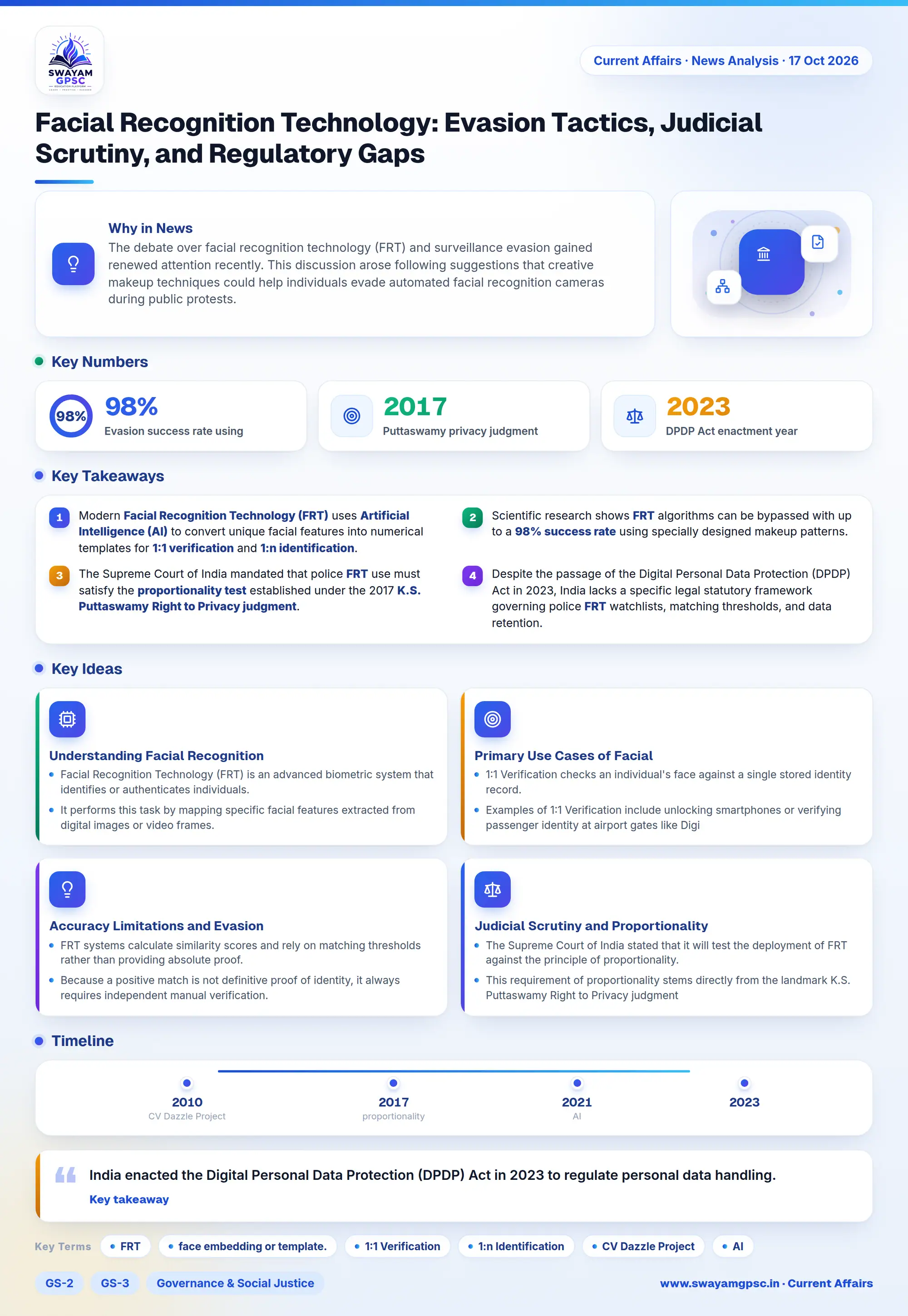
Facial Recognition Technology: Evasion Tactics, Judicial Scrutiny, and Regulatory Gaps
#GS-2 #GS-3 #Governance & Social Justice #IT & Computers #Artificial Intelligence #Good Governance #Transparency & Accountability #Rapid Fire CA #Quick Facts For Prelims
Key takeaways
- Modern Facial Recognition Technology (FRT) uses Artificial Intelligence (AI) to convert unique facial features into numerical templates for 1:1 verification and 1:n identification.
- Scientific research shows FRT algorithms can be bypassed with up to a 98% success rate using specially designed makeup patterns.
- The Supreme Court of India mandated that police FRT use must satisfy the proportionality test established under the 2017 *K.S. Puttaswamy* Right to Privacy judgment.
- Despite the passage of the Digital Personal Data Protection (DPDP) Act in 2023, India lacks a specific legal statutory framework governing police FRT watchlists, matching thresholds, and data retention.
- Inaccurate FRT algorithms pose risks of false positive matches and biased arrests, potentially infringing on citizens' fundamental rights under Article 19.
Why in News
- The debate over facial recognition technology (FRT) and surveillance evasion gained renewed attention recently.
- This discussion arose following suggestions that creative makeup techniques could help individuals evade automated facial recognition cameras during public protests.
Understanding Facial Recognition Technology
- Facial Recognition Technology (FRT) is an advanced biometric system that identifies or authenticates individuals.
- It performs this task by mapping specific facial features extracted from digital images or video frames.
- Modern FRT uses Artificial Intelligence (AI) instead of comparing images pixel by pixel.
- The system extracts unique visual patterns and converts them into a numerical representation called a face embedding or template.
Primary Use Cases of Facial Recognition
- 1:1 Verification checks an individual's face against a single stored identity record.
- Examples of 1:1 Verification include unlocking smartphones or verifying passenger identity at airport gates like Digi Yatra.
- 1:n Identification scans an individual's face against a whole database containing many facial records.
- Law enforcement agencies use 1:n Identification to scan crowds using CCTV cameras to find matches in criminal databases.
Accuracy Limitations and Evasion Tactics
- FRT systems calculate similarity scores and rely on matching thresholds rather than providing absolute proof.
- Because a positive match is not definitive proof of identity, it always requires independent manual verification.
- The CV Dazzle Project in 2010 showed how high-contrast makeup and asymmetrical hairstyles could disrupt automated pattern recognition.
- This concept took inspiration from World War I naval Dazzle camouflage, which used geometric patterns to confuse enemy targeting.
- A 2021 study by Ben-Gurion University proved that AI generated makeup patterns targeting key facial regions could fool FRT software with a 98% success rate.
Judicial Scrutiny and Proportionality
- The Supreme Court of India stated that it will test the deployment of FRT against the principle of proportionality.
- This requirement of proportionality stems directly from the landmark *K.S. Puttaswamy* Right to Privacy judgment in 2017.
- The court directed law enforcement agencies to limit real-time FRT deployment strictly to existing criminal databases.
- This directive aims to prevent indiscriminate and widespread public crowd monitoring by state agencies.
Key Challenges and Concerns in India
- India enacted the Digital Personal Data Protection (DPDP) Act in 2023 to regulate personal data handling.
- However, India still lacks a dedicated law governing how police forces deploy FRT systems.
- There are no explicit legal frameworks covering facial watchlists, matching thresholds, data retention periods, or independent audits.
- Algorithms frequently generate false positives, especially regarding gender and race, which can lead to wrongful arrests and bias against marginalized groups.
- Mass surveillance fears and potential state profiling can discourage citizens from exercising their fundamental right to peaceful assembly under Article 19 of the Constitution.