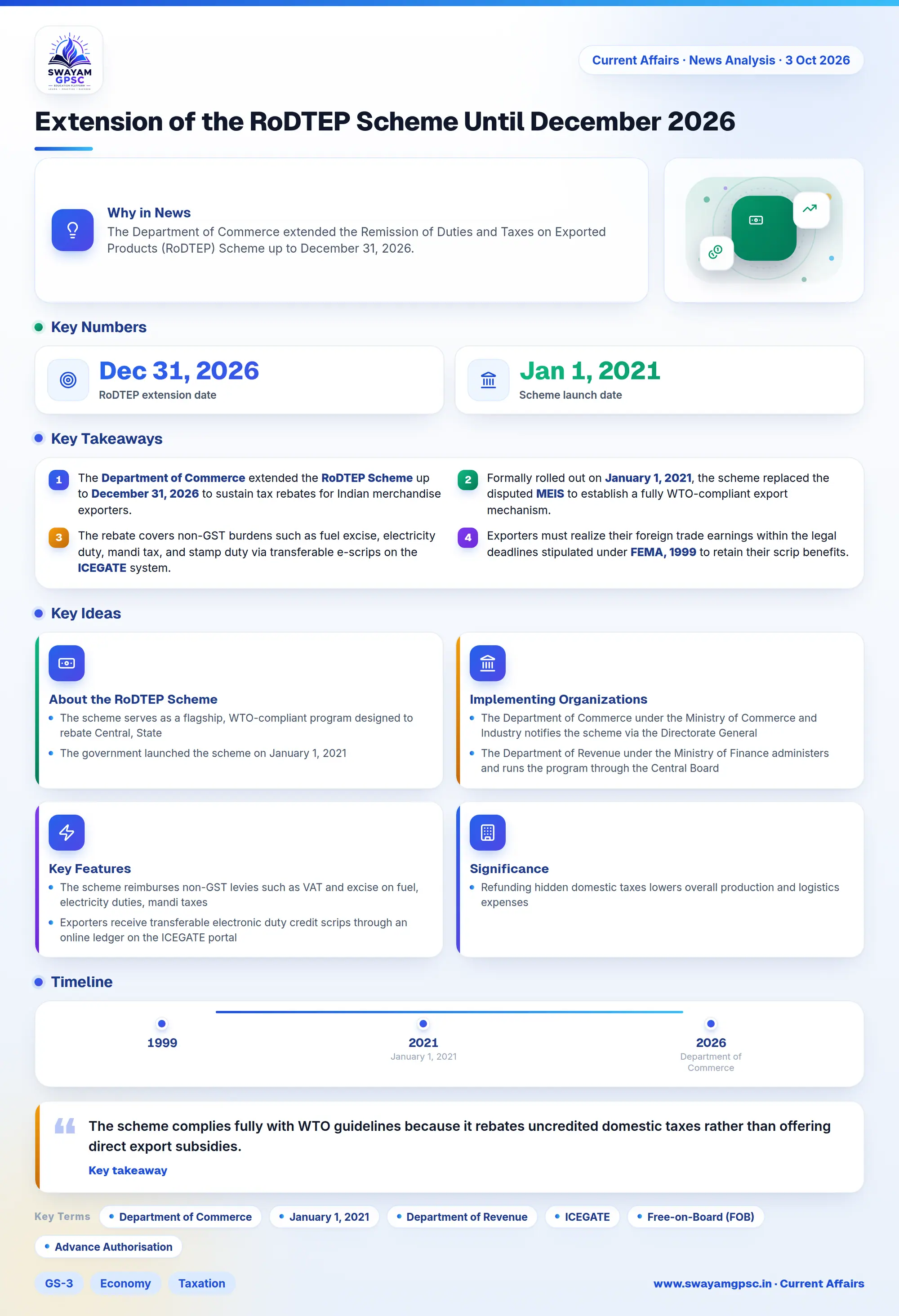
Extension of the RoDTEP Scheme Until December 2026
#GS-3 #Economy #Taxation #Growth #Current Events #National #Exports #Foreign Trade Policy
Key takeaways
- The Department of Commerce extended the RoDTEP Scheme up to December 31, 2026 to sustain tax rebates for Indian merchandise exporters.
- Formally rolled out on January 1, 2021, the scheme replaced the disputed MEIS to establish a fully WTO-compliant export mechanism.
- The rebate covers non-GST burdens such as fuel excise, electricity duty, mandi tax, and stamp duty via transferable e-scrips on the ICEGATE system.
- Exporters must realize their foreign trade earnings within the legal deadlines stipulated under FEMA, 1999 to retain their scrip benefits.
Why in News
- The Department of Commerce extended the Remission of Duties and Taxes on Exported Products (RoDTEP) Scheme up to December 31, 2026.
About the RoDTEP Scheme
- The scheme serves as a flagship, WTO-compliant program designed to rebate Central, State, and local taxes on exported items that no other mechanism refunds, including cumulative input and fuel taxes.
- The government launched the scheme on January 1, 2021, replacing the earlier Merchandise Exports from India Scheme (MEIS) which had faced disputes at the WTO.
Implementing Organizations and Objective
- The Department of Commerce under the Ministry of Commerce and Industry notifies the scheme via the Directorate General of Foreign Trade (DGFT).
- The Department of Revenue under the Ministry of Finance administers and runs the program through the Central Board of Indirect Taxes and Customs (CBIC).
- The scheme aims to remove embedded domestic taxes on outbound cargo, eliminate cost handicaps for Indian producers, avoid exporting local levies, and boost merchandise competitiveness overseas.
Key Features
- The scheme reimburses non-GST levies such as VAT and excise on fuel, electricity duties, mandi taxes, and stamp duties on shipping papers.
- Exporters receive transferable electronic duty credit scrips through an online ledger on the ICEGATE portal, which they can use to clear Basic Customs Duty or sell to other traders.
- The scheme calculates rebates as a percentage of the Free-on-Board (FOB) value, applying per-unit caps organized by eight-digit ITC-HS codes.
- The program covers domestic tariff area units while extending identical benefits to Advance Authorisation holders, Export Oriented Units (EOUs), and Special Economic Zone (SEZ) units under Appendix 4RE.
- Exporters must realize foreign proceeds within timeframes set by the Foreign Exchange Management Act (FEMA), 1999, or automated tools will recover the credits.
- The scheme runs within fixed annual budget allocations, adjusting sectoral rates when needed to avoid fiscal spillover or pending arrears in the following year.
Significance
- The scheme complies fully with WTO guidelines because it rebates uncredited domestic taxes rather than offering direct export subsidies.
- Refunding hidden domestic taxes lowers overall production and logistics expenses, enabling Indian goods to compete more effectively abroad.