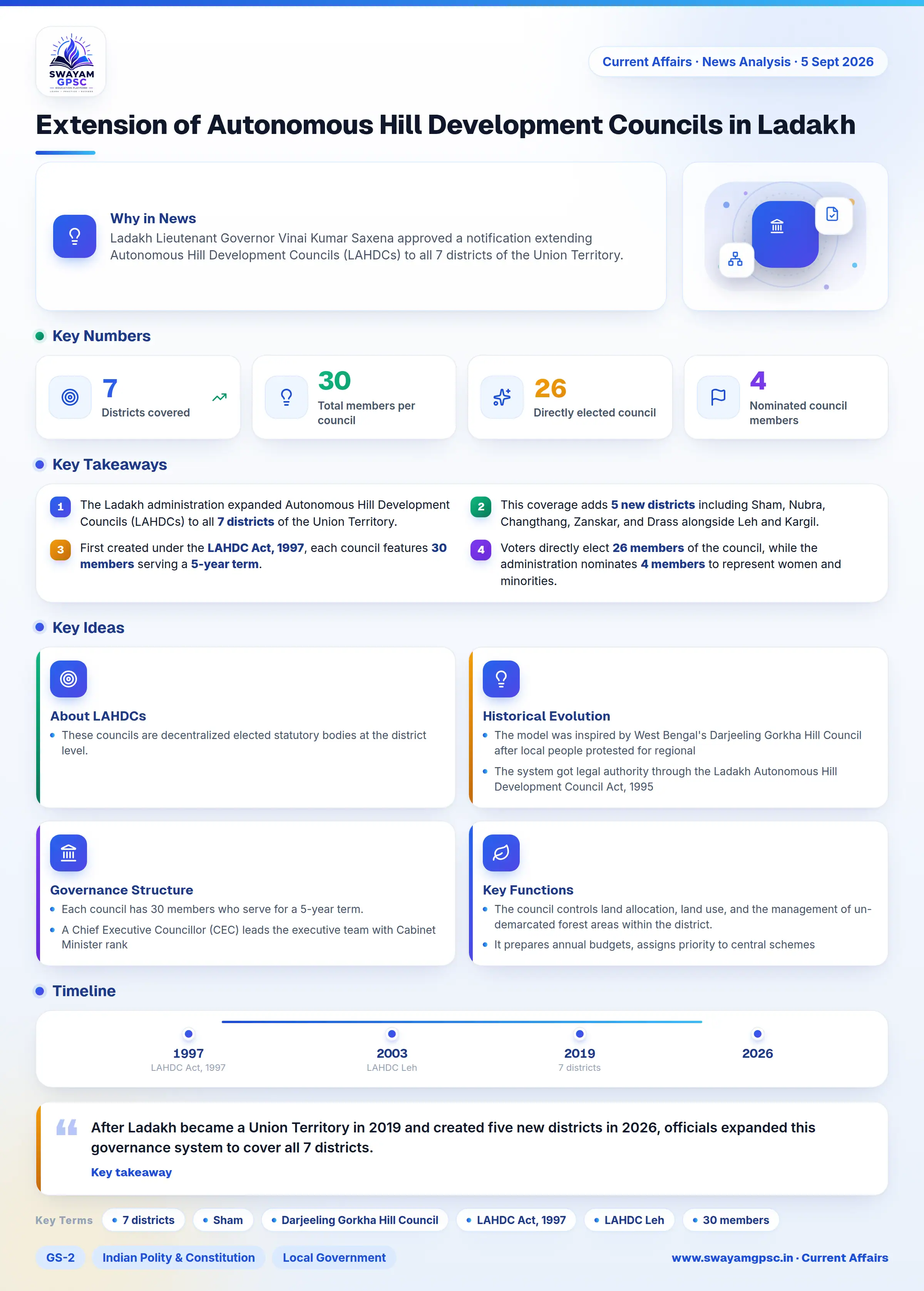
Extension of Autonomous Hill Development Councils in Ladakh
#GS-2 #Indian Polity & Constitution #Local Government #Federalism #Governance & Social Justice #Good Governance #Current Events #National #Ladakh #Autonomous Councils
Key takeaways
- The Ladakh administration expanded Autonomous Hill Development Councils (LAHDCs) to all 7 districts of the Union Territory.
- This coverage adds 5 new districts including Sham, Nubra, Changthang, Zanskar, and Drass alongside Leh and Kargil.
- First created under the LAHDC Act, 1997, each council features 30 members serving a 5-year term.
- Voters directly elect 26 members of the council, while the administration nominates 4 members to represent women and minorities.
- The Chief Executive Councillor (CEC) holds Cabinet Minister rank, and the District Deputy Commissioner serves as the council's CEO.
Why in News
- Ladakh Lieutenant Governor Vinai Kumar Saxena approved a notification extending Autonomous Hill Development Councils (LAHDCs) to all 7 districts of the Union Territory.
- This decision expands elected local governance from Leh and Kargil into five new districts: Sham, Nubra, Changthang, Zanskar, and Drass.
About LAHDCs
- These councils are decentralized elected statutory bodies at the district level. They aim to provide local self-rule, plan development, and manage land and natural resources in mountain areas.
Historical Evolution
- The model was inspired by West Bengal's Darjeeling Gorkha Hill Council after local people protested for regional self-rule.
- The system got legal authority through the Ladakh Autonomous Hill Development Council Act, 1995, which was later consolidated under the LAHDC Act, 1997.
- The government established LAHDC Leh in 1995 and LAHDC Kargil in July 2003 under the coalition government led by Mufti Mohammad Sayeed.
- After Ladakh became a Union Territory in 2019 and created five new districts in 2026, officials expanded this governance system to cover all 7 districts.
Governance Structure
- Each council has 30 members who serve for a 5-year term. Among them, 26 members are directly elected by voters, and 4 members are nominated to represent women and religious minorities.
- A Chief Executive Councillor (CEC) leads the executive team with Cabinet Minister rank, supported by four Executive Councillors holding Deputy Minister rank.
- The District Deputy Commissioner serves as the ex-officio Chief Executive Officer (CEO) to run administration and supervise local development projects.
Key Functions
- The council controls land allocation, land use, and the management of un-demarcated forest areas within the district.
- It prepares annual budgets, assigns priority to central schemes, and executes rural development programs suited for high-altitude regions.
- It manages basic public services including schools, training institutes, health centers, sanitation, and local roads except national highways.
- It supports local farming, canal irrigation, fisheries, grazing land management, and veterinary care for livestock like pashmina goats and yaks.
- It creates rules and projects to promote eco-tourism, protect local tribal languages, and preserve traditional culture and Buddhist monasteries.