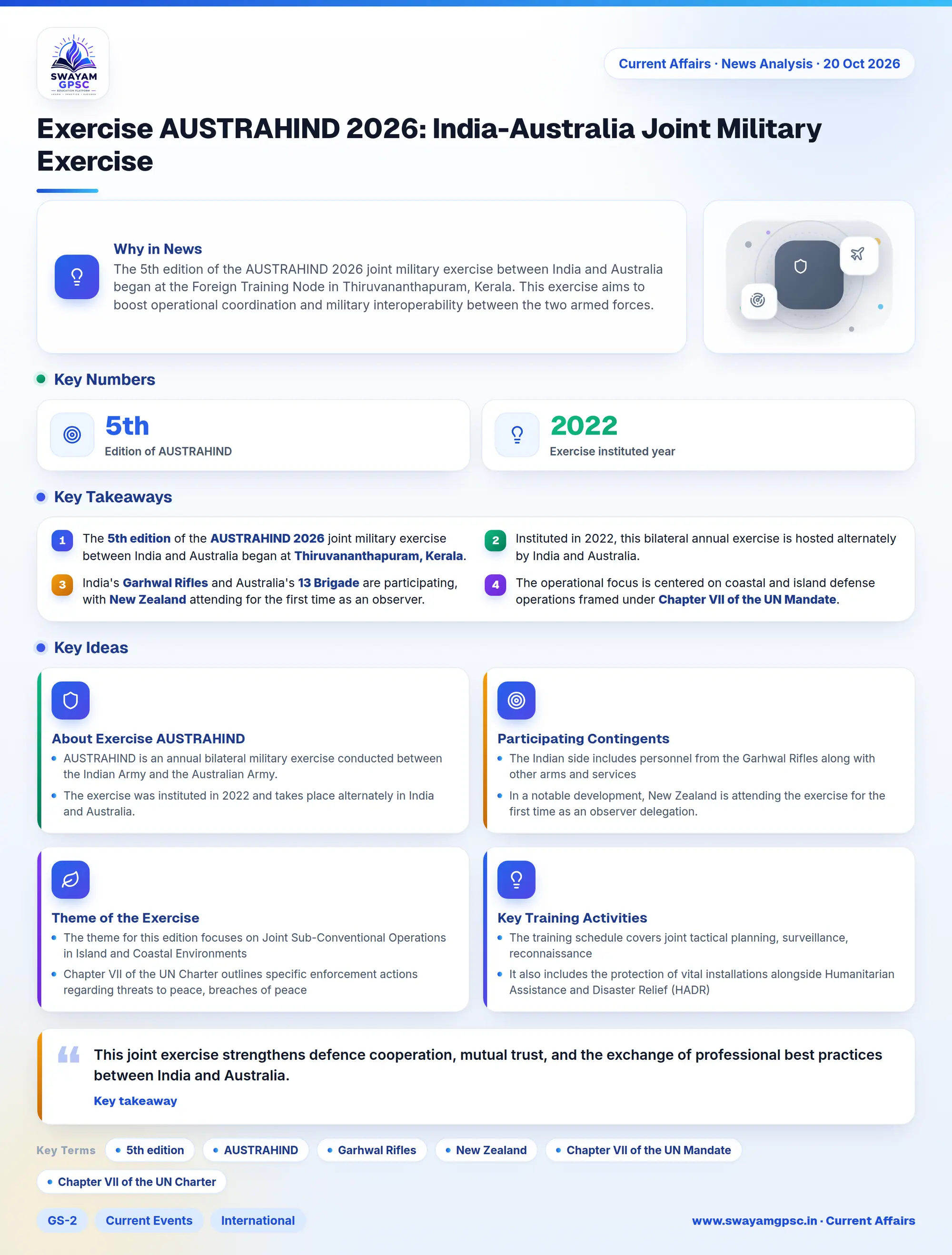
Exercise AUSTRAHIND 2026: India-Australia Joint Military Exercise
#GS-2 #Current Events #International #Defence Technology #Rapid Fire CA #Quick Facts For Prelims
Key takeaways
- The 5th edition of the AUSTRAHIND 2026 joint military exercise between India and Australia began at Thiruvananthapuram, Kerala.
- Instituted in 2022, this bilateral annual exercise is hosted alternately by India and Australia.
- India's Garhwal Rifles and Australia's 13 Brigade are participating, with New Zealand attending for the first time as an observer.
- The operational focus is centered on coastal and island defense operations framed under Chapter VII of the UN Mandate.
Why in News
- The 5th edition of the AUSTRAHIND 2026 joint military exercise between India and Australia began at the Foreign Training Node in Thiruvananthapuram, Kerala.
- This exercise aims to boost operational coordination and military interoperability between the two armed forces.
About Exercise AUSTRAHIND
- AUSTRAHIND is an annual bilateral military exercise conducted between the Indian Army and the Australian Army.
- The exercise was instituted in 2022 and takes place alternately in India and Australia.
Participating Contingents
- The Indian side includes personnel from the Garhwal Rifles along with other arms and services, while Australia is represented by its 13 Brigade.
- In a notable development, New Zealand is attending the exercise for the first time as an observer delegation.
Theme of the Exercise
- The theme for this edition focuses on Joint Sub-Conventional Operations in Island and Coastal Environments under Chapter VII of the UN Mandate.
- Chapter VII of the UN Charter outlines specific enforcement actions regarding threats to peace, breaches of peace, and acts of aggression.
Key Training Activities
- The training schedule covers joint tactical planning, surveillance, reconnaissance, and specialised coastal and island operations.
- It also includes the protection of vital installations alongside Humanitarian Assistance and Disaster Relief (HADR) drills involving aerial and maritime capabilities.
Significance
- This joint exercise strengthens defence cooperation, mutual trust, and the exchange of professional best practices between India and Australia.
- It builds a shared understanding of tactics, techniques, and procedures for coastal defense, promoting stability and security across the Indo-Pacific region.