Evolution of Swachh Bharat Mission-Gramin
#GS-2 #Governance & Social Justice #Good Governance #Health #Poverty #Current Events #National #GS-3 #Environment #Sustainable Development #Pollution #Welfare Schemes
Key takeaways
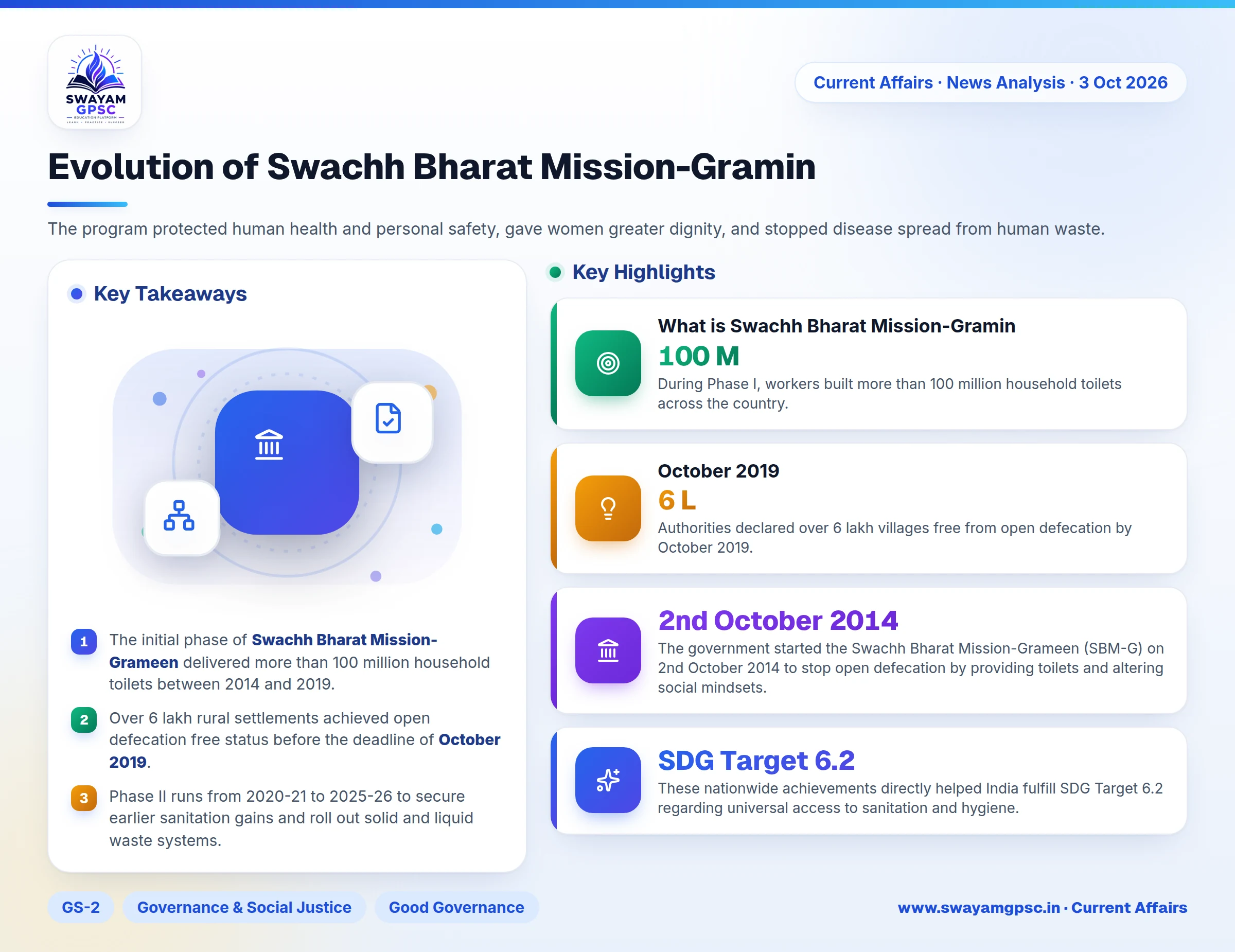
- The initial phase of Swachh Bharat Mission-Grameen delivered more than 100 million household toilets between 2014 and 2019.
- Over 6 lakh rural settlements achieved open defecation free status before the deadline of October 2019.
- Phase II runs from 2020-21 to 2025-26 to secure earlier sanitation gains and roll out solid and liquid waste systems.
- Rural sanitation coverage expanded rapidly from nearly 39% in 2014 to universal coverage under the mission.
- The GOBARdhan program turns livestock waste and agricultural refuse into commercially valuable biogas and organic bio-slurry.
Why in News
- The Swachh Bharat Mission-Grameen (SBM-G) has grown beyond building toilets into a people-driven sanitation drive.
- It now focuses on changing daily habits, managing rural waste, and setting up long-lasting sanitation systems.
What is Swachh Bharat Mission-Gramin
- The government started the Swachh Bharat Mission-Grameen (SBM-G) on 2nd October 2014 to stop open defecation by providing toilets and altering social mindsets.
- The first phase ran from 2014 to 2019 to wipe out open defecation and provide sanitation across every rural area.
- During Phase I, workers built more than 100 million household toilets across the country.
- Authorities declared over 6 lakh villages free from open defecation by October 2019.
- These nationwide achievements directly helped India fulfill SDG Target 6.2 regarding universal access to sanitation and hygiene.
- The program protected human health and personal safety, gave women greater dignity, and stopped disease spread from human waste.
- The government rolled out Phase II for the period 2020-21 to 2025-26 to protect earlier gains and manage total cleanliness.
- One key goal is protecting open defecation free gains so that villagers do not return to old habits.
- Another goal involves setting up working networks to gather, sort, treat, and safely dump household trash and plastic items.
- The program handles domestic greywater and dirty runoff through well-built village drains and treatment sites.
- The mission keeps public roads free of loose plastic, trash piles, and pools of dirty water.
- Under Phase II, an Aspiring village holds its open defecation free status and manages either solid or liquid waste.
- A Rising village maintains its open defecation free condition while managing both solid waste and wastewater together.
- A Model village preserves its open defecation free tag, runs both waste facilities, looks clean to visitors, and displays public information messages.
- The GOBARdhan (Galvanizing Organic Bio-Agro Resources Dhan) project processes cattle dung, crop leftovers, and kitchen refuse into biogas, fuel, and bio-fertilizer.
Significance of SBM-G
- The program uses persistent communication campaigns to turn personal cleanliness into a permanent everyday lifestyle.
- It guides families on washing hands, storing drinking water properly, separating wet and dry trash, and making home compost.
- Rural women lead local awareness drives by working actively as Swachhagrahis and members of Self-Help Groups (SHGs).
- These women convince neighbors to keep using toilets, organize village meetings, and manage local garbage collection systems.
- Primary and secondary schools teach children sound hygiene habits, garbage separation, and environmental care early in life.
- Schoolchildren practice these clean habits in class and guide their parents to adopt them at home.
- Elected Gram Panchayats and Village Water and Sanitation Committees (VWSCs) coordinate local sanitation planning and oversee day-to-day operations.
- These local bodies connect personal hygiene habits with overall village cleanliness goals.
- Community initiatives like Swachhata Hi Seva (SHS) encourage ordinary citizens, youth clubs, and local societies to clean public places together.
- The program creates local jobs in collecting household waste, running recycling centers, preparing compost, and repairing sanitary hardware.
- Women running village enterprises make money by collecting trash and processing organic waste.
- The GOBARdhan model turns agricultural debris and livestock manure into biogas and organic fertilizer, generating green rural wealth.
- Villages treat domestic greywater to restore underground water reserves and supply clean moisture for farming fields.
Challenges
- Some families might slide back into open defecation if community vigilance and daily hygiene habits drop over time.
- Villages often lack proper systems to collect, separate, recycle, and safely discard everyday plastic trash.
- Unplanned greywater flow pools on village pathways, creating foul odors and breeding spaces for disease-carrying insects.
- Many Gram Panchayats lack sufficient funds, skilled workers, and technical knowledge to maintain sanitation works on their own.
- Many places struggle to fund the ongoing upkeep of community toilets because waste reuse markets remain small.
- Relying only on government machinery without active village participation weakens the long-term survival of sanitation projects.
Way Forward
- Local motivators, self-help groups, and neighborhood schools must keep running persistent hygiene awareness campaigns.
- Panchayats should set up decentralized facilities to sort, recycle, and compost household garbage right inside the village.
- Local bodies need low-cost drainage systems, soak pits, and stabilization ponds to treat greywater and recharge village groundwater.
- State governments should provide steady technical training and financial planning support directly to Gram Panchayats.
- Agencies should expand projects like GOBARdhan and support women-led cooperatives in turning organic refuse into valuable fertilizer and green fuel.
- Community platforms like Swachhata Hi Seva must mobilize neighborhood volunteers, schools, and youth clubs to own and manage their sanitation spaces.
Conclusion
- India completed a three-step sanitation reform: first creating access to toilets, then driving regular usage, and now ensuring long-term sustainability.
- The mission successfully evolved from a public infrastructure plan into a self-sustaining civic movement driven by personal responsibility and clean habits.