Ethical Education as the Foundation of a Just Society
#GS-2 #Governance & Social Justice #Education #GS-4 #Ethics #Ethical Dilemmas #Current Events #National #Ethical Education #NEP 2020
Key takeaways
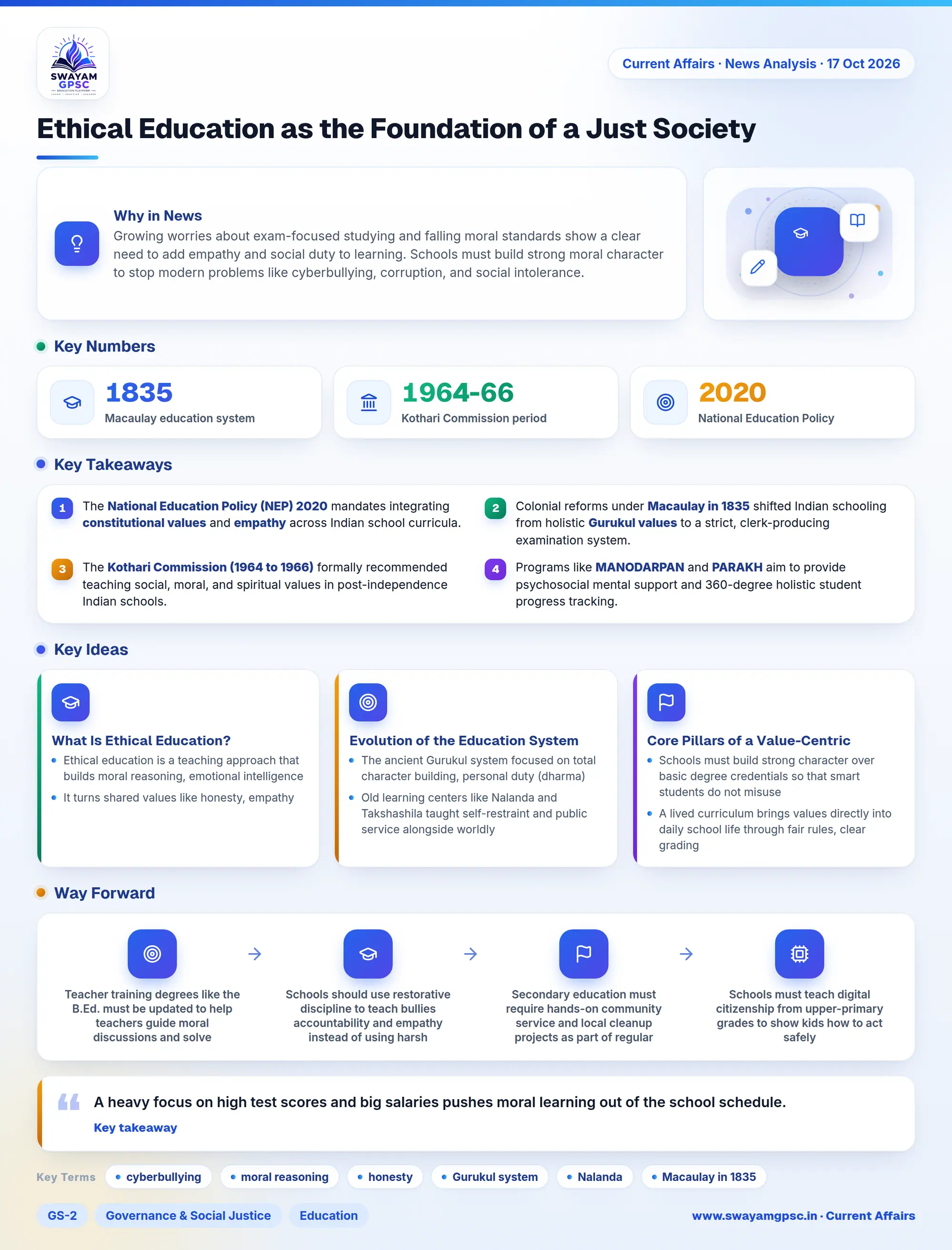
- The National Education Policy (NEP) 2020 mandates integrating constitutional values and empathy across Indian school curricula.
- Colonial reforms under Macaulay in 1835 shifted Indian schooling from holistic Gurukul values to a strict, clerk-producing examination system.
- The Kothari Commission (1964 to 1966) formally recommended teaching social, moral, and spiritual values in post-independence Indian schools.
- Programs like MANODARPAN and PARAKH aim to provide psychosocial mental support and 360-degree holistic student progress tracking.
Why in News
- Growing worries about exam-focused studying and falling moral standards show a clear need to add empathy and social duty to learning.
- Schools must build strong moral character to stop modern problems like cyberbullying, corruption, and social intolerance.
What Is Ethical Education?
- Ethical education is a teaching approach that builds moral reasoning, emotional intelligence, and civic responsibility alongside normal school subjects.
- It turns shared values like honesty, empathy, and constitutional morality into real daily experiences instead of forcing students to memorize moral lectures.
Evolution of the Education System in India
- The ancient Gurukul system focused on total character building, personal duty (dharma), and living peacefully in a community.
- Old learning centers like Nalanda and Takshashila taught self-restraint and public service alongside worldly knowledge.
- The colonial system created by Macaulay in 1835 replaced holistic learning with an exam-focused setup designed to train government clerks.
- This colonial approach favored English skills and rote memory while cutting students off from local moral values.
- After independence, bodies like the Kothari Commission (1964 to 1966) warned that secular schooling must include moral and spiritual values.
- The 21st century brought hyper-competitive testing that caused high student anxiety and focused purely on exam ranks.
- Modern coaching factories push students toward extreme stress, cheating, and feeling isolated from their peers.
Core Pillars of a Value-Centric Educational Framework
- Schools must build strong character over basic degree credentials so that smart students do not misuse their knowledge.
- A lived curriculum brings values directly into daily school life through fair rules, clear grading, and strong action against bullying.
- Modern learning must give students digital literacy to handle internet threats like data privacy and online cruelty.
- Education should teach environmental stewardship and respect for nature, public property, and gender equality.
- Parents and schools must work together because children copy the daily moral behavior they see in their adults at home.
Challenges
- A heavy focus on high test scores and big salaries pushes moral learning out of the school schedule.
- Students often justify cheating in exams because society measures success only by top marks.
- Teaching ethics through boring lectures stops students from learning how to solve real moral problems.
- Children feel confused when adults preach honesty in class but break rules or show bias in real life.
- Unchecked smartphone use exposes young people to toxic online trends, cyber trolling, and social hostility.
Initiatives Taken So Far
- The National Education Policy (NEP) 2020 mandates adding constitutional values, empathy, and environmental awareness to school lessons.
- Organizations like NCERT created helpful tools like the National Curriculum Framework for School Education (NCF-SE) for teachers.
- State governments created regional classes like the Happiness Curriculum and Deshbhakti Curriculum to teach self-awareness and public duty.
- The Ministry of Education launched MANODARPAN to provide mental health counseling and guide students through peer pressure.
Way Forward
- Teacher training degrees like the B.Ed. must be updated to help teachers guide moral discussions and solve classroom conflicts fairly.
- Schools should use restorative discipline to teach bullies accountability and empathy instead of using harsh suspensions.
- Secondary education must require hands-on community service and local cleanup projects as part of regular school credits.
- Schools must teach digital citizenship from upper-primary grades to show kids how to act safely and respectfully online.
- Student evaluations should shift to 360-degree holistic progress cards under PARAKH to track teamwork and moral values alongside exam marks.
Conclusion
- A country becomes truly great through the moral strength and empathy of its people, not just the total count of its technical graduates.
- Combining academic goals with strong moral values is key to building a fair, peaceful, and fully developed nation.