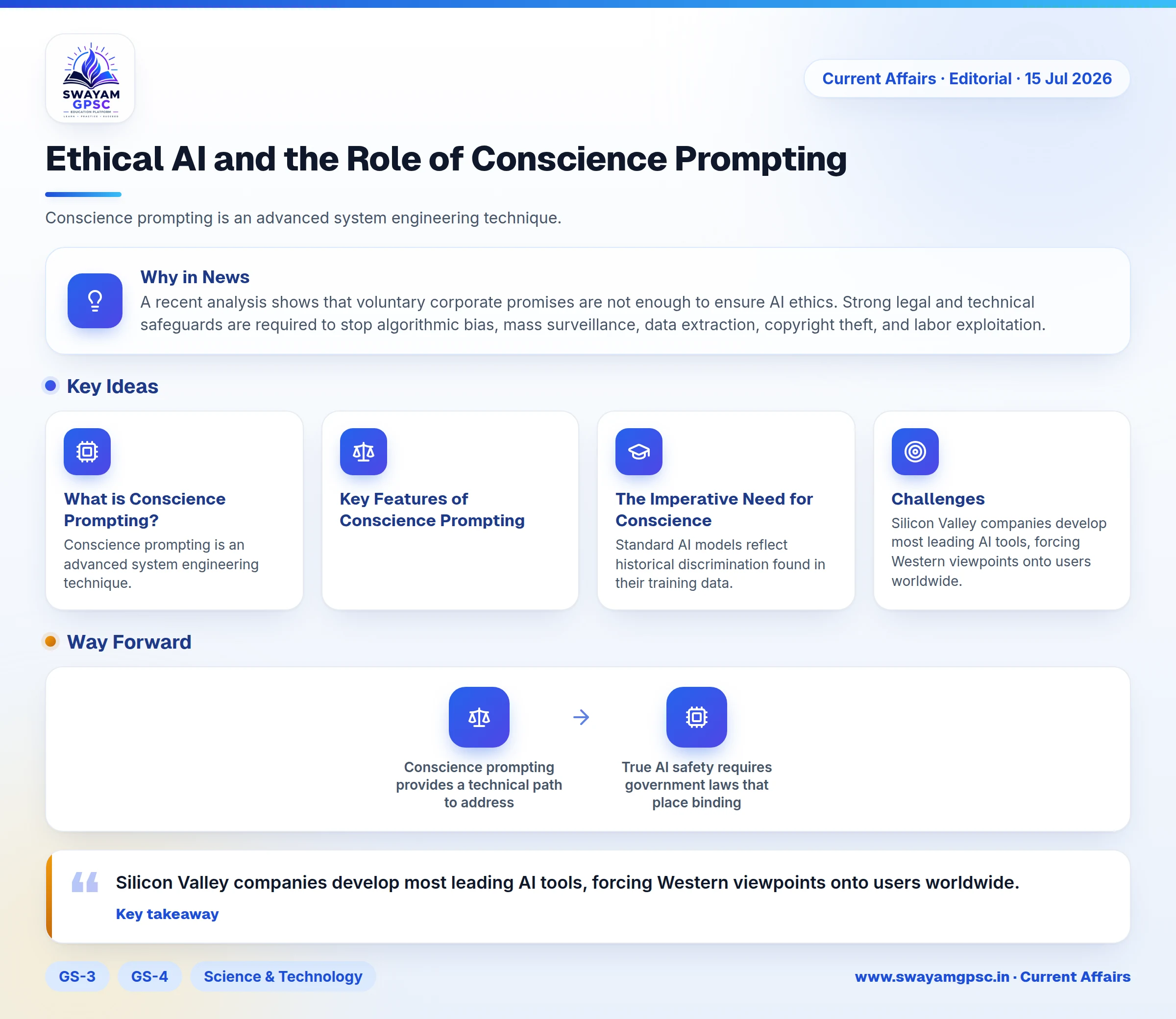
Ethical AI and the Role of Conscience Prompting
#GS-3 #GS-4 #Science & Technology #Ethics #Artificial Intelligence #Ethical Dilemmas #Conscience Prompting #Artificial Intelligence Ethics
Why in News
- A recent analysis shows that voluntary corporate promises are not enough to ensure AI ethics. Strong legal and technical safeguards are required to stop algorithmic bias, mass surveillance, data extraction, copyright theft, and labor exploitation.
What is Conscience Prompting?
- Conscience prompting is an advanced system engineering technique. It embeds moral rules, human values, and social limits directly into the basic instructions of Large Language Models (LLMs) and generative AI systems.
- Rather than relying on secret algorithms or post-generation filters, this method forces the AI to test its output against a clear moral framework before displaying answers to users.
- It acts like a digital conscience within the software. This helps the AI active identify and block toxic text, systemic bias, and misinformation.
Key Features of Conscience Prompting
- The model uses constitutional rules, like Anthropic’s Constitutional AI, to test all responses for helpfulness, harmlessness, and honesty.
- The system monitors its own language choices to catch subtle bias, preventing unfair shifts when evaluating individual human traits.
- The model bases its core prompt structures on global human rights standards like the UN Universal Declaration of Human Rights, rather than narrow commercial goals.
- The system creates clear verification trails by explaining step-by-step how its final answer aligns with internal ethical rules.
The Imperative Need for Conscience Prompting
- Standard AI models reflect historical discrimination found in their training data. For example, the Gender Shades audit showed that facial recognition tools often failed on darker-skinned women due to a lack of diverse data.
- AI algorithms skew language based on gendered names even when skills match. For example, changing a resume name from Jennifer to Jeff caused Gemini to upgrade project descriptions from community service to leadership.
- Predictive software creates harmful feedback loops by directing heavy police resources toward historic trouble spots. For example, predictive policing in New Delhi and Detroit targets over-policed neighborhoods, generating biased data that mislabels them as high-risk areas.
- Systems built without ethical prompts generate biased scores that harm marginalized communities in finance and healthcare. For example, credit algorithms trained on old banking records repeatedly block loans for low-income applicants based on past economic exclusion.
Challenges
- Silicon Valley companies develop most leading AI tools, forcing Western viewpoints onto users worldwide. For example, constitutional rules reflect Western educated norms, leaving communities in Noida or Nairobi without a voice in rule-making.
- Tech corporations use terms like trustworthy AI for marketing while avoiding strict public oversight and legal rules. For example, major tech firms use internal policy claims as PR shields while keeping their software hidden from external audits.
- Cleaning raw data for AI safety depends on low-wage workers under harsh conditions. For example, tech companies outsource data moderation to workers in Kenya and the Philippines, exposing them to disturbing content that harms their mental health.
- Users can bypass system rules using clever adversarial prompts or jailbreaking techniques. For example, online forums use complex roleplay inputs to disable safety settings, tricking the AI into issuing harmful output.
Methods to Develop Conscience Prompting
- System prompts must include enforceable safety filters to block excessive surveillance, bias, and unauthorized data collection.
- Developers should create double-pass self-correction tools, where a second internal layer evaluates draft responses against safety rules before showing them.
- Training sets must include diverse datasets, integrating local knowledge and varied languages from the Global South.
- Governments must mandate independent public audits to let external researchers test AI prompt boundaries in real scenarios.
- Systems need strict prompt guidelines that force neutral language and professional tone across all gender profiles.
Way Forward
- Conscience prompting provides a technical path to address historical bias, but it cannot replace real external legal accountability.
- True AI safety requires government laws that place binding limits on mass surveillance and data extraction, keeping human rights ahead of corporate profit.