Equality of Treatment for Persons with Disabilities
#GS-2 #Governance & Social Justice #Vulnerable Sections #Economy #Infrastructure
Key takeaways
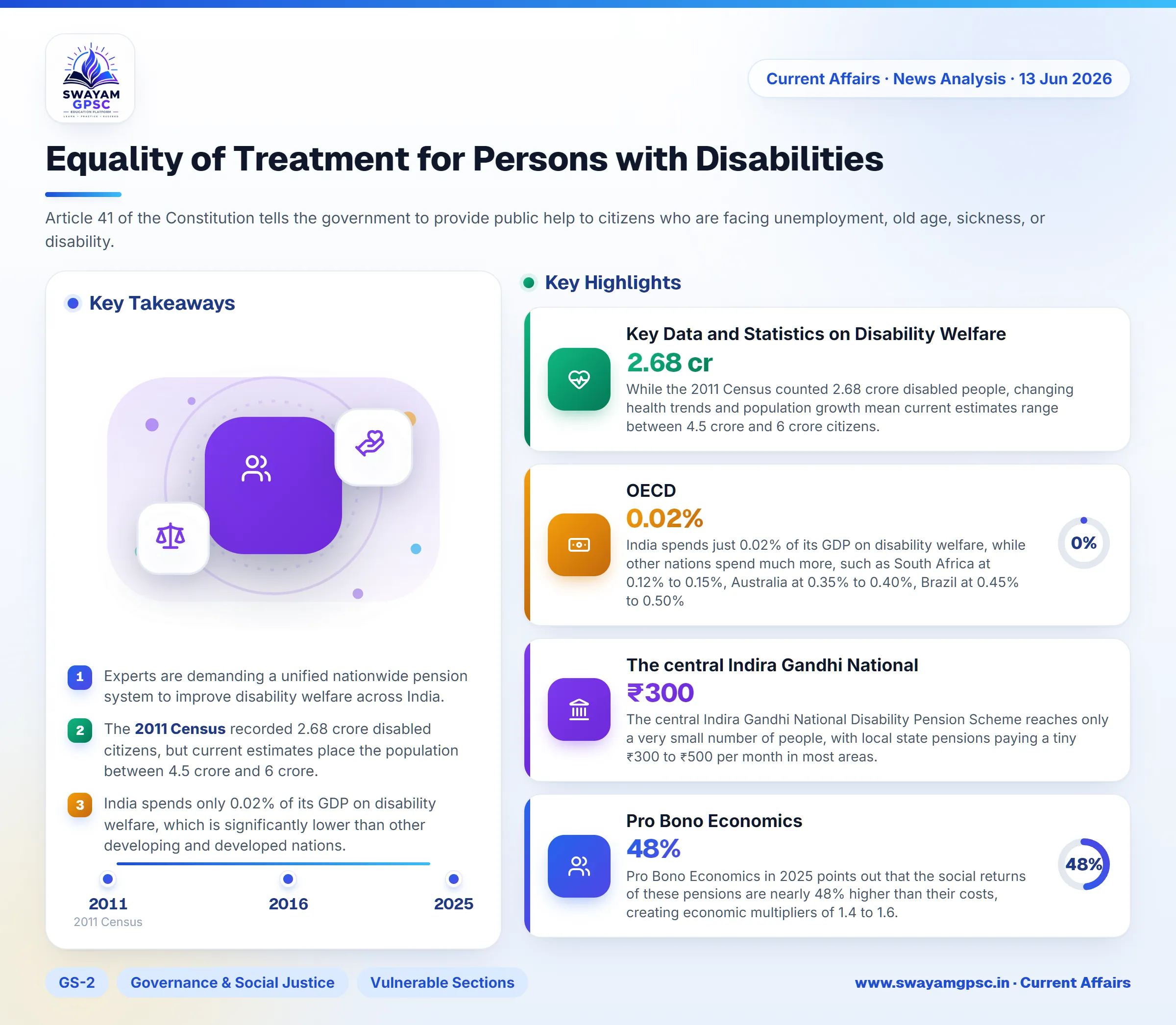
- Experts are demanding a unified nationwide pension system to improve disability welfare across India.
- The 2011 Census recorded 2.68 crore disabled citizens, but current estimates place the population between 4.5 crore and 6 crore.
- India spends only 0.02% of its GDP on disability welfare, which is significantly lower than other developing and developed nations.
- Establishing a minimum universal pension floor rate will help lift disabled citizens from survival to productive labor.
Why in News
- Experts are asking for a complete change in how India supports disabled citizens by setting up a single nationwide pension system.
- Even though Digital India Mission, Aadhaar-enabled Direct Benefit Transfers (DBT), and UPI have made India a global digital leader, disabled citizens are still left out of these benefits.
Constitutional and Legal Framework
- Moving disability pensions from a simple act of government charity to a legal right of every citizen helps fulfill important constitutional goals.
- Article 41 of the Constitution tells the government to provide public help to citizens who are facing unemployment, old age, sickness, or disability.
- Section 24 of the Rights of Persons with Disabilities Act, 2016 gives a legal guarantee of proper social security and fair pension benefits.
- The Supreme Court of India states that the right to live with dignity is a key part of the fundamental Right to Life under Article 21.
Key Data and Statistics on Disability Welfare
- While the 2011 Census counted 2.68 crore disabled people, changing health trends and population growth mean current estimates range between 4.5 crore and 6 crore citizens.
- India spends just 0.02% of its GDP on disability welfare, while other nations spend much more, such as South Africa at 0.12% to 0.15%, Australia at 0.35% to 0.40%, Brazil at 0.45% to 0.50%, and OECD nations at an average of 2.2% of GDP.
- The central Indira Gandhi National Disability Pension Scheme reaches only a very small number of people, with local state pensions paying a tiny ₹300 to ₹500 per month in most areas.
- Pro Bono Economics in 2025 points out that the social returns of these pensions are nearly 48% higher than their costs, creating economic multipliers of 1.4 to 1.6.
Need for Minimum Universal Disability Pension Floor Rate
- A citizen's basic survival should not depend on local state budgets or changing political decisions, which makes a nationwide minimum baseline essential.
- Leaving disabled people out of social security and jobs causes low and middle-income countries to lose an estimated 3% to 7% of their total GDP.
- Combining basic pensions with job help allows disabled citizens to move from just surviving to becoming active workers.
- Setting up a strong pension network supports global goals like Article 28 of the UN Convention on the Rights of Persons with Disabilities, ILO Recommendation No. 202, and the G-20 New Delhi Leaders’ Declaration.
Challenges
- Responsibility is split between the Ministry of Rural Development and the Department of Empowerment of Persons with Disabilities, which causes administrative delays and confusion.
- Spending on disability welfare is extremely low compared to other major national costs like food subsidies at ₹2.05 lakh crore or infrastructure at ₹11.11 lakh crore.
- Current job incentive programs are weak and lack strong tax breaks or wage subsidies used in other countries.
- Complex and non-portable registration systems trap vulnerable citizens in endless red tape, keeping them away from modern welfare benefits.
Way Forward
- Introduce a national baseline pension, such as ₹8,000 per month for 40 lakh beneficiaries costing 0.08% of GDP or ₹10,000 for 65 lakh beneficiaries costing 0.08% to 0.2% of GDP.
- Bring operations under a single independent body like South Africa’s SASSA or Australia’s NDIA to handle unified records and digital integration.
- Upgrade job incentive schemes by giving corporate tax breaks and wage subsidies like the UK’s Access to Work program.
- Expand grassroots programs like PM-DAKSH and the National Apprenticeship Promotion Scheme (NAPS) to connect welfare support directly to jobs.
- Use India’s direct benefit transfer system to send pensions straight to beneficiaries without regional delays.