Epigenetic Inheritance Beyond DNA Sequences
#GS-3 #Science & Technology #Biotechnology #Scientific Innovations & Discoveries #Current Events
Key takeaways
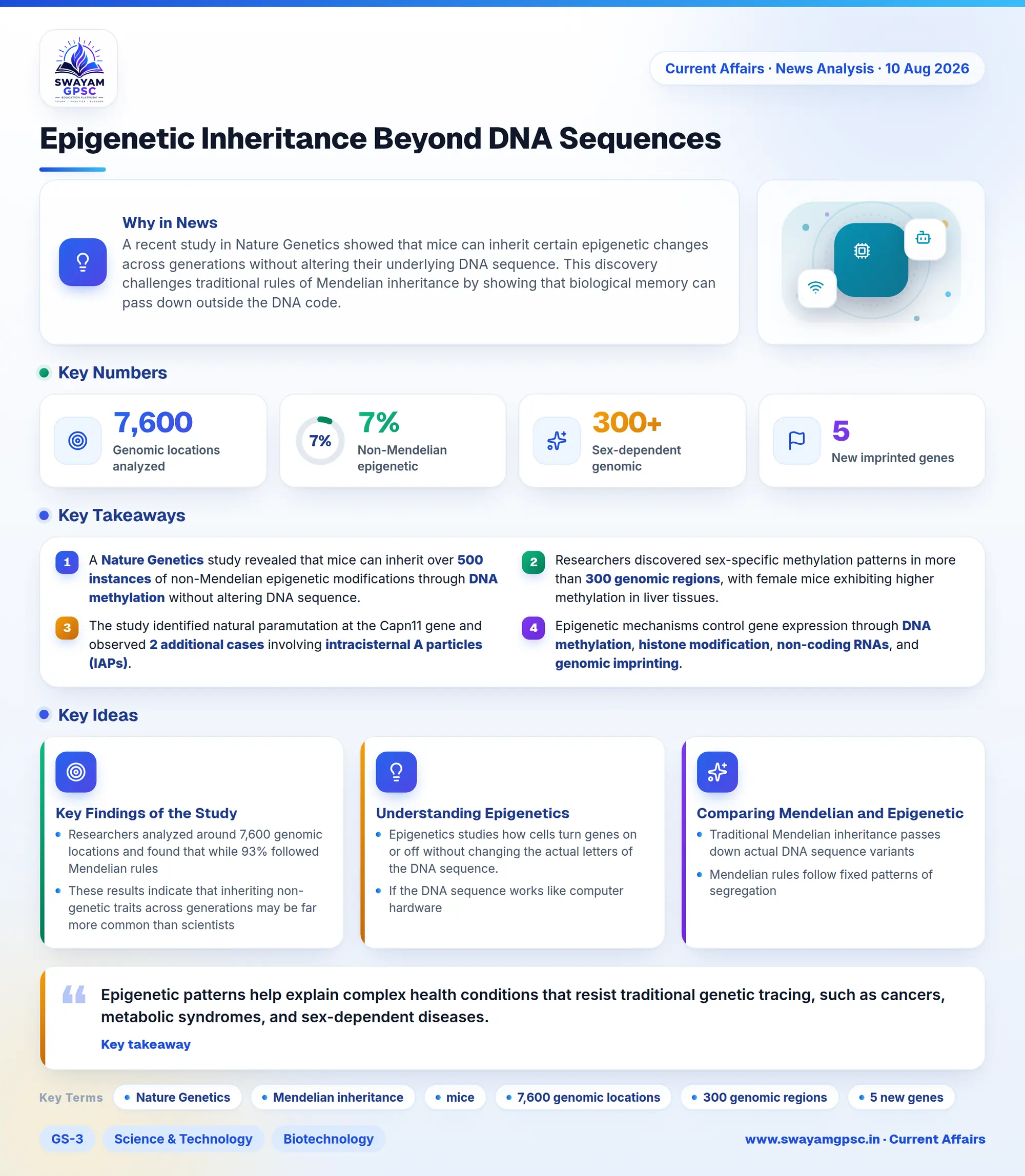
- A Nature Genetics study revealed that mice can inherit over 500 instances of non-Mendelian epigenetic modifications through DNA methylation without altering DNA sequence.
- Researchers discovered sex-specific methylation patterns in more than 300 genomic regions, with female mice exhibiting higher methylation in liver tissues.
- The study identified natural paramutation at the *Capn11* gene and observed 2 additional cases involving intracisternal A particles (IAPs).
- Epigenetic mechanisms control gene expression through DNA methylation, histone modification, non-coding RNAs, and genomic imprinting.
Why in News
- A recent study in Nature Genetics showed that mice can inherit certain epigenetic changes across generations without altering their underlying DNA sequence.
- This discovery challenges traditional rules of Mendelian inheritance by showing that biological memory can pass down outside the DNA code.
- Because scientists conducted this study on mice, experts cannot directly apply these findings to human biology without further research.
Key Findings of the Study
- Researchers analyzed around 7,600 genomic locations and found that while 93% followed Mendelian rules, about 7% showed non-Mendelian epigenetic inheritance across 500 instances.
- These results indicate that inheriting non-genetic traits across generations may be far more common than scientists previously thought.
- In over 300 genomic regions, methylation levels depended on the sex of the animal, with female mice showing much higher liver tissue methylation than males.
- The research team successfully discovered at least 5 new genes that demonstrate genomic imprinting.
- Scientists observed natural intergenerational paramutation at the *Capn11* gene, which plays a key role in testicular meiosis and male fertility.
- The team identified 2 additional cases of paramutation involving transposable elements called intracisternal A particles (IAPs).
- These IAPs are retroviral elements in mouse DNA that resist normal clearing during reproductive cell formation, allowing epigenetic marks to pass to offspring.
Understanding Epigenetics and Its Mechanisms
- Epigenetics studies how cells turn genes on or off without changing the actual letters of the DNA sequence.
- If the DNA sequence works like computer hardware, the epigenome acts like software that decides which instructions the cell executes.
- Even though all cells share identical DNA, epigenetic signals help liver, brain, and muscle cells perform completely different jobs.
- External factors like diet, stress, physical activity, ageing, and toxins modify these marks, connecting lifestyle to gene activity.
- In DNA methylation, cells attach a chemical tag called a methyl group (-CH3) directly to cytosine bases to reduce gene activity.
- Through histone modification, chemical tags adjust how tightly DNA wraps around protein spools called histones to activate or silence genes.
- Non-coding RNAs bind to coding RNA molecules and break them down, preventing cells from building specific proteins.
- Under genomic imprinting, offspring express only one parent copy of a gene because the cell silences the other copy through methylation before fertilisation.
- In paramutation, the epigenetic state of one gene copy permanently alters its partner copy, and this change can pass down to future generations.
- Epigenetic research helps scientists solve missing heritability questions that standard Genome-Wide Association Studies (GWAS) fail to explain.
- Doctors can design reversible epigenetic therapies in precision medicine to restore normal cell functions.
- Because environmental factors modify gene switches, maintaining good nutrition and environmental safety becomes critical for future generation health.
- Epigenetic patterns help explain complex health conditions that resist traditional genetic tracing, such as cancers, metabolic syndromes, and sex-dependent diseases.
- Rapid epigenetic adaptations may help species adjust to changing environments much faster than slow genetic mutations allow.
Comparing Mendelian and Epigenetic Inheritance
- Traditional Mendelian inheritance passes down actual DNA sequence variants, whereas epigenetic inheritance transfers gene-regulating marks without sequence changes.
- Mendelian rules follow fixed patterns of segregation, while epigenetic mechanisms frequently display non-Mendelian inheritance patterns.
- Inherited DNA sequences determine trait expression in Mendelian genetics, but epigenetic marks control whether genes turn on or off.
- Standard DNA sequences remain stable across generations, but epigenetic marks remain dynamic and reversible.
- Reproductive cells usually clear most epigenetic tags during sperm and egg creation, unlike DNA sequences which pass down intact.
- Mendelian traits follow predictable offspring patterns, whereas epigenetic marks can escape resetting, depend on sex, or alter partner alleles.