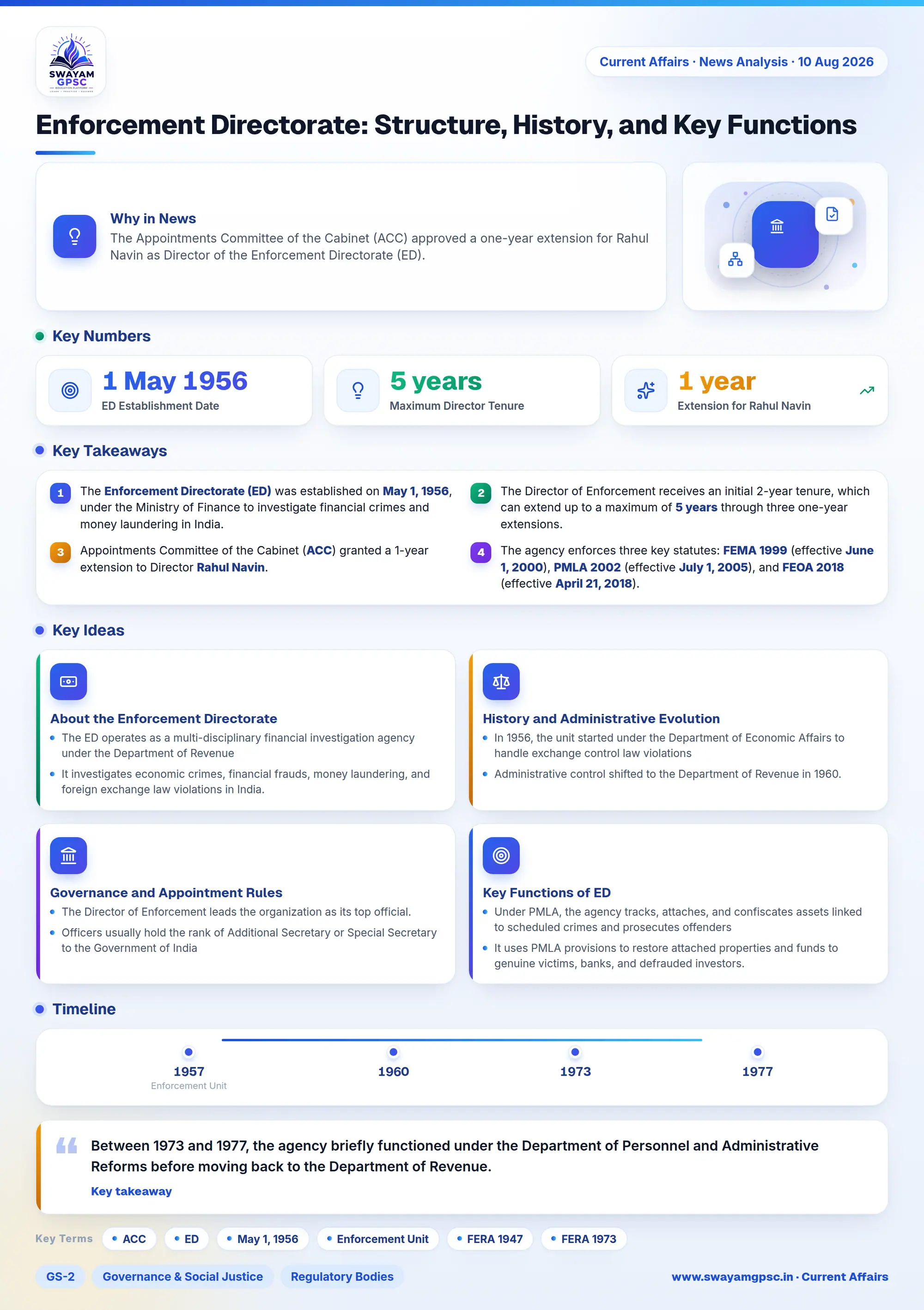
Enforcement Directorate: Structure, History, and Key Functions
#GS-2 #Governance & Social Justice #Regulatory Bodies #Current Events #National #GS-3 #Economy #Enforcement Directorate #PMLA #FEMA
Key takeaways
- The Enforcement Directorate (ED) was established on May 1, 1956, under the Ministry of Finance to investigate financial crimes and money laundering in India.
- The Director of Enforcement receives an initial 2-year tenure, which can extend up to a maximum of 5 years through three one-year extensions.
- Appointments Committee of the Cabinet (ACC) granted a 1-year extension to Director Rahul Navin.
- The agency enforces three key statutes: FEMA 1999 (effective June 1, 2000), PMLA 2002 (effective July 1, 2005), and FEOA 2018 (effective April 21, 2018).
Why in News
- The Appointments Committee of the Cabinet (ACC) approved a one-year extension for Rahul Navin as Director of the Enforcement Directorate (ED).
About the Enforcement Directorate
- The ED operates as a multi-disciplinary financial investigation agency under the Department of Revenue within the Ministry of Finance.
- It investigates economic crimes, financial frauds, money laundering, and foreign exchange law violations in India.
- The agency was established on May 1, 1956.
- Initially created as an Enforcement Unit under the Department of Economic Affairs, it was renamed the Enforcement Directorate in 1957.
History and Administrative Evolution
- In 1956, the unit started under the Department of Economic Affairs to handle exchange control law violations under the Foreign Exchange Regulation Act, 1947 (FERA 1947).
- Administrative control shifted to the Department of Revenue in 1960.
- Between 1973 and 1977, the agency briefly functioned under the Department of Personnel and Administrative Reforms before moving back to the Department of Revenue.
- The government replaced FERA 1973 with the Foreign Exchange Management Act, 1999 (FEMA), which took effect on June 1, 2000.
- The agency started enforcing the Prevention of Money Laundering Act, 2002 (PMLA) from July 1, 2005.
- The agency received enforcement powers under the Fugitive Economic Offenders Act, 2018 (FEOA) on April 21, 2018.
Governance and Appointment Rules
- The Director of Enforcement leads the organization as its top official.
- Officers usually hold the rank of Additional Secretary or Special Secretary to the Government of India, selected from the Indian Revenue Service (IRS) or Indian Police Service (IPS).
- The Central Government appoints the Director based on recommendations from a committee chaired by the Central Vigilance Commissioner (CVC).
- Statutory amendments allow an initial fixed tenure of 2 years, which can expand through three one-year extensions up to a maximum total of 5 years.
Key Functions of ED
- Under PMLA, the agency tracks, attaches, and confiscates assets linked to scheduled crimes and prosecutes offenders in Special PMLA Courts.
- It uses PMLA provisions to restore attached properties and funds to genuine victims, banks, and defrauded investors.
- Under FEMA, it investigates foreign exchange violations, trade mis-invoicing, and illegal hawala transactions, imposing civil penalties on violators.
- Under FEOA, it seizes domestic and overseas properties of economic offenders who flee India to avoid criminal trials.
- It coordinates with overseas intelligence units and international bodies like FATF and Interpol to track cross-border illicit funds and execute Letters Rogatory.