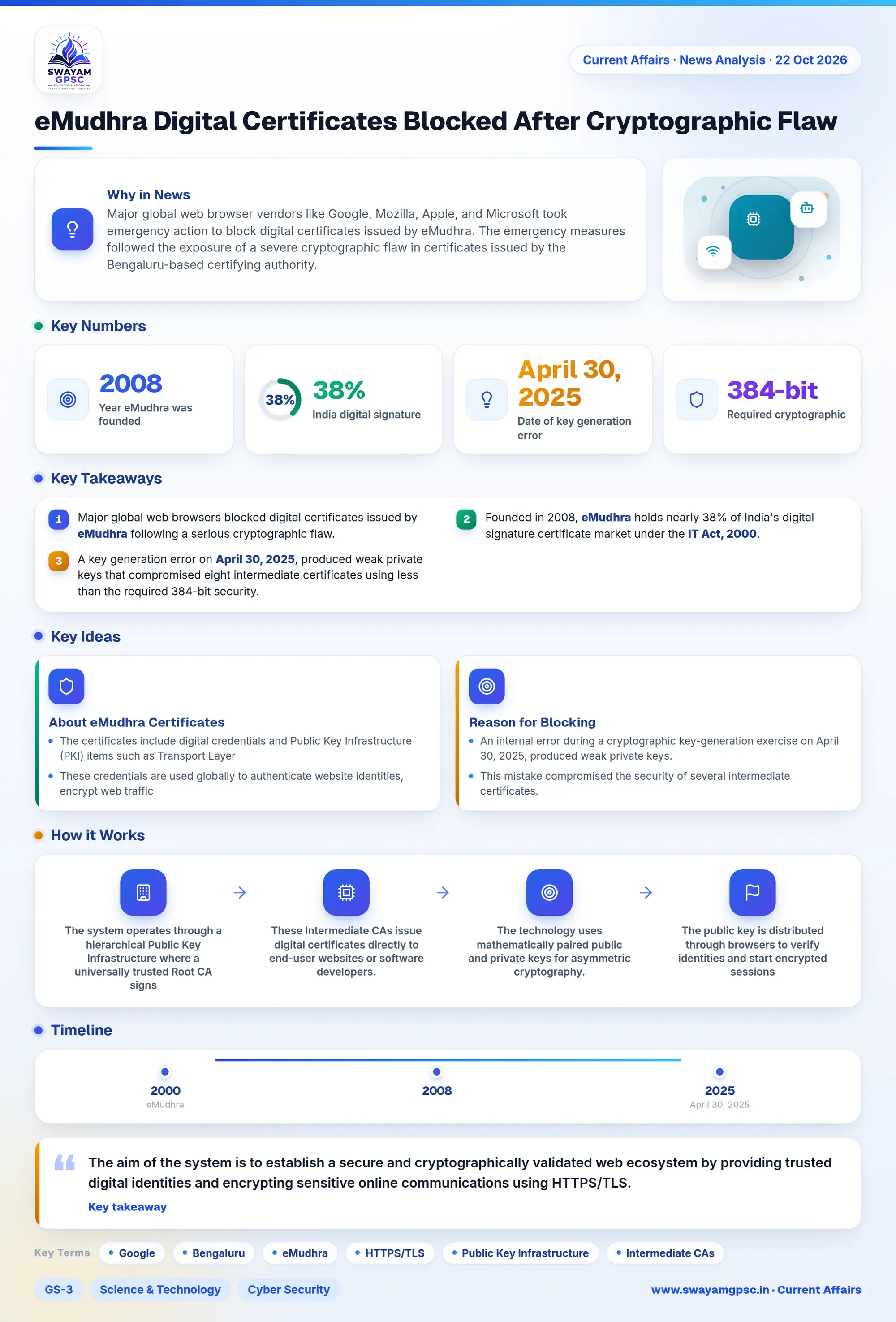
eMudhra Digital Certificates Blocked After Cryptographic Flaw
#GS-3 #Science & Technology #Cyber Security #Current Events #National #Economy
Key takeaways
- Major global web browsers blocked digital certificates issued by eMudhra following a serious cryptographic flaw.
- Founded in 2008, eMudhra holds nearly 38% of India's digital signature certificate market under the IT Act, 2000.
- A key generation error on April 30, 2025, produced weak private keys that compromised eight intermediate certificates using less than the required 384-bit security.
Why in News
- Major global web browser vendors like Google, Mozilla, Apple, and Microsoft took emergency action to block digital certificates issued by eMudhra.
- The emergency measures followed the exposure of a severe cryptographic flaw in certificates issued by the Bengaluru-based certifying authority.
About eMudhra Certificates
- The certificates include digital credentials and Public Key Infrastructure (PKI) items such as Transport Layer Security/Secure Sockets Layer (TLS/SSL) and code-signing certificates.
- These credentials are used globally to authenticate website identities, encrypt web traffic, and verify legitimate software publishers.
- Founded in 2008, eMudhra is a CCA-licensed digital identity and security firm under the IT Act, 2000.
- The firm holds nearly 38% of India's digital signature certificate market.
- The aim of the system is to establish a secure and cryptographically validated web ecosystem by providing trusted digital identities and encrypting sensitive online communications using HTTPS/TLS.
- Other key goals include preventing eavesdropping and ensuring that software remains tamper-resistant.
How it Works
- The system operates through a hierarchical Public Key Infrastructure where a universally trusted Root CA signs Intermediate CAs.
- These Intermediate CAs issue digital certificates directly to end-user websites or software developers.
- The technology uses mathematically paired public and private keys for asymmetric cryptography.
- The public key is distributed through browsers to verify identities and start encrypted sessions, while the private key must stay strictly secret to create digital signatures.
- When a user visits an HTTPS website, the browser traces the certificate chain up to a pre-installed trusted root in its trust store.
- An encrypted connection is established if the mathematical signature matches the expected values.
Reason for Blocking
- An internal error during a cryptographic key-generation exercise on April 30, 2025, produced weak private keys.
- This mistake compromised the security of several intermediate certificates.
- Eight intermediate certificates, consisting of six website authentication and two code-signing items, used predictable private keys instead of the required 384-bit cryptographic security.
- These easily recoverable private keys created risks for potential forged TLS certificates, man-in-the-middle attacks, website impersonation, and malicious software signing.
- Mozilla and Google blocked the vulnerable intermediate certificates through OneCRL and CRLSets.
- They also took steps to distrust the parent emSign Root TLS CA - G3.