Empowering Governance Through Digital Infrastructure
#GS-2 #Governance & Social Justice #E-Governance #Good Governance #GS-3 #Economy #Infrastructure #Science & Technology #ICT #National #Digital Public Infrastructure #Government Policies & Interventions
Key takeaways
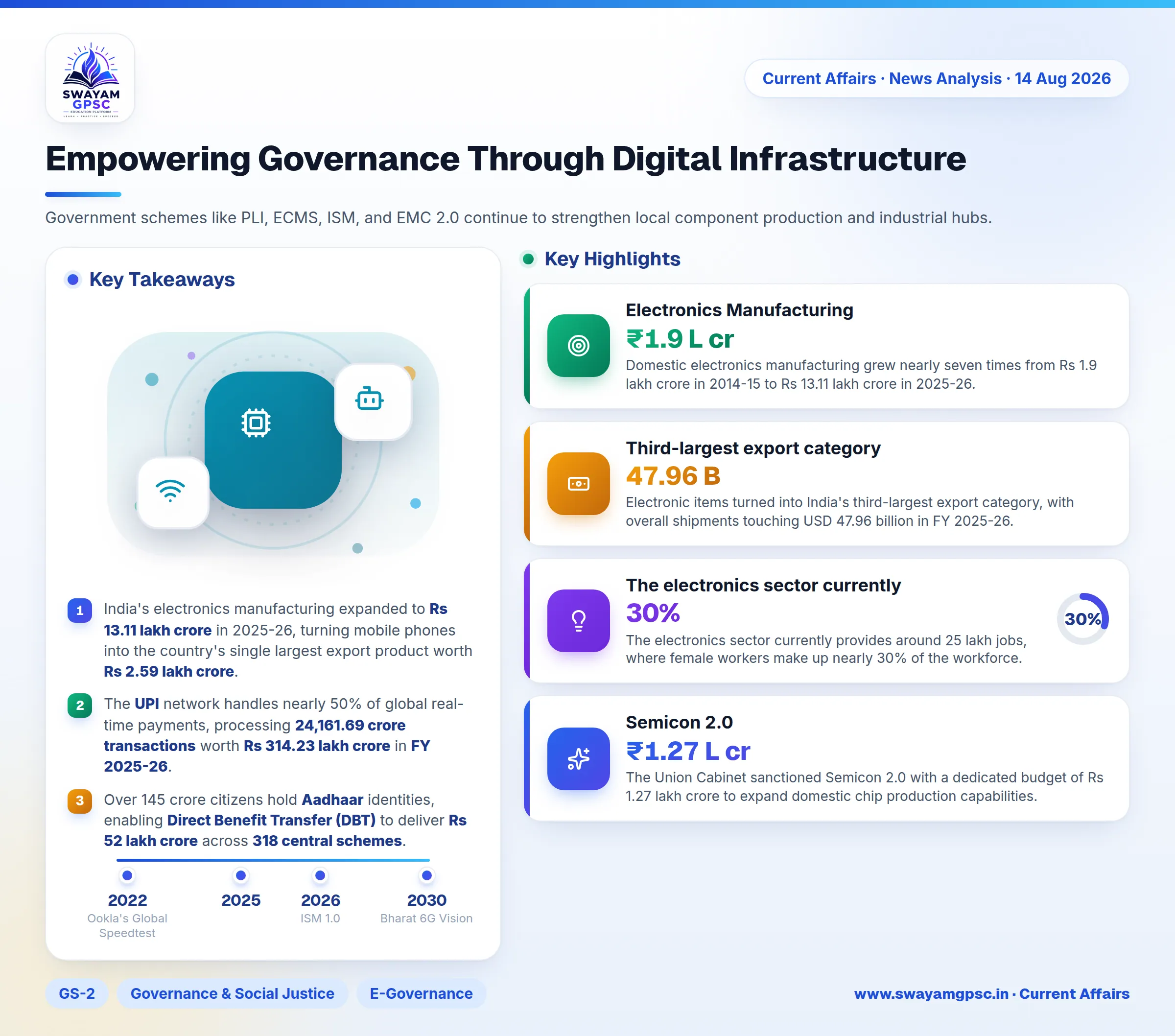
- India's electronics manufacturing expanded to Rs 13.11 lakh crore in 2025-26, turning mobile phones into the country's single largest export product worth Rs 2.59 lakh crore.
- The UPI network handles nearly 50% of global real-time payments, processing 24,161.69 crore transactions worth Rs 314.23 lakh crore in FY 2025-26.
- Over 145 crore citizens hold Aadhaar identities, enabling Direct Benefit Transfer (DBT) to deliver Rs 52 lakh crore across 318 central schemes.
- Internet connectivity reached 109.2 crore subscribers by March 2026, supported by 5G access across 99.9% of Indian districts.
Why in News
- As India marks its 80th Independence Day, the government highlighted how Digital Public Infrastructure is transforming public governance across the nation.
- This digital backbone improves public service delivery, opens economic chances, and helps achieve the vision of Viksit Bharat.
Electronics Manufacturing
- Domestic electronics manufacturing grew nearly seven times from Rs 1.9 lakh crore in 2014-15 to Rs 13.11 lakh crore in 2025-26.
- Electronics exports jumped almost eleven times from Rs 38,000 crore to Rs 4.24 lakh crore over the same timeframe, boosting global supply ties.
- Electronic items turned into India's third-largest export category, with overall shipments touching USD 47.96 billion in FY 2025-26.
- The electronics sector currently provides around 25 lakh jobs, where female workers make up nearly 30% of the workforce.
- Government schemes like PLI, ECMS, ISM, and EMC 2.0 continue to strengthen local component production and industrial hubs.
- The Union Cabinet sanctioned Semicon 2.0 with a dedicated budget of Rs 1.27 lakh crore to expand domestic chip production capabilities.
- Under ISM 1.0, officials approved 12 semiconductor units worth Rs 1.64 lakh crore, with three plants already operating and another starting in 2026.
Mobile Phones
- India became the second-largest mobile phone manufacturer globally, turning mobile phones from the 153rd export item in FY 2014-15 into the top export product in FY 2025-26.
- Mobile phone production expanded nearly 33 times, climbing from Rs 18,000 crore in 2014-15 to Rs 6.27 lakh crore in 2025-26.
- Mobile phone exports surged 165 times, jumping from Rs 1,500 crore to Rs 2.59 lakh crore over the same period.
- Mobile manufacturing currently offers about 12 lakh jobs, with female workers representing almost 70% of the industry workforce.
Expanding Telecom Connectivity
- Telephone connections grew from 93.3 crore in 2014 to more than 134.8 crore by June 2026 across the nation.
- Tele-density in India expanded from 75.23% in 2014 to 94.31% by June 2026, showing deeper telecom coverage.
- Active wireless mobile subscribers reached 120.11 crore in June 2026, forming the core foundation of the digital network.
Internet and Digital Connectivity
- The count of internet users jumped from 25.15 crore in 2014 to over 109.2 crore by March 2026.
- Mobile data pricing dropped steeply from Rs 308 per GB in 2014 to Rs 7.51 per GB in 2026.
- According to Ookla's Global Speedtest Index, mobile broadband speeds increased from 13.67 Mbps in March 2022 to 132 Mbps in December 2025.
- By June 2026, 5G reached 99.9% of districts using nearly 5.63 lakh 5G Base Transceiver Stations.
- Telecom operators covered roughly 6.31 lakh villages with 4G services, helping close the digital gap in rural areas.
- Under BharatNet, over 2.21 lakh Gram Panchayats became service-ready by June 2026 through 8.5 lakh route km of fiber cable.
- By February 2026, authorities setup over 4 lakh PM-WANI hotspots, later introducing QR log-ins and flexible time plans in May 2026.
- The Bharat 6G Vision targets top global leadership in 6G technology by 2030 through local research and innovations.
UPI: Powering Seamless Digital Payments
- The UPI platform handles nearly 50% of all real-time payment transactions across the globe.
- In FY 2025-26, UPI completed 24,161.69 crore transactions with a total value of Rs 314.23 lakh crore.
- Over 55.49 crore individuals and 6.5 crore merchants use UPI, which links 731 banks together on one network.
- During FY 2025-26, UPI made up roughly 85% of all retail digital payments by volume in India.
- Monthly payments on UPI jumped dramatically from 0.01 crore in 2016 to over 2,000 crore per month in 2025.
- Today, 11 foreign countries accept UPI, including Singapore, UAE, France, Mauritius, and Cambodia.
Digital Commerce
- The ONDC network allows buyers and sellers to trade freely across multiple platforms without being trapped in one app.
- By June 2026, ONDC expanded to over 20 crore buyers, 5 lakh sellers, and 1,000 cities, processing nearly 90 lakh transactions each month.
- Platforms like eSaras and Indiahandmade connect self-help groups and artisans to market buyers, supported by the multilingual Sahayak WhatsApp Bot.
- The GeM portal transformed public purchasing into an open, paperless, and fair process for all government vendors.
- By June 2026, GeM achieved an overall order volume of over Rs 18.4 lakh crore, helping more than 11 lakh MSMEs sell to government buyers.
- The SWAYATT scheme helps startups, female entrepreneurs, and young business owners sell directly to government agencies via GeM.
- By FY 2025-26, female-led businesses gained Rs 83,323 crore and startups earned Rs 54,005.8 crore in sales through GeM.
E-Governance Initiatives
- As of 31 July 2026, DigiLocker crossed 72 crore users and issued over 934 crore documents, removing the need for paper files.
- The UMANG app expanded from 166 services in 2017 to 2,585 services by 23 July 2026, handling over 798 crore transactions.
- Total Aadhaar IDs grew from 0.42 crore in 2010-11 to over 145 crore by July 2026, providing an instant biometric identity verification system.
- India operated over 5.16 lakh CSCs by June 2026, offering citizens easy local access to online government services.
- The DBT system links 318 schemes across 56 Ministries, sending over Rs 52 lakh crore directly to bank accounts without middlemen.
Challenges
- Despite massive progress, a digital divide remains that leaves remote and rural populations behind.
- Keeping high-speed internet and electronic hardware affordable for lower-income groups continues to test policymakers.
- Rapidly increasing online transactions raise serious risks around cybersecurity, user data privacy, and digital fraud.
- Limited digital literacy among vulnerable groups prevents many citizens from using e-governance platforms fully.
Way Forward
- Strengthening public digital networks requires strong cybersecurity measures and strict enforcement of data protection laws.
- Expanding digital literacy drives nationwide will help every citizen safely use online public portals.
- Creating an inclusive and accessible digital framework is critical to convert technical progress into the vision of Viksit Bharat.