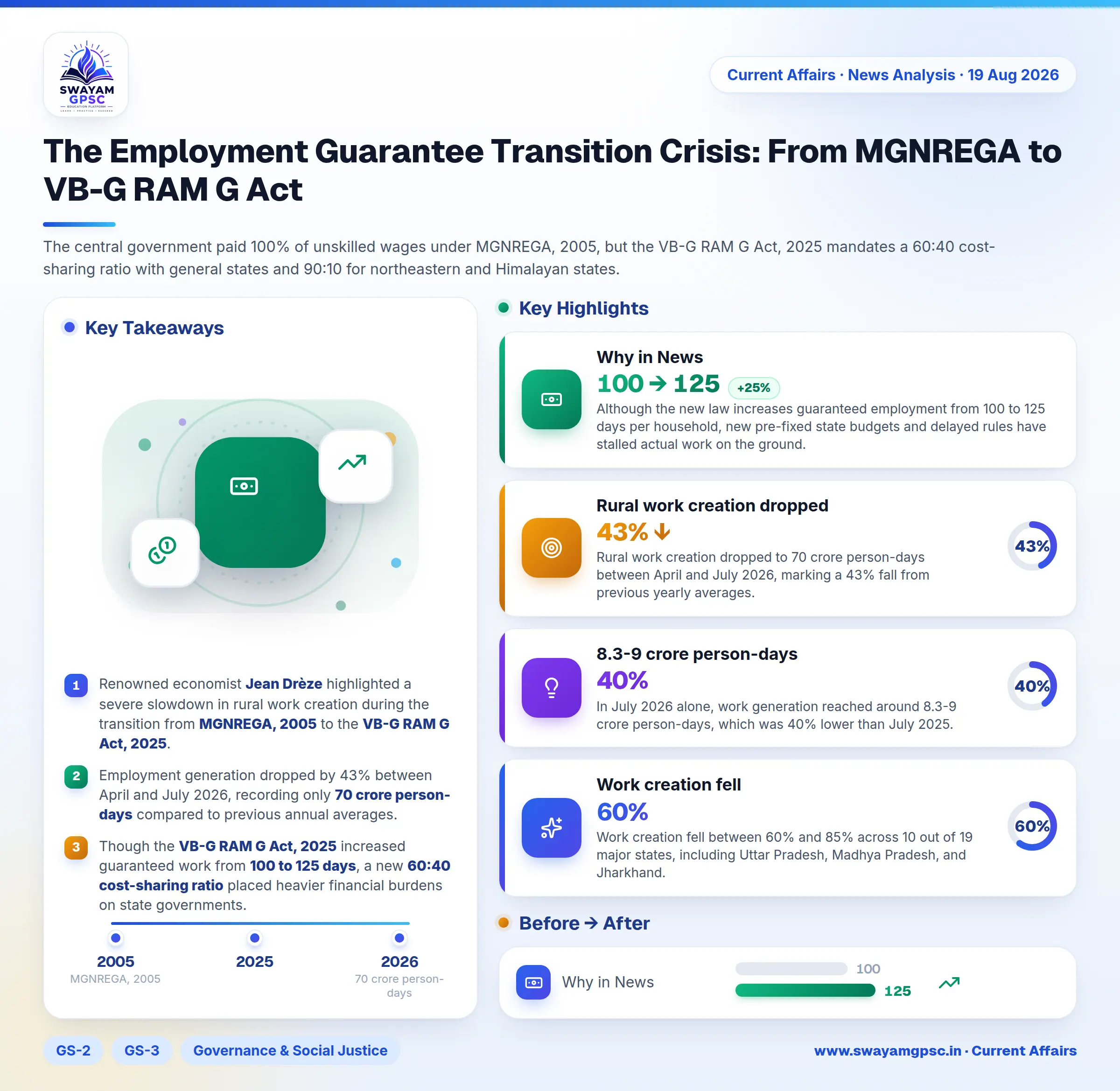
The Employment Guarantee Transition Crisis: From MGNREGA to VB-G RAM G Act
#GS-2 #GS-3 #Governance & Social Justice #Economy #Employment #Poverty #Good Governance #Infrastructure #National
Key takeaways
- Renowned economist Jean Drèze highlighted a severe slowdown in rural work creation during the transition from MGNREGA, 2005 to the VB-G RAM G Act, 2025.
- Employment generation dropped by 43% between April and July 2026, recording only 70 crore person-days compared to previous annual averages.
- Though the VB-G RAM G Act, 2025 increased guaranteed work from 100 to 125 days, a new 60:40 cost-sharing ratio placed heavier financial burdens on state governments.
- Delays in releasing draft rules, pre-fixed spending caps, and biometric verification failures further halted work creation during the critical pre-monsoon season.
- Smooth financial flow between Centre and states along with offline work authentication are essential to restore guaranteed employment for rural families.
Why in News
- The phrase describes the administrative delays and bureaucratic paralysis during the shift from MGNREGA, 2005 to the new VB-G RAM G Act, 2025.
- Although the new law increases guaranteed employment from 100 to 125 days per household, new pre-fixed state budgets and delayed rules have stalled actual work on the ground.
Key Data & Statistics
- Rural work creation dropped to 70 crore person-days between April and July 2026, marking a 43% fall from previous yearly averages.
- In July 2026 alone, work generation reached around 8.3-9 crore person-days, which was 40% lower than July 2025.
- Work creation fell between 60% and 85% across 10 out of 19 major states, including Uttar Pradesh, Madhya Pradesh, and Jharkhand.
- The Union Budget 2026-27 allocated ₹95,692 crore for the program, but operational hurdles stopped actual fund deployment on the ground.
Key Features: MGNREGA vs. VB-G RAM G Act
- Under MGNREGA, 2005, every rural household had a legal guarantee of 100 days of unskilled manual labor, whereas the VB-G RAM G Act, 2025 expands this right to 125 days.
- The central government paid 100% of unskilled wages under MGNREGA, 2005, but the VB-G RAM G Act, 2025 mandates a 60:40 cost-sharing ratio with general states and 90:10 for northeastern and Himalayan states.
- MGNREGA, 2005 provided open-ended funding based on worker demand, while the new law sets strict Normative Allocations that cap total spending per state.
- Local planning evolved from Gram Sabha approved proposals under the old scheme to integrated Viksit Gram Panchayat Plans within a national infrastructure framework under the new act.
- While MGNREGA, 2005 offered continuous employment throughout the year, the VB-G RAM G Act, 2025 allows states to pause work for up to 60 days during peak farming seasons.
Challenges
- The central government passed the law in December 2025 but only finalized operational rules at the end of June 2026, creating a policy void for three full months.
- Requiring states to cover 40% of wage costs discouraged state governments with tight budgets from approving new infrastructure projects.
- Compulsory biometric checks and facial recognition technology failed in poor internet areas, turning away willing manual workers.
- Fixed annual expenditure limits encouraged district officers to restrict new work projects to avoid exceeding assigned financial limits.
- The transition took place during the pre-monsoon summer period, which normally accounts for nearly 50% of yearly rural employment demand.
Way Forward
- State governments should create a revolving fund to ensure timely wage payments without waiting for central clearance.
- Field officers must allow offline register backups and non-biometric alternatives to stop technical issues from denying work.
- Authorities should treat pre-set budget limits as flexible benchmarks rather than strict caps during times of high rural distress.
- The administration must provide training and digital infrastructure to village secretaries to design local development plans smoothly.
- State agencies should conduct regular social audits and pay mandatory unemployment compensation if labor is not provided within 15 days of application.
Conclusion
- The VB-G RAM G Act, 2025 aimed to strengthen rural security by adding guaranteed workdays, but implementation hurdles damaged local livelihood support. Resolving funding disputes, simplifying digital technology, and protecting the legal right to work are crucial steps to restore worker confidence.