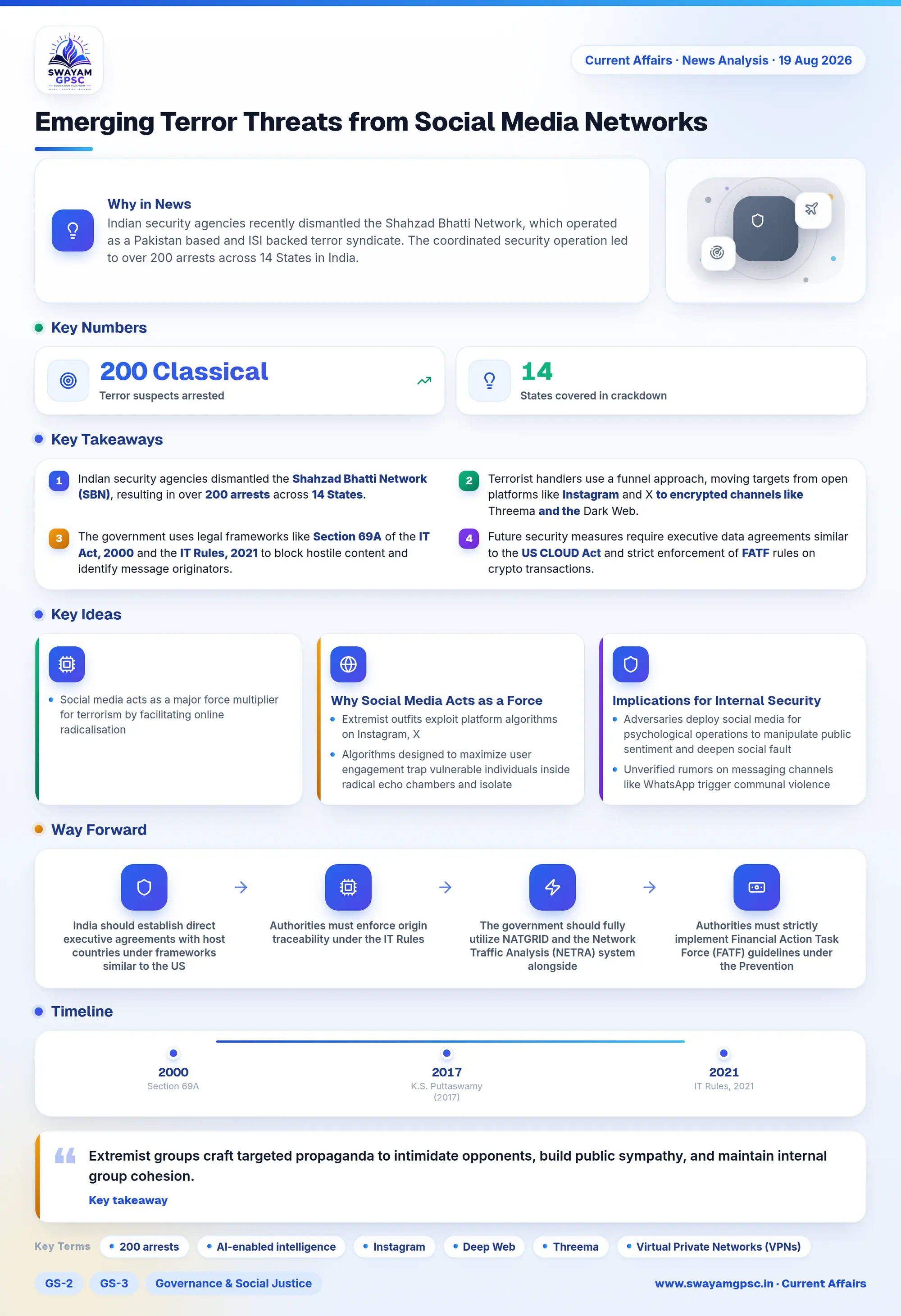
Emerging Terror Threats from Social Media Networks
#GS-2 #GS-3 #Governance & Social Justice #Cyber Security #Terrorism in Hinterland & Border Areas #Linkages of Organized Crime with Terrorism #Challenges to Internal Security Through Communication Networks #National
Key takeaways
- Indian security agencies dismantled the Shahzad Bhatti Network (SBN), resulting in over 200 arrests across 14 States.
- Terrorist handlers use a funnel approach, moving targets from open platforms like Instagram and X to encrypted channels like Threema and the Dark Web.
- The government uses legal frameworks like Section 69A of the IT Act, 2000 and the IT Rules, 2021 to block hostile content and identify message originators.
- Future security measures require executive data agreements similar to the US CLOUD Act and strict enforcement of FATF rules on crypto transactions.
Why in News
- Indian security agencies recently dismantled the Shahzad Bhatti Network, which operated as a Pakistan based and ISI backed terror syndicate.
- The coordinated security operation led to over 200 arrests across 14 States in India.
- This operation highlighted how terror groups increasingly use social media platforms for extremist propaganda, radicalisation, and recruitment.
Summary
- Social media acts as a major force multiplier for terrorism by facilitating online radicalisation, encrypted communication, lone wolf mobilization, and digital terror funding.
- India needs a technology driven and rights based strategy that combines AI-enabled intelligence, cyber forensics, cross border data sharing, and platform accountability while protecting privacy.
Why Social Media Acts as a Force Multiplier for Threats
- Extremist outfits exploit platform algorithms on Instagram, X, and YouTube Shorts to target youth in sensitive regions like Jammu & Kashmir and Punjab. summit
- Algorithms designed to maximize user engagement trap vulnerable individuals inside radical echo chambers and isolate them from moderate viewpoints.
- Terrorist handlers follow a funnel strategy by engaging users on open social platforms before moving selected candidates to encrypted channels or the Deep Web.
- Suspects use dead-drop emails by storing draft messages inside a shared single anonymous account, leaving no active network transmission data for tracking.
- Extremist groups adopt metadata-less encrypted platforms like Threema that do not store phone numbers or user logs, making traditional wiretapping ineffective.
- Handlers utilize Virtual Private Networks (VPNs) and the Dark Web to hide IP addresses while coordinating logistics and operations.
- Unrestricted access to digital tactical guides and instructions for Improvised Explosive Devices (IEDs) enables self-radicalized lone wolf attackers to operate without a command structure.
- Terror outfits run fake online crowdfunding campaigns disguised as charities or use privacy tokens like Monero and Bitcoin to evade Anti-Money Laundering (AML) systems.
Implications for Internal Security
- Extremist groups craft targeted propaganda to intimidate opponents, build public sympathy, and maintain internal group cohesion.
- Adversaries deploy social media for psychological operations to manipulate public sentiment and deepen social fault lines across the nation.
- Unverified rumors on messaging channels like WhatsApp trigger communal violence, forcing authorities to enforce temporary internet shutdowns.
- Synthetic media including AI-generated deepfakes and automated bot campaigns threaten democratic stability by manipulating electoral narratives.
- Engagement-driven algorithms give disproportionate reach to extreme views, driving vulnerable users toward deeper ideological polarization.
- Features like digital anonymity, low distribution costs, foreign server hosting, and micro-payment networks complicate tracking efforts for security agencies.
Challenges for Law Enforcement
- Foreign server locations force Indian authorities to rely on slow Mutual Legal Assistance Treaties (MLATs) to collect digital evidence.
- High volumes of daily online traffic make complete monitoring impossible, while extremists easily migrate to decentralized fringe platforms.
- Automated content moderation systems frequently fail to understand regional languages, local dialects, coded words, and cultural contexts.
- Law enforcement must protect national security without violating freedom of speech or the right to privacy under the K.S. Puttaswamy (2017) judgment.
- Local state police officers serve as first responders but often lack specialized Open Source Intelligence (OSINT) training and advanced cyber-forensic tools.
India's Counter Initiatives
- Section 69A of the Information Technology (IT) Act, 2000 empowers the government to block online content that threatens national security and public order.
- The IT Rules, 2021 place due diligence duties on social media intermediaries, including requirements to identify the first originator of unlawful messages.
- The Indian Cyber Crime Coordination Centre (I4C) and CERT-In direct national efforts against cybercrime, incident response, and cyber-enabled terrorism.
- Information platforms such as the Multi-Agency Centre (MAC), NATGRID, and CCTNS facilitate real-time intelligence sharing between central agencies and state police forces.
- The Unlawful Activities (Prevention) Act (UAPA), 1967 serves as the primary legal framework to prosecute online radicalisation, terror recruitment, and digital funding.
Way Forward
- India should establish direct executive agreements with host countries under frameworks similar to the US CLOUD Act to expedite cross-border data requests.
- Authorities must enforce origin traceability under the IT Rules, 2021 and explore client-side scanning technologies without breaking standard end-to-end encryption.
- The government should fully utilize NATGRID and the Network Traffic Analysis (NETRA) system alongside Artificial Intelligence (AI) tools to detect emerging threats.
- Authorities must strictly implement Financial Action Task Force (FATF) guidelines under the Prevention of Money Laundering Act (PMLA) to monitor cryptocurrency flows.
- Every state police headquarters should establish dedicated Open Source Intelligence (OSINT) units to monitor regional digital space effectively.
- Public-private partnerships involving I4C, CERT-In, and tech companies should conduct regular red-teaming exercises to patch algorithmic vulnerabilities.
- Security agencies should adopt structured digital de-radicalisation models like the Maharashtra ATS framework to counsel vulnerable youth instead of immediate criminalization.
- Tech platforms must undergo independent audits of their recommendation engines and use digital hash databases to prevent removed terror content from reappearing.
- Authorities should expand digital and media literacy programs across educational institutes to help young citizens identify online extremist recruitment attempts.