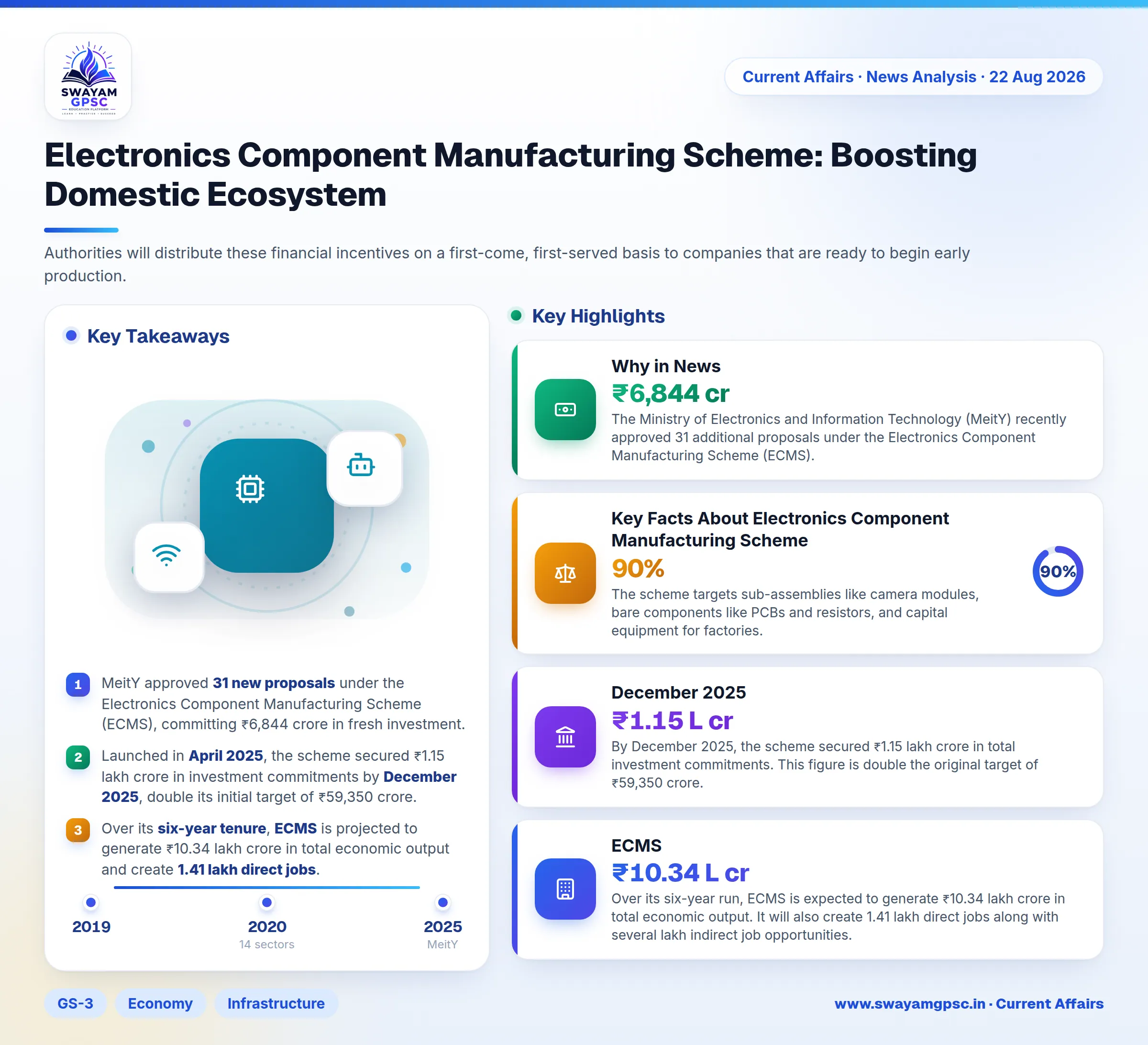
Electronics Component Manufacturing Scheme: Boosting Domestic Ecosystem
#GS-3 #Economy #Infrastructure #Science & Technology #ICT #GS-2 #Current Events #National #Electronics Component Manufacturing Scheme #Government Policies & Interventions
Key takeaways
- MeitY approved 31 new proposals under the Electronics Component Manufacturing Scheme (ECMS), committing ₹6,844 crore in fresh investment.
- Launched in April 2025, the scheme secured ₹1.15 lakh crore in investment commitments by December 2025, double its initial target of ₹59,350 crore.
- Over its six-year tenure, ECMS is projected to generate ₹10.34 lakh crore in total economic output and create 1.41 lakh direct jobs.
- The latest project approvals span 10 States, with Tamil Nadu leading with 7 approvals, expecting to generate ₹82,243 crore in output and 10,000 jobs.
Why in News
- The Ministry of Electronics and Information Technology (MeitY) recently approved 31 additional proposals under the Electronics Component Manufacturing Scheme (ECMS). These new proposals bring a fresh investment of ₹6,844 crore.
- The approved projects will manufacture key items like electrolyte additives, hermetic terminals for defence assemblies, metalised films for capacitors, and coils. India is producing all these specific components domestically for the first time.
Key Facts About Electronics Component Manufacturing Scheme
- MeitY launched the Electronics Component Manufacturing Scheme (ECMS) in April 2025. It aims to create a self-sustaining component ecosystem by connecting India's domestic electronic sector with Global Value Chains (GVCs).
- The scheme offers turnover-linked, capex-linked, or hybrid fiscal incentives. A key part of these incentives is directly tied to creating new employment opportunities.
- Authorities will distribute these financial incentives on a first-come, first-served basis to companies that are ready to begin early production.
- ECMS runs for a total tenure of six years. The turnover-linked incentive includes a one-year gestation period, while the capital expenditure incentive remains available for five years.
- The scheme targets sub-assemblies like camera modules, bare components like PCBs and resistors, and capital equipment for factories. These items together make up nearly 90% of the Bill of Materials (BoM) for mobile phones.
- By December 2025, the scheme secured ₹1.15 lakh crore in total investment commitments. This figure is double the original target of ₹59,350 crore.
- Over its six-year run, ECMS is expected to generate ₹10.34 lakh crore in total economic output. It will also create 1.41 lakh direct jobs along with several lakh indirect job opportunities.
- Electronics could soon become India's second-largest export item. This comes after domestic production grew six-fold over the past decade.
- ECMS works alongside India Semiconductor Mission (ISM) 2.0 as a horizontal enabler. Together, they build a complete ecosystem that covers raw materials, manufacturing equipment, and advanced packaging.
Significance of the Scheme
- India has achieved complete self-reliance in items like enclosures, relays, anode material, and optical transceivers. Domestic factories also meet 80% of demand for laminates, 75% for connectors, 60% for lithium-ion cells, and 55% for transducers.
- The newly approved projects are spread across 10 States, including Himachal Pradesh, Gujarat, Maharashtra, and Telangana. Tamil Nadu leads the list with 7 project approvals.
- The latest tranche of approved projects will generate around ₹82,243 crore in total production. It will also create direct employment for nearly 10,000 people.
Supporting Policy Framework
- The Production-Linked Incentive (PLI) Scheme covers 14 sectors. It has driven nearly 70% of the USD 4 billion foreign direct investment received in electronics since 2020. The government also permits 100% Foreign Direct Investment in electronics manufacturing under standard laws.
- The Modified Electronics Manufacturing Clusters (EMC 2.0) Scheme focuses on building world-class infrastructure for electronic units across the country.
- The Scheme for Promotion of Manufacturing of Electronic Components and Semiconductors (SPECS) provides a 25% financial incentive on capital expenditure for high-value components.
- The National Policy on Electronics (NPE) 2019 acts as the main overarching policy. It aims to establish India as a global manufacturing hub for Electronics System Design and Manufacturing (ESDM).
- The Union Budget 2026-27 introduced key tax benefits to boost production. These include Basic Customs Duty (BCD) exemptions on microwave oven components and Social Welfare Surcharge exemptions on electronic toy parts.