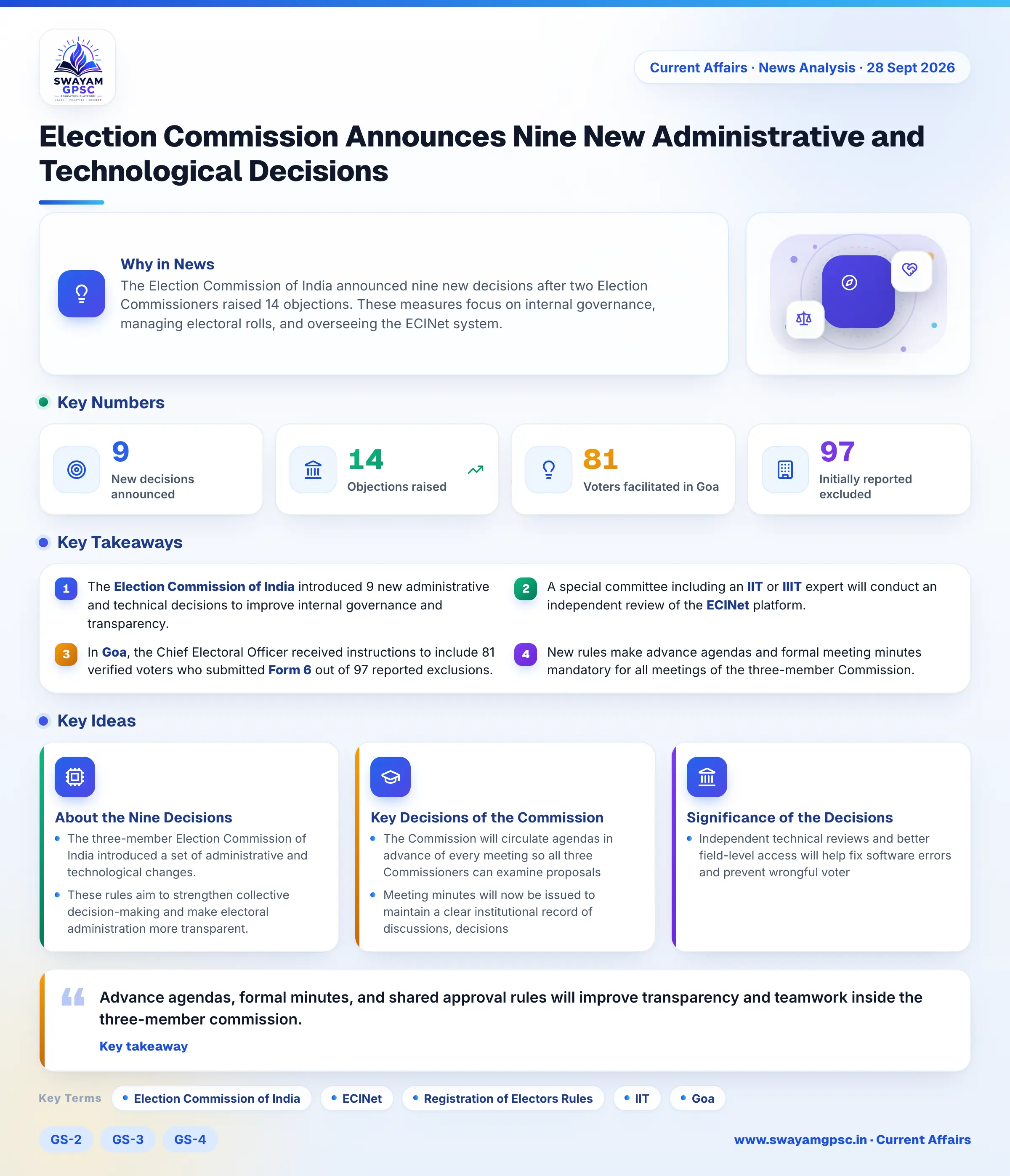
Election Commission Announces Nine New Administrative and Technological Decisions
#GS-2 #GS-3 #GS-4 #Indian Polity & Constitution #Constitutional Bodies #Governance & Social Justice #Good Governance #E-Governance #Science & Technology #ICT #Ethics #Integrity #Transparency #Accountability #Current Events #National
Key takeaways
- The Election Commission of India introduced 9 new administrative and technical decisions to improve internal governance and transparency.
- A special committee including an IIT or IIIT expert will conduct an independent review of the ECINet platform.
- In Goa, the Chief Electoral Officer received instructions to include 81 verified voters who submitted Form 6 out of 97 reported exclusions.
- New rules make advance agendas and formal meeting minutes mandatory for all meetings of the three-member Commission.
Why in News
- The Election Commission of India announced nine new decisions after two Election Commissioners raised 14 objections.
- These measures focus on internal governance, managing electoral rolls, and overseeing the ECINet system.
About the Nine Decisions
- The three-member Election Commission of India introduced a set of administrative and technological changes.
- These rules aim to strengthen collective decision-making and make electoral administration more transparent.
- They also address concerns about centralized control over the software used for managing electoral rolls.
Key Decisions of the Commission
- The Commission will circulate agendas in advance of every meeting so all three Commissioners can examine proposals beforehand.
- Meeting minutes will now be issued to maintain a clear institutional record of discussions, decisions, and accountability.
- Official foreign trips by Election Commission of India officers will now require direct approval from the Commission.
- A committee of officers will examine all new digital portals and IT modules before sending them to the Commission.
- An independent review of ECINet will be conducted by a committee led by a senior Deputy Election Commissioner and an expert from an IIT or IIIT.
- Field officers will get extra system access and operational flexibility to manage voter lists more smoothly.
- Officers must strictly follow directions given by the Election Commissioners to improve administrative accountability.
- The Election Commission of India directed the Chief Electoral Officer of Goa to help include 81 verified voters who submitted Form 6 out of 97 excluded individuals.
- The Commission clarified that the form specified under the Registration of Electors Rules will apply outside the Special Intensive Revision period.
Significance of the Decisions
- Advance agendas, formal minutes, and shared approval rules will improve transparency and teamwork inside the three-member commission.
- Independent technical reviews and better field-level access will help fix software errors and prevent wrongful voter exclusions.