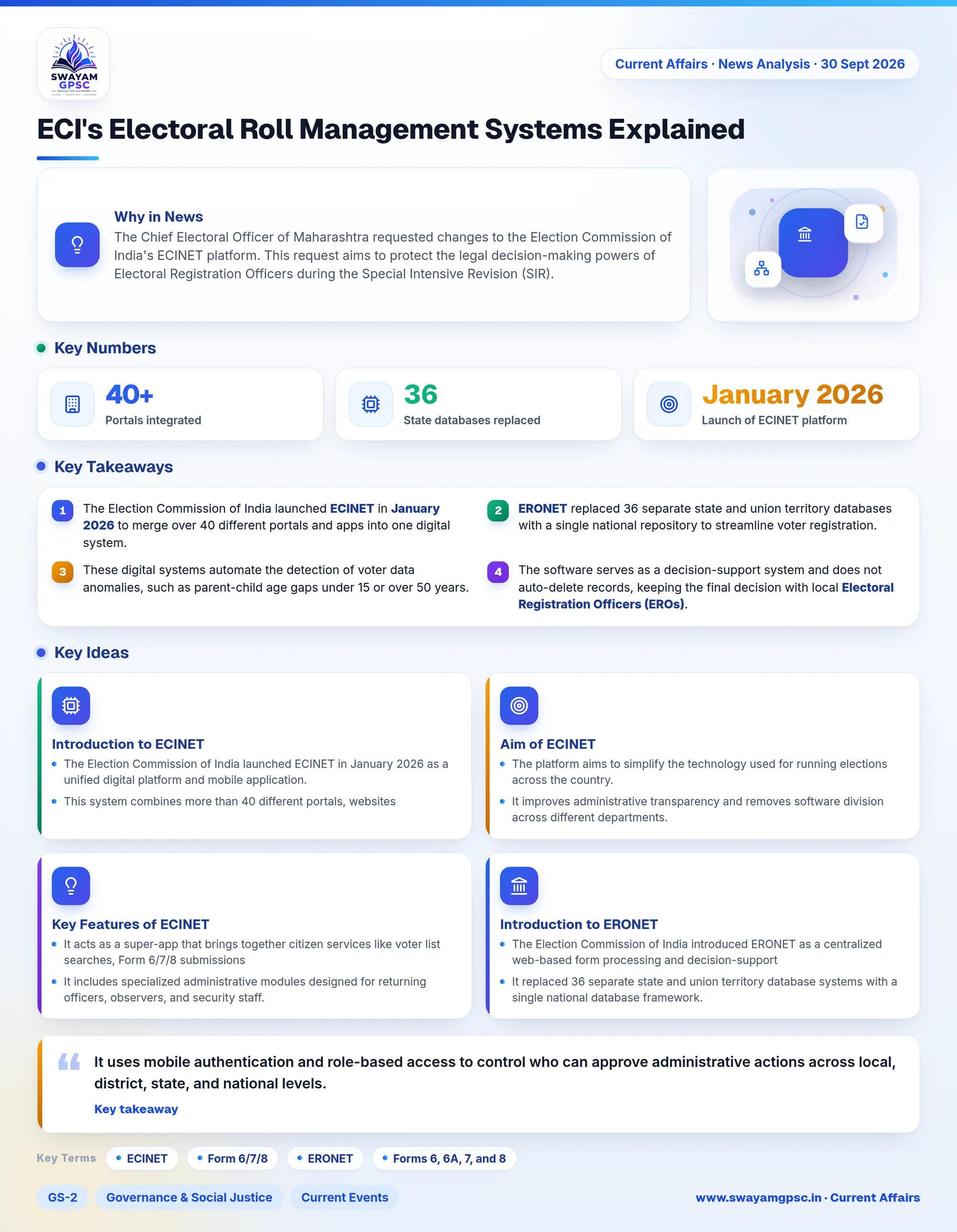
ECI's Electoral Roll Management Systems Explained
#GS-2 #Governance & Social Justice #Current Events #National #Electoral Reforms #Technology in Governance
Key takeaways
- The Election Commission of India launched ECINET in January 2026 to merge over 40 different portals and apps into one digital system.
- ERONET replaced 36 separate state and union territory databases with a single national repository to streamline voter registration.
- These digital systems automate the detection of voter data anomalies, such as parent-child age gaps under 15 or over 50 years.
- The software serves as a decision-support system and does not auto-delete records, keeping the final decision with local Electoral Registration Officers (EROs).
Why in News
- The Chief Electoral Officer of Maharashtra requested changes to the Election Commission of India's ECINET platform.
- This request aims to protect the legal decision-making powers of Electoral Registration Officers during the Special Intensive Revision (SIR).
- The move comes after concerns were raised about centralized software controls taking away local administrative discretion.
Introduction to ECINET
- The Election Commission of India launched ECINET in January 2026 as a unified digital platform and mobile application.
- This system combines more than 40 different portals, websites, and mobile applications into one single digital structure.
- It serves voters, candidates, political parties, and election administrators under one umbrella.
Aim of ECINET
- The platform aims to simplify the technology used for running elections across the country.
- It improves administrative transparency and removes software division across different departments.
- It also gives citizens easy, single-window access to voter lists, candidate profiles, and polling booth details.
Key Features of ECINET
- It acts as a super-app that brings together citizen services like voter list searches, Form 6/7/8 submissions, and e-EPIC downloads.
- It includes specialized administrative modules designed for returning officers, observers, and security staff.
- The platform incorporates the backend functions of ERONET to manage voter registrations and list revisions.
- It uses automated algorithms to detect age gaps under 15 or over 50 years between parents and children, incorrect names, or missing documents.
- It uses mobile authentication and role-based access to control who can approve administrative actions across local, district, state, and national levels.
Introduction to ERONET
- The Election Commission of India introduced ERONET as a centralized web-based form processing and decision-support system.
- It replaced 36 separate state and union territory database systems with a single national database framework.
Aim of ERONET
- The system standardizes how statutory voter forms like Forms 6, 6A, 7, and 8 are processed.
- It automates voter movement between different states and districts to stop duplicate registrations.
- It assists Electoral Registration Officers in keeping voter lists accurate and updated.
Key Features of ERONET
- It serves as a decision-support tool and does not delete voter records automatically.
- It flags duplicate entries and similar demographic details so field staff can conduct physical inquiries.
- It automatically sends transfer requests when a voter relocates to a new constituency.
- The system alerts the previous officer to delete the old record only after confirming the new registration.
- It builds a digital, trackable pipeline that connects Booth Level Officers, Assistant EROs, and EROs during voter list revisions.
- It runs phonetic and demographic matching algorithms across the national database to find identical names, addresses, or photos.