Ease of Doing Business: Strengthening India’s Business Framework
#GS-3 #Economy #Infrastructure #Governance & Social Justice #Good Governance #Current Events #National
Key takeaways
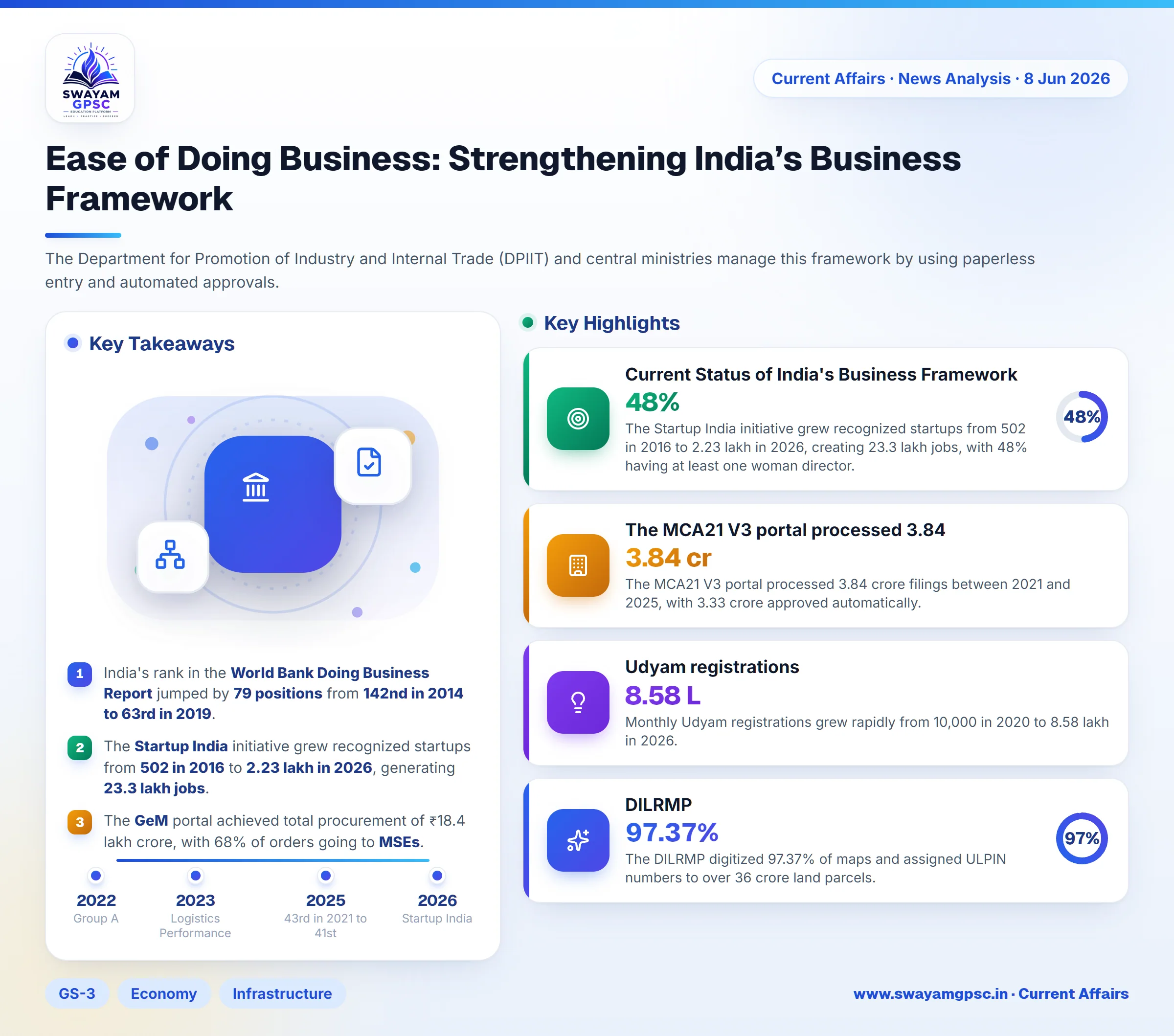
- India's rank in the World Bank Doing Business Report jumped by 79 positions from 142nd in 2014 to 63rd in 2019.
- The Startup India initiative grew recognized startups from 502 in 2016 to 2.23 lakh in 2026, generating 23.3 lakh jobs.
- The GeM portal achieved total procurement of ₹18.4 lakh crore, with 68% of orders going to MSEs.
- UPI transaction volume surged from 2 crore in FY17 to 24,162 crore in FY26, processing ₹314 lakh crore.
Context and Background
- The Ministry of Commerce and Industry released a detailed backgrounder about the regulatory reforms that transformed India's business landscape.
- These changes rely on digital governance, trust-based administration, and fewer rules to boost investor confidence and global competitiveness.
What the Ease of Doing Business Framework Means
- India changed its old system of heavy bureaucratic rules into a digital and supportive regulatory environment.
- The Department for Promotion of Industry and Internal Trade (DPIIT) and central ministries manage this framework by using paperless entry and automated approvals.
Key Performance Rankings and Metrics
- The World Bank Doing Business Report showed India jumping by 79 positions from 142nd in 2014 to 63rd in 2019.
- The IMD World Competitiveness Ranking noted India moving up from 43rd in 2021 to 41st in 2025.
- The World Bank placed India in its top Group A category in the GovTech Maturity Index for 2020, 2022, and 2025.
- The UN E-Government Survey gave India a very high score for online services and digital infrastructure.
Current Status of India's Business Framework
- The Startup India initiative grew recognized startups from 502 in 2016 to 2.23 lakh in 2026, creating 23.3 lakh jobs, with 48% having at least one woman director.
- The SPICe+ Form combined 10 company registration steps into one online application across multiple states.
- The MCA21 V3 portal processed 3.84 crore filings between 2021 and 2025, with 3.33 crore approved automatically.
- Monthly Udyam registrations grew rapidly from 10,000 in 2020 to 8.58 lakh in 2026.
- The DILRMP digitized 97.37% of maps and assigned ULPIN numbers to over 36 crore land parcels.
- The NSWS system integrates approvals from 32 central departments and 34 states, granting over 8.29 lakh clearances.
- The PARIVESH 2.0 portal reduced environmental clearance time to 64 days.
- The GeM portal achieved total procurement of ₹18.4 lakh crore, with ₹5 lakh crore coming in FY26 alone, where MSEs took 68% of orders.
- The PM GatiShakti initiative connects planning across 58 ministries using 3,199 GIS layers to review 352 projects worth ₹16.1 lakh crore.
- India improved its rank in the Logistics Performance Index from 54th in 2014 to 38th in 2023 while tracking 95 million containers.
- The CGTMSE provided ₹9.34 lakh crore in guarantees, and PMMY disbursed ₹40.07 lakh crore through 57 crore loans since 2015.
- UPI transaction volume surged from 2 crore in FY17 to 24,162 crore in FY26, processing ₹314 lakh crore.
- GST taxpayers increased from 60 lakh to 1.64 crore, while 188.27 crore E-Way Bills were generated in FY26.
Success of the Reforms
- Transparent digital checks replaced corrupt physical inspections to remove the old inspector raj.
- The 2025 Labour Codes introduced web-based random inspections and turned field inspectors into helpful guides.
- Changes to the Uniform Consent Guidelines made industrial operating permits valid until cancelled, removing the need for regular renewals.
- Formal credit systems brought marginalized groups into the main economy, with women taking 59.81% of Mudra loan accounts.
- The Open Network for Digital Commerce (ONDC) onboarded over 7.64 lakh sellers across 616+ cities to break large digital monopolies.
Challenges
- Digital portals work well at the center, but local implementation remains uneven across districts.
- The National Generic Document Registration System (NGDRS) works in only 17 States and UTs, leaving half the country using older models.
- Local tribunals still face delays in processing bankruptcy petitions, which slows down capital recovery.
- Discrepancies between old paper records and high-resolution maps cause trouble during land verification.
- Small artisans and rural businesses struggle to use advanced online bidding dashboards without outside help.
Way Forward
- The government should enforce the Insolvency and Bankruptcy Code (Amendment) Act, 2026 to make local benches accept or reject petitions within a 14-day window.
- Authorities must expand the District Business Reform Action Plan (D-BRAP) to ensure single-window systems work properly at the grassroot level.
- Implementing the 2026-27 Union Budget proposal to mandate the TReDS system for public enterprises will clear delayed invoices quickly.
- The Jan Vishwas Act 2026 should be used to change minor rule breaks from criminal jail terms into simple money fines.
- The Export Promotion Mission and its sub-schemes must give small exporters easy access to overseas warehouses and trade finance.
Conclusion
- India's shift toward an easy business environment shows the strength of combining smart policies with digital public infrastructure.
- By modernizing entry rules and expanding open commerce, the nation has built a strong foundation for sustainable entrepreneurship.