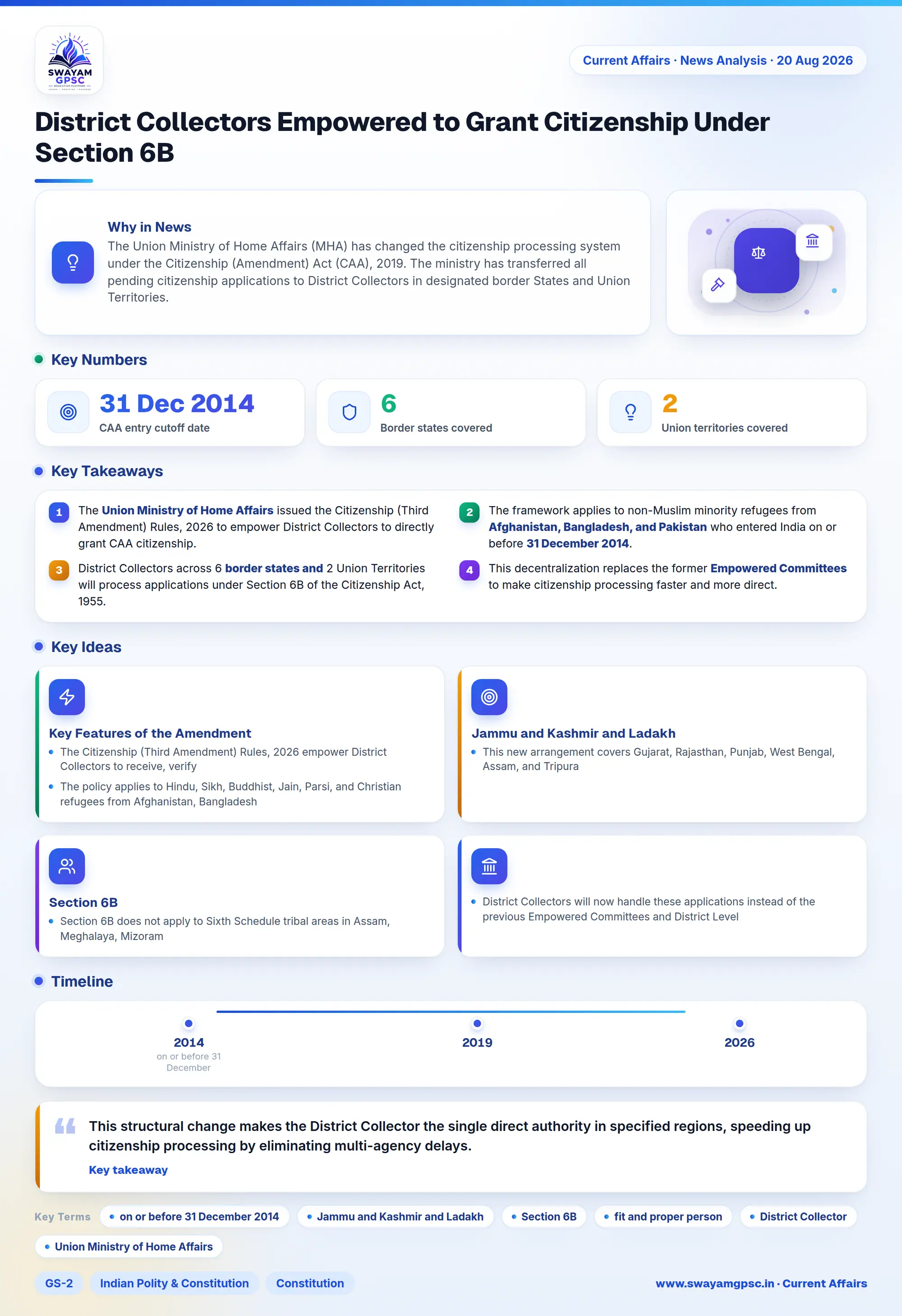
District Collectors Empowered to Grant Citizenship Under Section 6B
#GS-2 #Indian Polity & Constitution #Constitution #Executive #Current Events #National #Gujarat #Citizenship Amendment Act
Key takeaways
- The Union Ministry of Home Affairs issued the Citizenship (Third Amendment) Rules, 2026 to empower District Collectors to directly grant CAA citizenship.
- The framework applies to non-Muslim minority refugees from Afghanistan, Bangladesh, and Pakistan who entered India on or before 31 December 2014.
- District Collectors across 6 border states and 2 Union Territories will process applications under Section 6B of the Citizenship Act, 1955.
- This decentralization replaces the former Empowered Committees to make citizenship processing faster and more direct.
Why in News
- The Union Ministry of Home Affairs (MHA) has changed the citizenship processing system under the Citizenship (Amendment) Act (CAA), 2019.
- The ministry has transferred all pending citizenship applications to District Collectors in designated border States and Union Territories.
Key Features of the Amendment
- The Citizenship (Third Amendment) Rules, 2026 empower District Collectors to receive, verify, and decide on citizenship applications under Section 6B of the Citizenship Act, 1955.
- The policy applies to Hindu, Sikh, Buddhist, Jain, Parsi, and Christian refugees from Afghanistan, Bangladesh, and Pakistan who entered India on or before 31 December 2014.
- This new arrangement covers Gujarat, Rajasthan, Punjab, West Bengal, Assam, and Tripura, along with the Union Territories of Jammu and Kashmir and Ladakh.
- Section 6B does not apply to Sixth Schedule tribal areas in Assam, Meghalaya, Mizoram, and Tripura or Inner Line Permit zones, so these tribal regions remain excluded.
- District Collectors will now handle these applications instead of the previous Empowered Committees and District Level Committees led by Designated Officers.
- District Collectors can receive citizenship forms online, check all legal documents, conduct background inquiries, and evaluate candidate eligibility under Section 6B.
- The District Collector can administer the Oath of Allegiance and grant citizenship through registration or naturalization if the applicant is a fit and proper person.
- Officials can reject a citizenship request if the applicant fails to appear in person, sign the document, or take the Oath of Allegiance despite multiple opportunities.
- This structural change makes the District Collector the single direct authority in specified regions, speeding up citizenship processing by eliminating multi-agency delays.