Digital Transformation of Indian Judiciary
#GS-2 #Indian Polity & Constitution #Judiciary #Governance & Social Justice #E-Governance #Current Events #National
Key takeaways
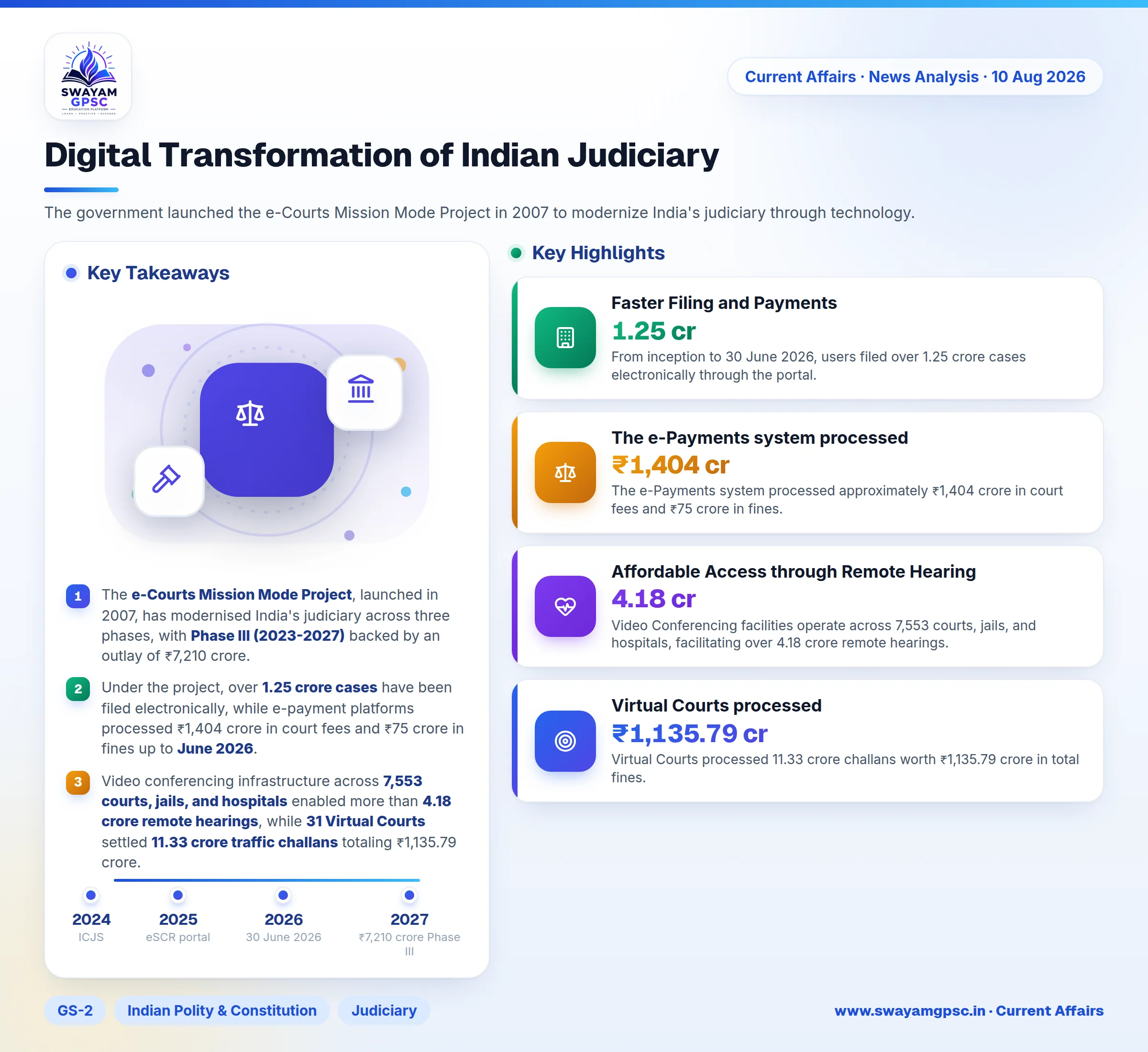
- The e-Courts Mission Mode Project, launched in 2007, has modernised India's judiciary across three phases, with Phase III (2023-2027) backed by an outlay of ₹7,210 crore.
- Under the project, over 1.25 crore cases have been filed electronically, while e-payment platforms processed ₹1,404 crore in court fees and ₹75 crore in fines up to June 2026.
- Video conferencing infrastructure across 7,553 courts, jails, and hospitals enabled more than 4.18 crore remote hearings, while 31 Virtual Courts settled 11.33 crore traffic challans totaling ₹1,135.79 crore.
- Citizen outreach expanded through 2,584 e-Sewa Kendras nationwide and digital platforms like the e-Courts Services Portal, which handles 35 lakh hits daily.
- Advanced technological adoption under Phase III includes AI tools for legal research, multilingual judgment translation into 18 Indian languages, and GPS-tracked summons delivery via NSTEP across 6,895 courts.
Why in News
- The Government of India highlighted the progress of the e-Courts Mission Mode Project to showcase the modernization of the judicial system.
- The project transformed India's paper-based judiciary into a digitally enabled, transparent, and trackable justice delivery network.
- This digital transition relies on tools like e-filing, virtual courts, digitized records, e-Sewa Kendras, video conferencing, AI tools, and integrated criminal justice platforms.
Overview of e-Courts Mission Mode Project
- The government launched the e-Courts Mission Mode Project in 2007 to modernize India's judiciary through technology.
- The project aimed to reduce reliance on physical paper records and traditional court infrastructure to make judicial processes faster and more efficient.
- It lowers the time, travel demands, and financial burden on citizens by simplifying access to court services and case information.
- The main objective of the mission is to accelerate court proceedings through digitisation while keeping processes affordable, accessible, and transparent.
Phase I - Basic Computerisation (2011-2015)
- The first phase built the core technology foundation by computerising more than 14,000 courts across the country.
- It established basic network infrastructure to enable digital judicial services in local courts.
Phase II - Citizen-Centric Digital Services (2015-2023)
- The second phase introduced key platforms like the National Judicial Data Grid (NJDG), eFiling, and eSewa Kendras.
- It expanded video-conferencing infrastructure more than fivefold to improve virtual courtroom access.
Phase III - Digital and Intelligent Courts (2023-2027)
- The mission is currently executing Phase III (2023-2027), which focuses on building an intelligent, paperless judicial system.
- Rapid digitisation and e-filing are expanding, with 4,519 courts implementing e-filing and 474 courts operating without paper.
- Virtual justice access strengthened through 538 courts enabled for virtual hearings, 1,806 eSewa Kendras, and Video Conferencing in 7,553 courts, jails, and hospitals.
- System-wide integration includes NSTEP in 6,895 courts, ICJS implementation in all High Courts, 734 court websites on S3WAAS, and SD-WAN connectivity across 174 sites.
- Phase III incorporates AI, OCR, analytics, training, a Learning Management System (LMS) developed by IIT Madras, and solar facilities at 1,626 court complexes.
Greater Transparency through NJDG
- Launched under Phase II, the National Judicial Data Grid (NJDG) serves as a public online dashboard offering real-time data on orders, judgments, case details, and pendency.
- Making pending case data public boosts transparency and accountability while helping High Court judges, District Judges, and Registries plan and monitor administrative tasks remotely.
- NJDG features three distinct dashboards for the Supreme Court, High Courts, and District Courts to provide complete visibility on judicial functioning.
- It tracks pending and disposed cases across High Courts and subordinate courts across the nation.
- It categorizes case distribution by stage, including admission, hearing, judgment, and final disposal.
- The dashboard identifies reasons and durations for delays, such as missing parties, pending documents, court stays, or procedural roadblocks.
Faster Filing and Payments
- The e-Filing system allows citizens and lawyers to submit court documents online from any location, eliminating physical visits.
- It offers services in English and regional languages across District Courts, High Courts, and the Supreme Court.
- The platform delivers end-to-end services, including online fee payments, Vakalatnama submission, e-signing, oath video recording, case management, and pleading templates.
- From inception to 30 June 2026, users filed over 1.25 crore cases electronically through the portal.
- The e-Payments system processed approximately ₹1,404 crore in court fees and ₹75 crore in fines.
Affordable Access through Remote Hearing
- Video Conferencing allows litigants, lawyers, witnesses, and experts to join court hearings remotely, saving travel time and expenses across state boundaries.
- Video Conferencing facilities operate across 7,553 courts, jails, and hospitals, facilitating over 4.18 crore remote hearings.
- Court access broadened with livestreaming in 11 High Courts and 31 Virtual Courts handling online traffic challans.
- Virtual Courts processed 11.33 crore challans worth ₹1,135.79 crore in total fines.
- Launched in 2024 under ICJS, Nyaya Shruti lets accused persons, witnesses, police officers, prosecutors, and prisoners testify virtually to speed up trials.
Seamless Tracking of Judicial Business through Digital Platforms
- Lawyers, litigants, and judges can monitor case statuses, cause lists, and judicial updates via the multilingual e-Courts Services Portal, mobile apps, SMS, and email.
- Users receive over 4 lakh SMSs and 6 lakh emails daily, while the e-Courts Services Portal registers around 35 lakh hits per day.
- The e-Courts Services App reached approximately 3.84 crore downloads, giving users mobile access to case tracking and court updates.
- Judges use the JustIS App, which recorded 22,594 downloads, to organize, monitor, and manage daily judicial workloads digitally.
- The National Service and Tracking of Electronic Processes (NSTEP) enables bailiffs to serve summons electronically using a GPS-enabled web and mobile platform.
Citizen Assistance through e-Sewa Kendras
- Located inside court complexes, e-Sewa Kendras help litigants check case statuses, hearing dates, certified copies, and judge leave schedules.
- These centres assist citizens with e-filing, e-signatures, e-stamp purchases, online payments, and Aadhaar-based digital signatures.
- They guide citizens in downloading the e-Courts mobile app, joining virtual hearings, fetching digital orders, and settling traffic challans.
- Staff guide eligible litigants toward free legal aid services and arrange eMulakat appointments for virtual prison visits.
- As of 30 June 2026, 49 e-Sewa Kendras functioned in High Courts and 2,535 across District Courts.
AI-Assisted Judicial Processes
- Out of the ₹7,210 crore Phase III outlay, the government allocated ₹53.57 crore for AI and Machine Learning tools in High Courts through 2027.
- AI and ML tools transcribe oral arguments in Constitution Bench cases, publishing the output directly on the Supreme Court website.
- The LegRAA (Legal Research and Analysis Assistant) tool supports judges with legal research and complex document analysis.
- The Digital Courts 2.1 platform provides judicial officers with a single-window paperless system for managing courtroom tasks.
- Voice conversion tool ASR-SHRUTI converts spoken words into text, while PANINI helps translate and dictate court orders.
- The eSCR portal translates judgments into 18 Indian languages, completing over 83,000 translations including 36,344 in Hindi by March 2025.
- An AI defect-scrutiny tool developed with IIT Madras automatically flags errors in e-filed petitions and extracts metadata, with prototypes provided to 200 Advocates-on-Record.
Conclusion
- The e-Courts Mission Mode Project converted India's traditional judiciary into a modern, transparent, and technology-driven system.
- As Phase III progresses through 2027, it will make justice delivery faster, cheaper, and universally accessible across India.