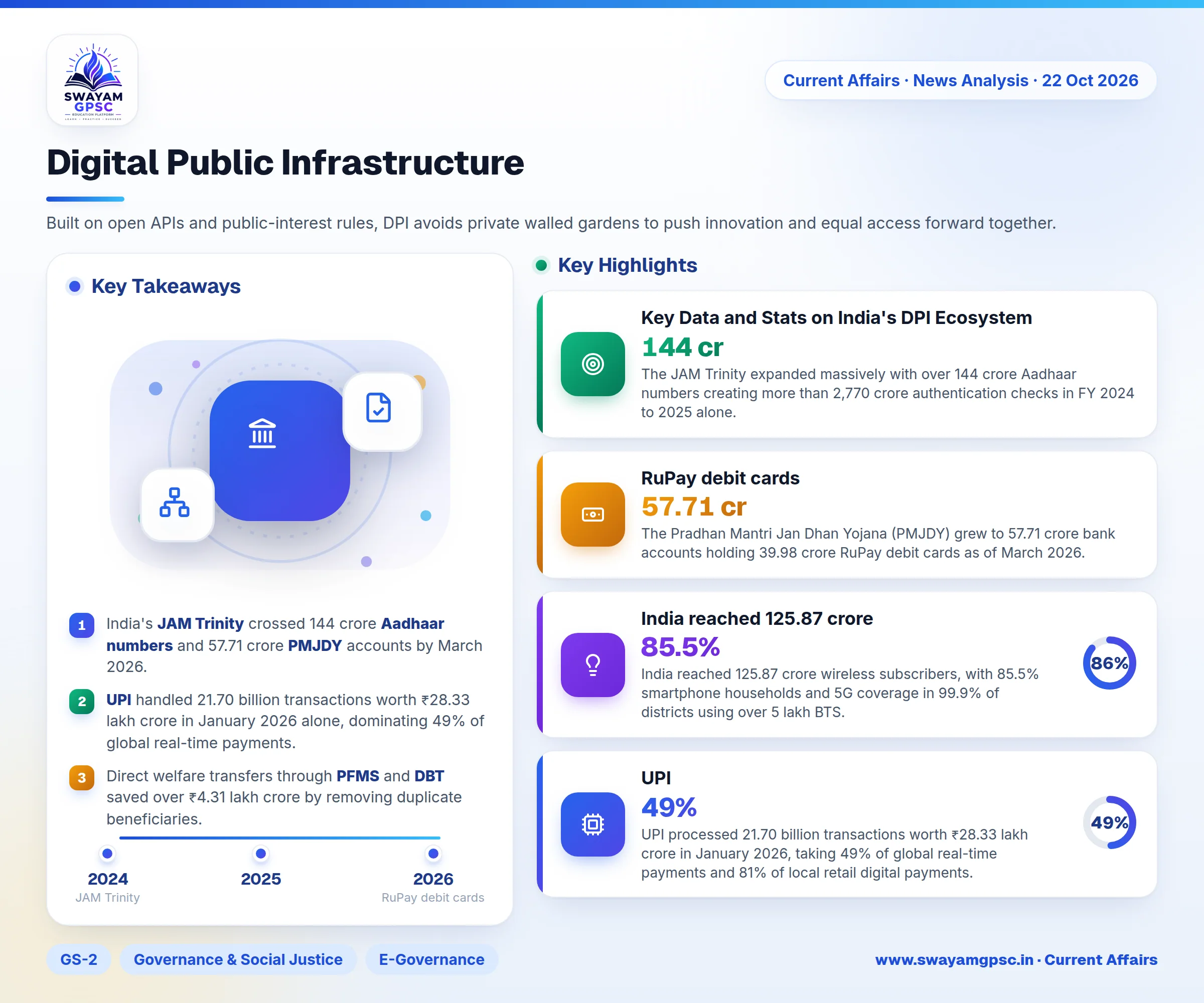
Digital Public Infrastructure
#GS-2 #Governance & Social Justice #E-Governance #Economy #Infrastructure #Current Events #National
Key takeaways
- India's JAM Trinity crossed 144 crore Aadhaar numbers and 57.71 crore PMJDY accounts by March 2026.
- UPI handled 21.70 billion transactions worth ₹28.33 lakh crore in January 2026 alone, dominating 49% of global real-time payments.
- Direct welfare transfers through PFMS and DBT saved over ₹4.31 lakh crore by removing duplicate beneficiaries.
- The Government e-Marketplace (GeM) processed 3.27 crore orders worth ₹16.41 lakh crore, strongly supporting micro and small enterprises.
Why in News
- India's Digital Public Infrastructure (DPI) stands out globally for running population-scale governance smoothly.
- It proves that open and flexible digital systems can boost financial inclusion and service delivery at a very low cost.
About Digital Public Infrastructure
- DPI works like a physical railway or power grid, serving as the core base for secure digital connections among citizens, businesses, and governments.
- Built on open APIs and public-interest rules, DPI avoids private walled gardens to push innovation and equal access forward together.
Key Data and Stats on India's DPI Ecosystem
- The JAM Trinity expanded massively with over 144 crore Aadhaar numbers creating more than 2,770 crore authentication checks in FY 2024 to 2025 alone.
- The Pradhan Mantri Jan Dhan Yojana (PMJDY) grew to 57.71 crore bank accounts holding 39.98 crore RuPay debit cards as of March 2026.
- India reached 125.87 crore wireless subscribers, with 85.5% smartphone households and 5G coverage in 99.9% of districts using over 5 lakh BTS.
- UPI processed 21.70 billion transactions worth ₹28.33 lakh crore in January 2026, taking 49% of global real-time payments and 81% of local retail digital payments.
- The PFMS and DBT systems enabled total transfers of ₹49.09 lakh crore, cutting duplicate accounts and saving over ₹4.31 lakh crore in public funds.
- The Government e-Marketplace (GeM) recorded 3.27 crore orders worth ₹16.41 lakh crore, where MSEs contributed 44.8% worth ₹7.35 lakh crore.
Key Pillars of the India Stack in Action
- The identity layer uses Aadhaar and DigiLocker to offer portable biometric identity and cloud storage, reducing delay and simplifying KYC rules.
- The payments layer features UPI and AePS to build an open multi-bank system that removes high card-network transaction fees.
- The data exchange layer uses the Account Aggregator framework to share encrypted financial data safely and unlock collateral-free credit.
- The Open Network for Digital Commerce (ONDC) connects independent buyers and over 1.16 lakh retail sellers across 630+ cities.
- The Government e-Marketplace connects over 1.67 lakh government buyer bodies with 24 lakh vendor profiles.
Challenges Associated with India's DPI
- Uneven digital literacy across rural and elderly groups creates barriers, forcing people to rely on intermediaries like CSC operators for mobile banking.
- Fast-growing real-time payment rails face rising threats from social engineering, identity theft, and fake QR code scams.
- Physical biometric wear and tear can cause authentication failures for manual laborers and senior citizens at Fair Price Shops.
- Consumer payment volumes remain heavily concentrated, with a private foreign-backed duopoly holding over 80% of daily retail UPI market share.
Way Forward
- India can share modular open-source systems with developing nations through the Global Digital Public Infrastructure Repository (GDPIR) set up during its G20 Presidency.
- Strengthening domestic scheduled banks and public apps like BHIM will help reduce reliance on a few private front-end apps.
- Enforcing the Digital Personal Data Protection (DPDP) Act rules will protect citizen privacy across all data networks.
- Expanding near-field communication and offline payment rails like UPI Lite X ensures smooth transactions in low-bandwidth areas.
- Integrating ONDC with rural artisanal clusters will help nano-enterprises access formal working capital through the Account Aggregator network.