Delimitation in India: Challenges, Federal Impact, and Reforms
#GS-2 #Indian Polity & Constitution #Constitution #Elections #Parliament #Constitutional Bodies #Statutory Bodies #Federalism
Key takeaways
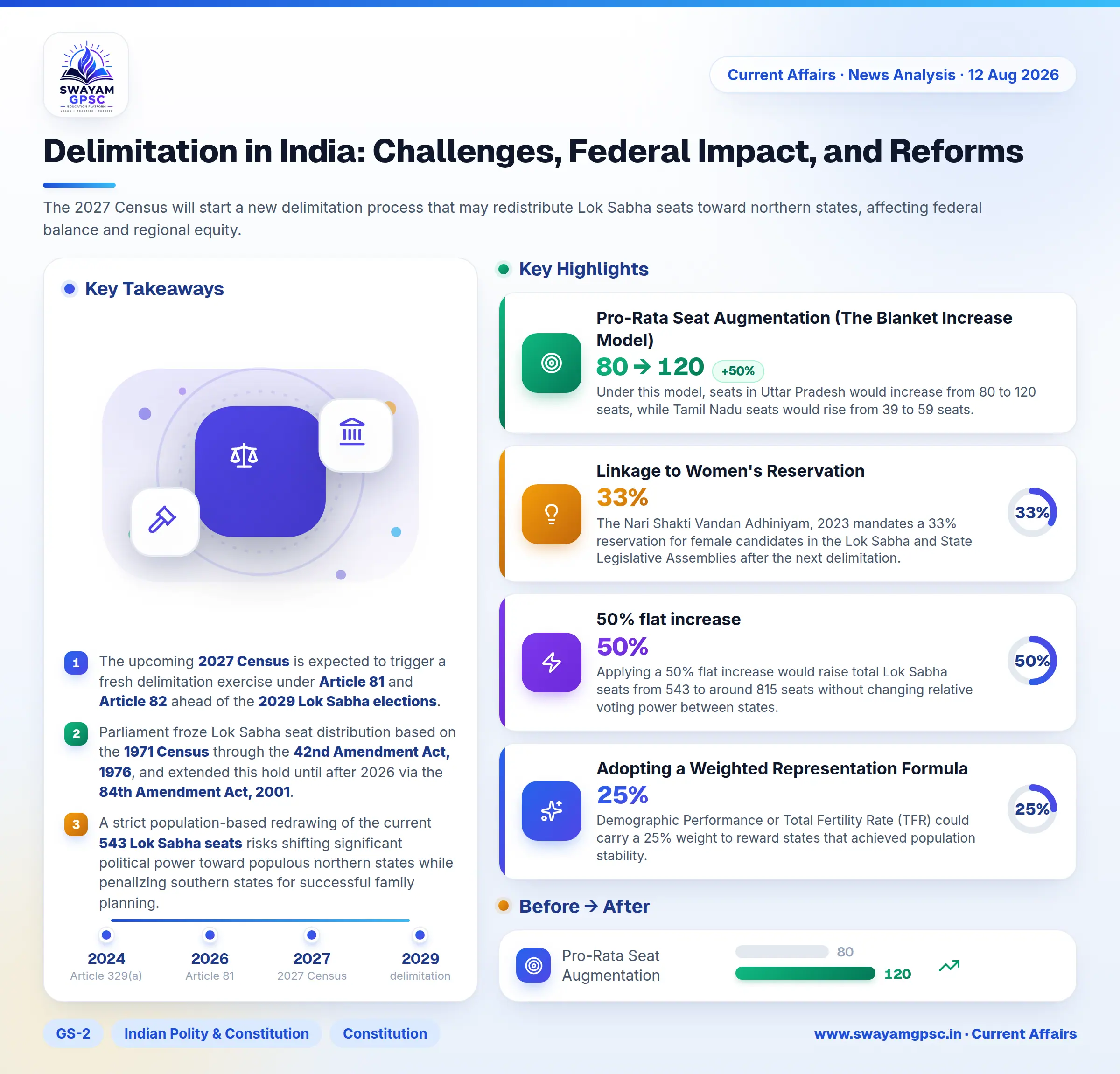
- The upcoming 2027 Census is expected to trigger a fresh delimitation exercise under Article 81 and Article 82 ahead of the 2029 Lok Sabha elections.
- Parliament froze Lok Sabha seat distribution based on the 1971 Census through the 42nd Amendment Act, 1976, and extended this hold until after 2026 via the 84th Amendment Act, 2001.
- A strict population-based redrawing of the current 543 Lok Sabha seats risks shifting significant political power toward populous northern states while penalizing southern states for successful family planning.
- The defeated 131st Constitutional Amendment Bill, 2026 proposed expanding the constitutional upper limit of the Lok Sabha from 550 seats to 850 seats.
- Implementation of the Nari Shakti Vandan Adhiniyam, 2023, which guarantees a 33% reservation for women in legislative bodies, remains legally tied to this next delimitation.
Why in News
- The redrawing of Lok Sabha constituencies through delimitation has resurfaced as a central political issue as the Union government prepares for the 2029 Lok Sabha elections.
- Conducting the upcoming 2027 Census will trigger fresh redrawing of electoral maps under Article 81 and Article 82 of the Indian Constitution.
- This process could shift legislative seats toward populous northern states, creating serious political concerns among southern states that successfully stabilized their population growth.
Summary of Delimitation Dynamics
- The 2027 Census will start a new delimitation process that may redistribute Lok Sabha seats toward northern states, affecting federal balance and regional equity.
- A fair delimitation process must balance the constitutional mandate of One Person, One Vote, One Value with the long-term federal interests of states that controlled population growth.
Federal vs Demographic Dilemma (The North-South Divide)
- The primary goal of delimitation is to uphold the core democratic principle of One Person, One Vote, One Value.
- Using present population numbers strictly will unfairly penalize southern states like Kerala, Tamil Nadu, Karnataka, and Andhra Pradesh for successfully executing family planning programs.
- Conversely, states in the northern region with higher historical population growth rates like Uttar Pradesh, Bihar, Madhya Pradesh, and Rajasthan stand to gain additional Lok Sabha seats.
- This seat redistribution could move national political control toward northern states while reducing the influence of southern states in financial allocations and constitutional decisions.
Linkage to Women's Reservation
- The Nari Shakti Vandan Adhiniyam, 2023 mandates a 33% reservation for female candidates in the Lok Sabha and State Legislative Assemblies after the next delimitation.
- While political consensus exists regarding women's reservation, population-based seat redistribution faces sharp political resistance from several states.
- Linking women's seat reservation directly to seat redrawing risks delaying political representation for women if states fail to reach an agreement on delimitation.
Delays and Ambiguity in Census Data
- Under Article 81 and Article 82, delimitation can only begin after the publication of official figures from the first Census conducted after 2026.
- The regular decadal 2021 Census faced indefinite delays because of the Covid-19 pandemic disruption.
- An earlier attempt by the Union Government under the Delimitation Bill of 2026 and the Constitution (131st Amendment) Bill, 2026 to conduct delimitation using old data from the 2011 Census caused deep political distrust.
- Delimitation is historically a slow process. For instance, the Delimitation Commission formed in 2002 after the 2001 Census completed its work only in 2008 for the 2009 Lok Sabha elections.
- The proposed 2027 Census will run digitally, which could speed up data collection. However, if redrawing is not completed before the 2029 Lok Sabha elections, the process will spill into the next parliamentary term.
Logistics of a Larger Parliament
- The current elected strength of the Lok Sabha is 543 seats, while Article 81 currently caps total seats at 550 seats.
- The defeated 131st Constitutional Amendment Bill, 2026 suggested raising this constitutional upper limit to 850 seats.
- Expanding the total number of legislative seats accommodates population growth but presents huge administrative and logistical challenges for parliamentary business.
- A much larger Lok Sabha reduces the speaking time available to individual Members of Parliament (MPs) to debate legislation and raise public issues.
Gerrymandering and Sub-Nationalism
- Delimitation involves setting inter-state seat shares and drawing exact constituency boundaries inside individual states.
- This local mapping creates a risk of gerrymandering, where political parties alter boundary lines to gain an unfair electoral advantage.
- One common tactic is cracking, where an opposition party's voters are spread thinly across multiple districts so they cannot form a majority anywhere.
- Another tactic is packing, where opposition voters are concentrated into a few districts, wasting their excess votes and helping the ruling party win surrounding seats.
- Perceived unfairness in drawing constituency boundaries can stir regional sub-nationalism and lead to widespread public protests.
What is Delimitation?
- Delimitation is the official redrawing of territorial boundaries for parliamentary and state assembly constituencies to maintain equal voter representation.
- The core objective is to enact One Person, One Vote, One Value while fixing reserved seats for Scheduled Castes (SC) and Scheduled Tribes (ST).
- Under Article 82 and Article 170, Parliament passes a Delimitation Act after every Census to adjust constituency boundaries in the Lok Sabha and State Assemblies.
- Delimitation is executed by an independent Delimitation Commission consisting of a retired or serving Supreme Court Judge, the Chief Election Commissioner, and relevant State Election Commissioners.
- Delimitation orders generally enjoy immunity from court review under Article 329(a), but the Supreme Court ruled in the Kishorchandra Chhanganlal Rathod case (2024) that limited judicial review applies if orders are arbitrary.
- India has established four Delimitation Commissions so far, in 1952, 1963, 1973, and 2002.
- The 42nd Amendment Act, 1976 froze total seat numbers according to the 1971 Census so that states executing population control were not penalized.
- The 84th Amendment Act, 2001 extended this freeze on total seat allocation until the first Census published after 2026, though internal boundaries were updated in 2002 using 2001 Census data.
Pro-Rata Seat Augmentation (The Blanket Increase Model)
- The pro-rata seat augmentation model suggests increasing total seats in the Lok Sabha while preserving the existing seat ratio between states based on the 1971 Census.
- Applying a 50% flat increase would raise total Lok Sabha seats from 543 to around 815 seats without changing relative voting power between states.
- Under this model, seats in Uttar Pradesh would increase from 80 to 120 seats, while Tamil Nadu seats would rise from 39 to 59 seats.
- The Delimitation Commission would then use recent census figures only to redraw internal constituency boundaries within each state to balance rural and urban voter densities.
Adopting a Weighted Representation Formula
- A Weighted Representation Formula could assign weights to demographic performance, economic contribution, and geography alongside raw population figures, similar to Finance Commission models.
- Under this system, Population Size could hold a 50% weight to maintain democratic representation.
- Demographic Performance or Total Fertility Rate (TFR) could carry a 25% weight to reward states that achieved population stability.
- Economic and Developmental Contribution measured by Human Development Index (HDI) and GST collections could carry a 15% weight.
- Geographic Area could receive a 10% weight to protect representation for large states with lower population densities.
- Implementing this model requires amending Article 81, which currently bases Lok Sabha representation strictly on population figures.
Decoupling the Women's Reservation Act
- Parliament could pass a constitutional amendment to uncouple women's reservation from the broader delimitation timeline.
- Implementing the 33% reservation for women on the existing 543 seats ensures immediate political progress without waiting for state consensus on delimitation.
Bicameral Rebalancing: Empowering the Rajya Sabha
- India could grant equal state representation in the Rajya Sabha, following the federal model used by the United States Senate or the Australian Senate.
- Expanding the legislative authority of the Rajya Sabha over financial matters like Money Bills would create a strong federal check against population-based majoritarianism in the Lok Sabha.
Enhancing Institutional Transparency and Consensus
- Redrawing legislative maps requires genuine institutional consensus across political parties to avoid claims of political bias.
- The Delimitation Act could be amended to give non-voting Associate Members from Parliament and State Assemblies binding votes on internal boundary adjustments.
- The Union Government should convene the Inter-State Council under Article 263 to build consensus on delimitation terms before setting up the new Commission.
- The Delimitation Commission should use open-source Geographic Information System (GIS) algorithms to draw unbiased boundaries, combined with mandatory public consultations.
Conclusion
- Representation in a diverse federal country is not merely a mathematical exercise of counting citizens.
- A successful delimitation must balance individual voting equality with the federal rights and economic contributions of individual states.
Frequently Asked Questions
- Delimitation is the periodic redrawing of electoral constituency boundaries under Article 81, Article 82, and Article 170 of the Constitution.
- Parliament froze Lok Sabha seat allocations using the 1971 Census under the 42nd Amendment Act, 1976 and extended it under the 84th Amendment Act, 2001.
- The upcoming 2027 Census will serve as the legal trigger for fresh delimitation under Article 82.
- Gerrymandering refers to manipulating electoral boundaries for political advantage through strategies like cracking and packing voters.
- Proposed delimitation reforms include pro-rata seat augmentation, weighted representation formulas, strengthening the Rajya Sabha, using the Inter-State Council, and adopting GIS mapping technology.