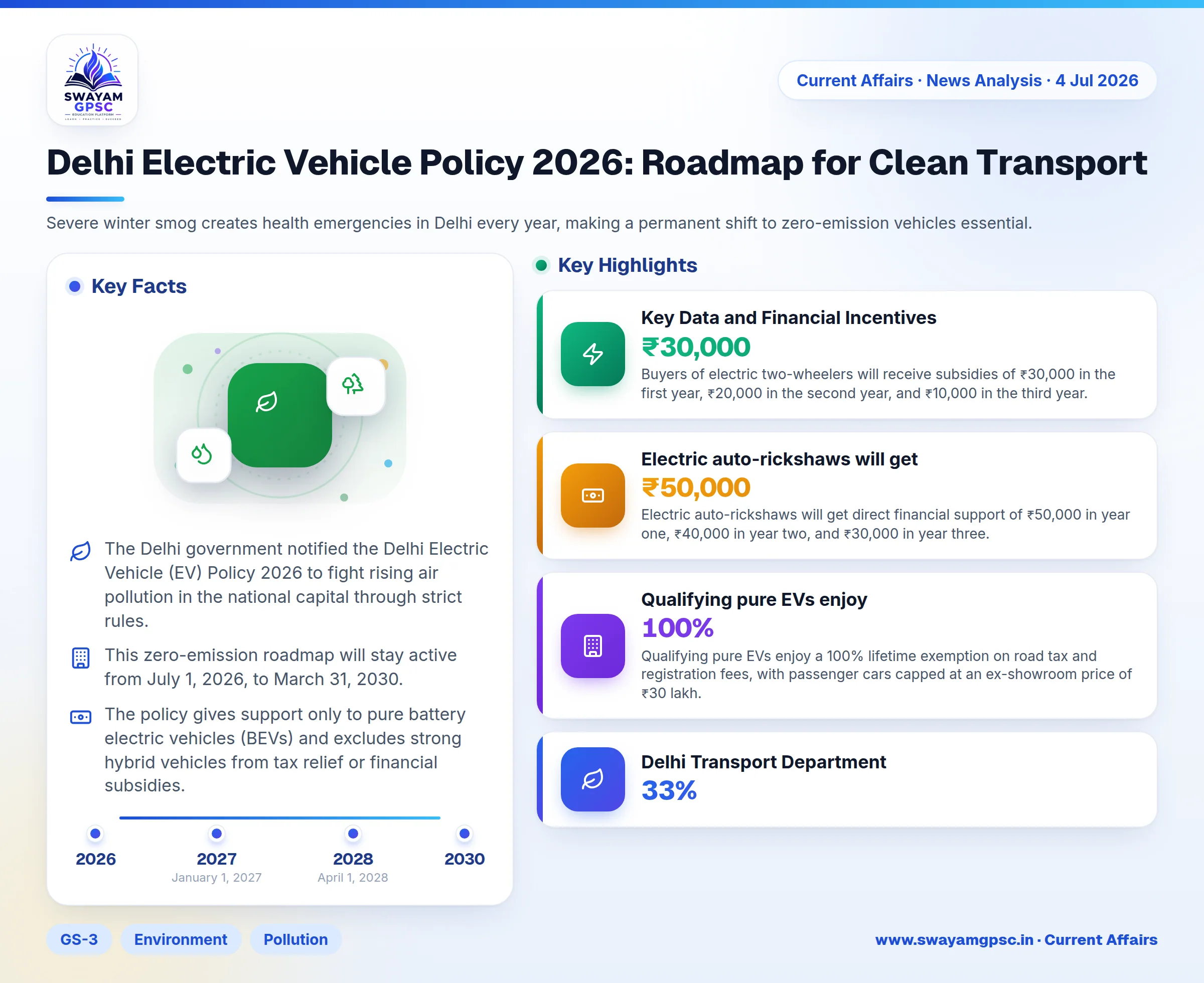
Delhi Electric Vehicle Policy 2026: Roadmap for Clean Transport
#GS-3 #Environment #Pollution #Climate Change #Sustainable Development #Economy #Infrastructure #Current Events #National #Electric Vehicles #Delhi EV Policy 2026
Why in News
- The Delhi government notified the Delhi Electric Vehicle (EV) Policy 2026 to fight rising air pollution in the national capital through strict rules.
- This zero-emission roadmap will stay active from July 1, 2026, to March 31, 2030.
- The policy gives support only to pure battery electric vehicles (BEVs) and excludes strong hybrid vehicles from tax relief or financial subsidies.
Key Data and Financial Incentives
- Buyers of electric two-wheelers will receive subsidies of ₹30,000 in the first year, ₹20,000 in the second year, and ₹10,000 in the third year.
- Electric auto-rickshaws will get direct financial support of ₹50,000 in year one, ₹40,000 in year two, and ₹30,000 in year three.
- Qualifying pure EVs enjoy a 100% lifetime exemption on road tax and registration fees, with passenger cars capped at an ex-showroom price of ₹30 lakh.
- According to Delhi Transport Department records, commercial delivery trucks cause 33% of vehicular pollution, whereas two-wheelers and three-wheelers together contribute 46%.
Need for the EV Roadmap
- Severe winter smog creates health emergencies in Delhi every year, making a permanent shift to zero-emission vehicles essential.
- Two-wheelers form almost two-thirds of all active vehicles on Delhi roads, but electric models make up under 8% of current sales.
- Small commercial trucks and delivery vehicles operate constantly across the city, releasing large amounts of harmful particulate matter into the air.
- Setting obligatory electric vehicle quotas forces private schools, delivery companies, and bus operators to share the cost of cleaning up city transport.
Key Transition Timelines and Initiatives
- Starting from January 1, 2027, Delhi will register only pure electric passenger three-wheelers and N1 category light goods vehicles.
- From April 1, 2028, the city will stop registering petrol or CNG scooters and bikes, allowing only pure electric models.
- Private schools must convert their bus fleets to electric vehicles, hitting 10% within two years, 20% within three years, and 30% by March 31, 2030.
- The government launched evsubsidy.delhi.gov.in, where buyers can apply within 30 days of purchase to get direct bank transfers within 60 days.
Challenges
- Car manufacturers disagree with excluding hybrid cars from subsidies, arguing that hybrid technology helps drivers switch away from fossil fuels gradually.
- High upfront costs for electric autos and delivery vans will strain low-income drivers unless banks provide affordable loans easily.
- Power distribution companies and Delhi Transco Ltd. (DTL) must upgrade local substations quickly to handle electricity spikes from thousands of fast chargers.
- To stop people from taking subsidies and reselling vehicles outside the city, owners cannot sell or re-register subsidized EVs outside Delhi for 3 years.
Way Forward
- The government should speed up installing 32,000 public charging spots near metro stations and market areas using funds from PM e-Drive.
- Authorities must ensure the new portal processes claims efficiently so that Aadhaar linked payouts land in bank accounts within 60 days.
- Electricity distribution companies (DISCOMs) should provide separate home meters offering cheaper power rates for charging electric vehicles at night.
- The first 1,000 electric medium trucks between 3.5 to 12 tonnes should receive a 10-year exemption from daytime traffic entry restrictions.
- Clear guidelines must reassure owners that existing petrol and diesel vehicles registered before the deadlines can run until their registration certificates expire.
Conclusion
- Mandatory registration deadlines give vehicle manufacturers and commercial fleet owners a predictable path toward clean transportation.
- Success will ultimately rely on building the proposed 32,000 charging stations rapidly and transferring subsidies without delays to protect small vehicle operators.