Delhi Electric Vehicle Policy 2.0
#GS-3 #GS-2 #Economy #Infrastructure #Environment #Pollution #Sustainable Development #Governance & Social Justice #Government Policies & Interventions #Current Events #National
Why in News
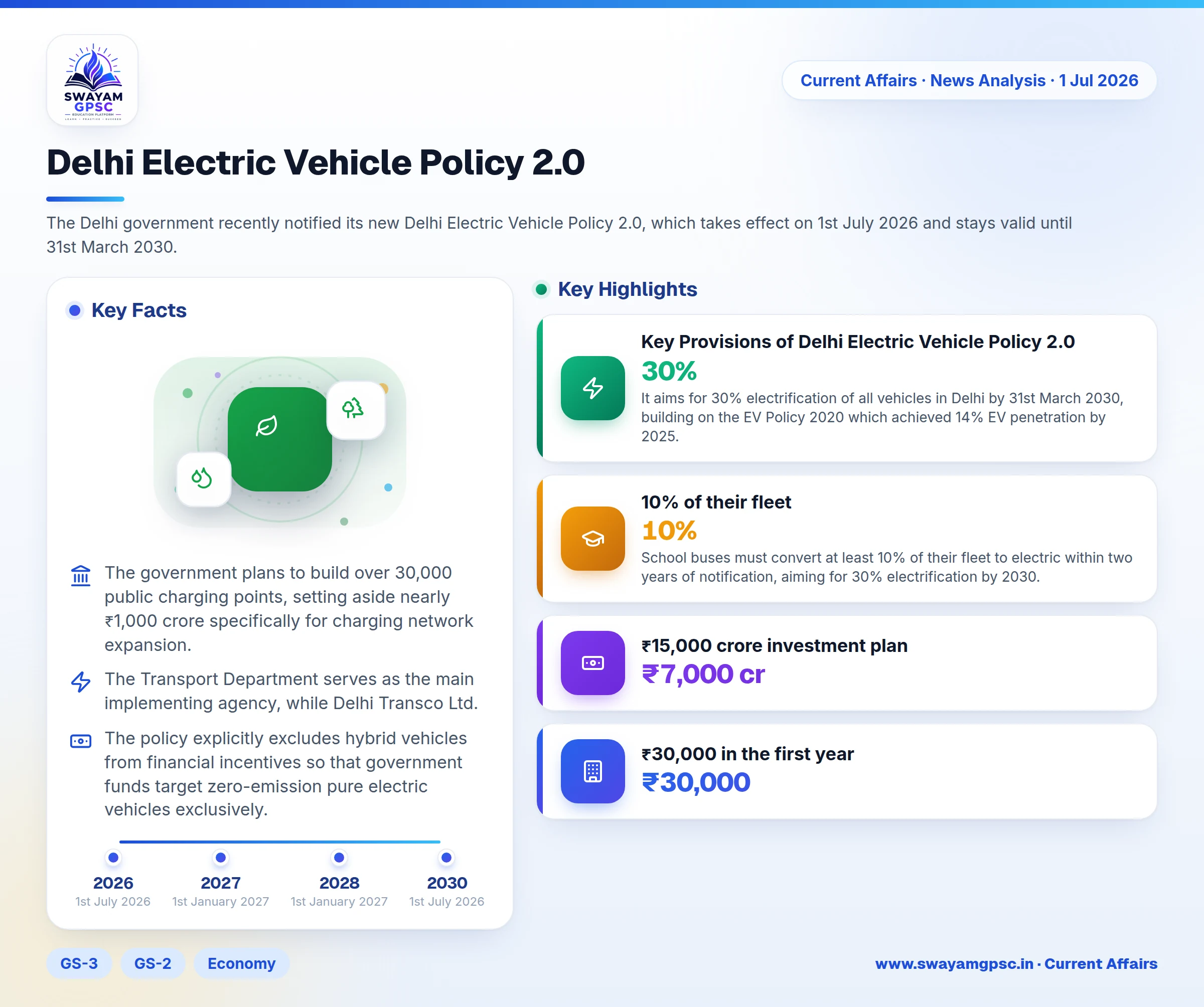
- The Delhi government recently notified its new Delhi Electric Vehicle Policy 2.0, which takes effect on 1st July 2026 and stays valid until 31st March 2030.
Key Provisions of Delhi Electric Vehicle Policy 2.0
- The policy aims to turn Delhi into a major electric vehicle hub by prioritizing heavily polluting and high-use transport like two-wheelers, three-wheelers, trucks, school buses, and government vehicles.
- It aims for 30% electrification of all vehicles in Delhi by 31st March 2030, building on the EV Policy 2020 which achieved 14% EV penetration by 2025.
- Starting 1st January 2027, Delhi will register only electric three-wheelers and N1 category trucks, while electric two-wheelers will become mandatory for registration from 1st April 2028.
- School buses must convert at least 10% of their fleet to electric within two years of notification, aiming for 30% electrification by 2030.
- The government assigned ₹7,000 crore to execute the policy within a broader ₹15,000 crore investment plan that covers chargers, purchase incentives, and scrapping benefits.
- Buyers get purchase subsidies, road tax exemptions, and waived registration fees, with two-wheeler subsidies set at ₹30,000 in the first year, ₹20,000 in the second year, and ₹10,000 in the third year.
- Scrapping incentives will apply to vehicles below BS-IV emission norms, giving ₹10,000 for two-wheelers, ₹25,000 for three-wheelers, ₹1 lakh for four-wheelers, and ₹50,000 for N1 trucks.
- The government plans to build over 30,000 public charging points, setting aside nearly ₹1,000 crore specifically for charging network expansion.
- The Transport Department serves as the main implementing agency, while Delhi Transco Ltd. manages charging network setup alongside power distribution firms.
- Electric N2 trucks carrying between 3.5 and 12 tonnes get a 10-year exemption from peak-hour entry bans, limited to the first 1,000 N2 trucks bought within three months.
- The policy explicitly excludes hybrid vehicles from financial incentives so that government funds target zero-emission pure electric vehicles exclusively.
Challenges
- The high purchase price of electric vehicles creates a financial burden for auto drivers, delivery workers, and small business owners.
- Limited access to affordable loans makes it hard for low-income drivers to buy new electric models.
- Charging networks struggle with frequent power outages, poor maintenance, and insufficient access across urban pockets.
- Heavy electricity demand from large-scale electric vehicle charging can strain local power grids in crowded city areas.
- Proper recycling of battery waste, securing space for charging stations, and retraining traditional mechanics remain key concerns.
Significance
- Transitioning to electric vehicles significantly lowers tailpipe emissions and improves overall air quality across Delhi.
- Targeting heavy-use segments like two-wheelers, rickshaws, and delivery trucks maximizes pollution reduction where it matters most.
- The strategy shifts Delhi from short-term purchase subsidies toward strict long-term registration mandates.
- The policy drives private investments into electric vehicle manufacturing, battery recycling, charging stations, and commercial fleets.
- A successful rollout turns Delhi into a practical model for other Indian cities planning their own clean mobility transitions.