Decentralised Grain Storage Plan in the Cooperative Sector
#GS-2 #GS-3 #Governance & Social Justice #Economy #Agriculture #Food Security #Infrastructure #Cooperatives #Agricultural Marketing #Food Processing #Government Policies & Interventions #National
Key takeaways
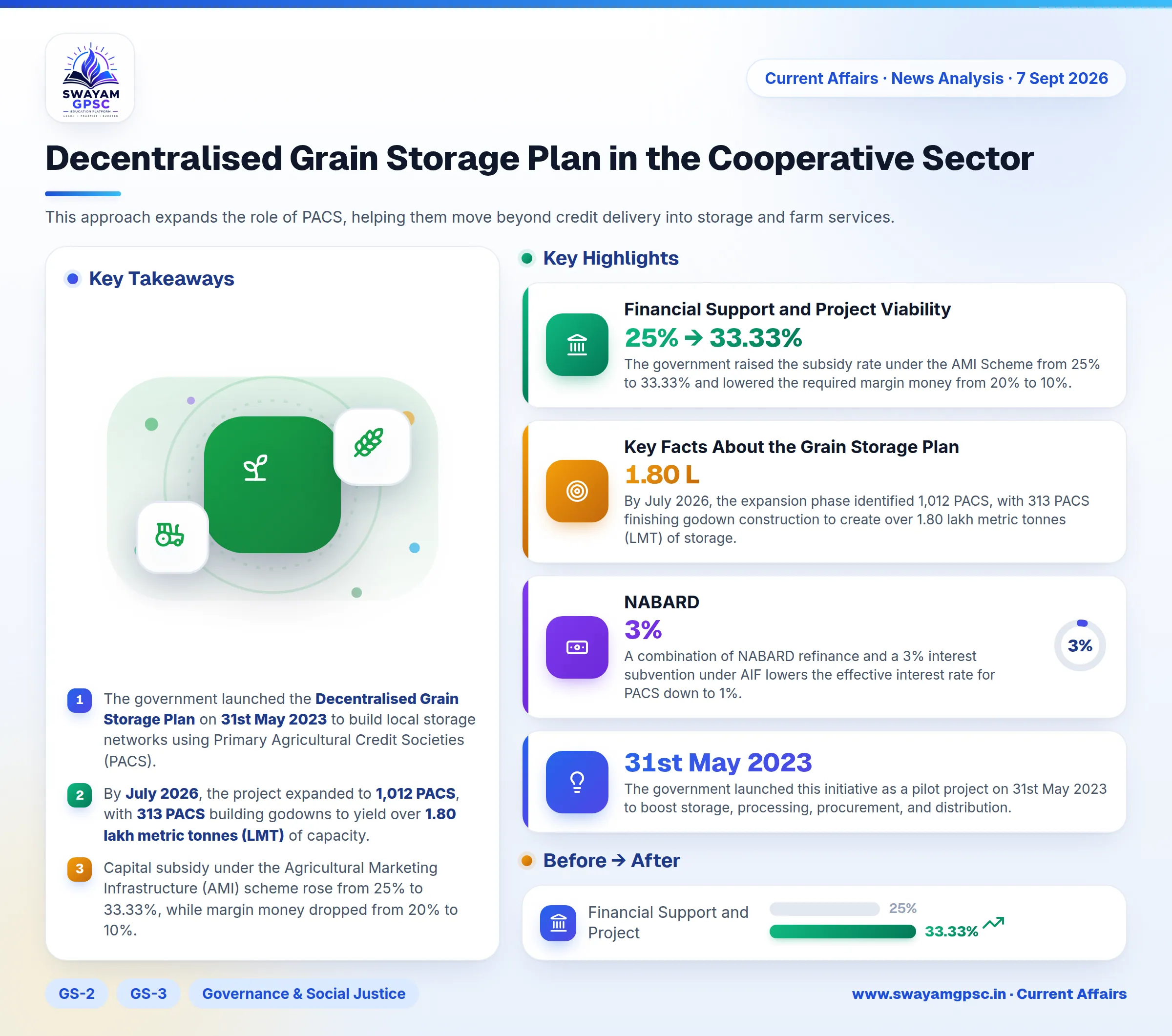
- The government launched the Decentralised Grain Storage Plan on 31st May 2023 to build local storage networks using Primary Agricultural Credit Societies (PACS).
- By July 2026, the project expanded to 1,012 PACS, with 313 PACS building godowns to yield over 1.80 lakh metric tonnes (LMT) of capacity.
- Capital subsidy under the Agricultural Marketing Infrastructure (AMI) scheme rose from 25% to 33.33%, while margin money dropped from 20% to 10%.
- Through NABARD refinance and a 3% interest subvention under the Agriculture Infrastructure Fund (AIF), effective borrowing costs for PACS fall to 1%.
- The Food Corporation of India (FCI) offers guaranteed hiring for eligible cooperative godowns to secure project revenue.
Why in News
- The Decentralised Grain Storage Plan in the Cooperative Sector is gaining strong momentum across India.
- The plan expands village-level storage capacity and strengthens rural agricultural infrastructure through local cooperatives.
Key Facts About the Grain Storage Plan
- The government launched this initiative as a pilot project on 31st May 2023 to boost storage, processing, procurement, and distribution.
- The plan uses an integrated cooperative model that brings together existing central schemes through Primary Agricultural Credit Societies (PACS).
- This approach expands the role of PACS, helping them move beyond credit delivery into storage and farm services.
- Farmers benefit directly by avoiding distress sales, storing crops safely, and earning better market prices.
- Local storage shortens the supply chain by linking procurement centres directly to Fair Price Shops, cutting transport costs and post-harvest losses.
- The initial pilot covered 11 PACS across 11 States, adding 9,750 MT of storage capacity to test model feasibility.
- By July 2026, the expansion phase identified 1,012 PACS, with 313 PACS finishing godown construction to create over 1.80 lakh metric tonnes (LMT) of storage.
Integrated Infrastructure and Convergence Framework
- The plan transforms PACS into full agricultural service hubs that provide storage, processing, and marketing support at the village level.
- The Agriculture Infrastructure Fund (AIF) offers long-term financing and interest subvention for building post-harvest facilities.
- The Agricultural Marketing Infrastructure (AMI) Scheme provides capital subsidies for constructing new foodgrain storage units.
- The Sub Mission on Agricultural Mechanization (SMAM) assists in setting up Custom Hiring Centres for modern farm equipment.
- The Pradhan Mantri Formalisation of Micro Food Processing Enterprises (PMFME) Scheme supports the formal growth of local food processing units.
Selection Process and Institutional Framework
- District Cooperative Development Committees (DCDCs) identify and approve eligible PACS based on regional storage needs.
- Participating PACS must possess non-waterlogged land outside forest zones, approved by society members or leased for over 20 years.
Implementation Mechanism and Governance
- The National Cooperative Development Corporation (NCDC) acts as the main implementing agency for the entire project.
- An Inter-Ministerial Committee (IMC) guides national policy, while the National Level Coordination Committee (NLCC) coordinates institutional efforts.
- At the local level, State Cooperative Development Committees (SCDCs) and DCDCs supervise regional implementation.
Financial Support and Project Viability
- The government raised the subsidy rate under the AMI Scheme from 25% to 33.33% and lowered the required margin money from 20% to 10%.
- NABARD manages subsidy distribution under AMI, while state and district cooperative banks deliver credit to PACS.
- A combination of NABARD refinance and a 3% interest subvention under AIF lowers the effective interest rate for PACS down to 1%.
- The Food Corporation of India (FCI) promises assured hiring of eligible godowns, giving local storage units stable income.
Quality Standards and Transparency Framework
- Uniform branding guidelines establish standard logos and colour themes for all cooperative storage structures nationwide.
- Godown structures must satisfy Warehousing Development and Regulatory Authority (WDRA) standards, featuring good ventilation and weatherproofing.
- Project accountability relies on routine audits, member supervision, and regular construction tracking by Project Management Consultants (PMC).
Way Forward
- Shifting from centralized storage to community-managed facilities creates a resilient infrastructure network at the grassroots level.
- Converting PACS into multi-service hubs protects national food security while raising smallholder farmer income across India.