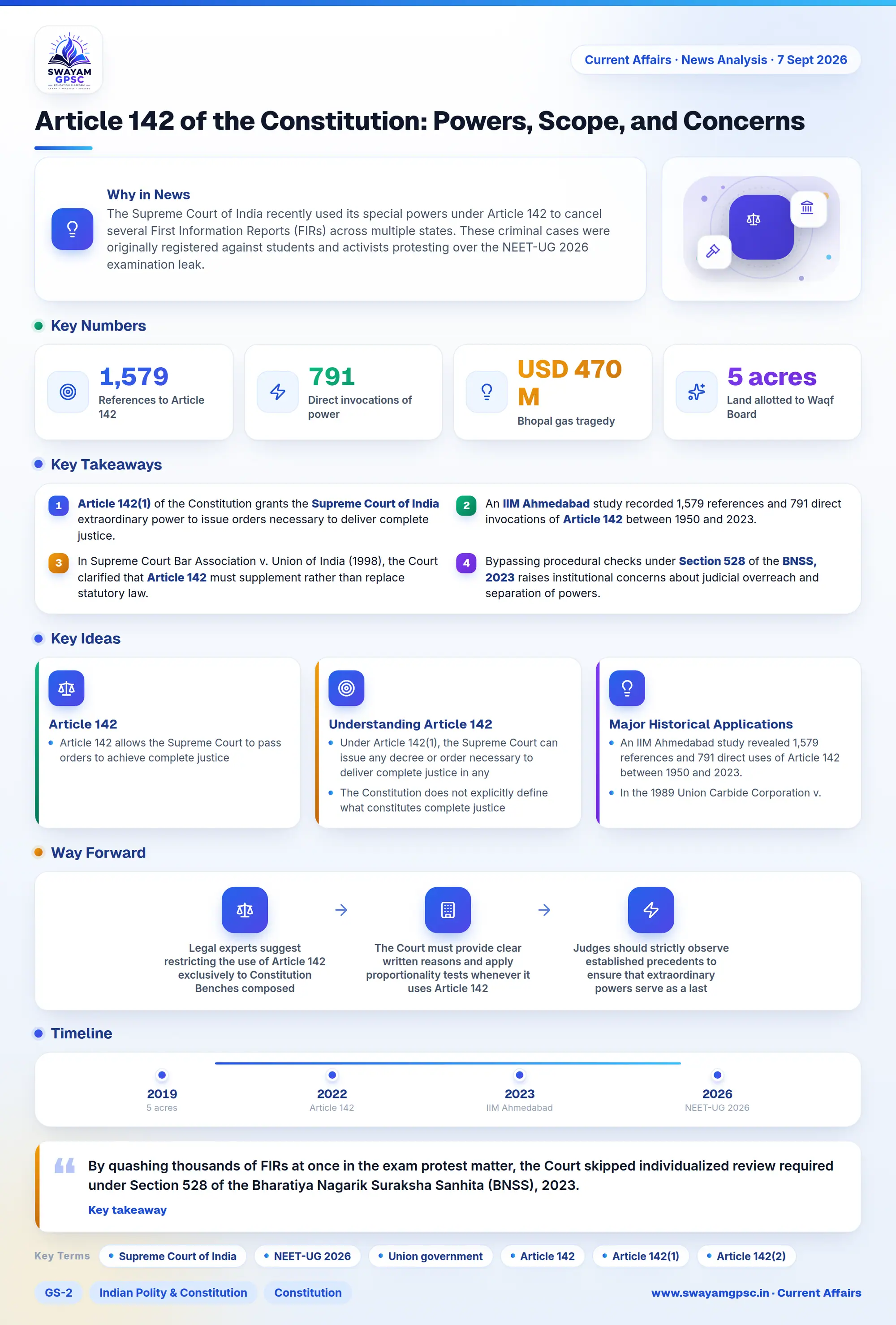
Article 142 of the Constitution: Powers, Scope, and Concerns
#GS-2 #Indian Polity & Constitution #Constitution #Judiciary #Separation of Powers #Current Events #National #Judgements & Cases
Key takeaways
- Article 142(1) of the Constitution grants the Supreme Court of India extraordinary power to issue orders necessary to deliver complete justice.
- An IIM Ahmedabad study recorded 1,579 references and 791 direct invocations of Article 142 between 1950 and 2023.
- In Supreme Court Bar Association v. Union of India (1998), the Court clarified that Article 142 must supplement rather than replace statutory law.
- Bypassing procedural checks under Section 528 of the BNSS, 2023 raises institutional concerns about judicial overreach and separation of powers.
Why in News
- The Supreme Court of India recently used its special powers under Article 142 to cancel several First Information Reports (FIRs) across multiple states.
- These criminal cases were originally registered against students and activists protesting over the NEET-UG 2026 examination leak.
- The apex court issued this order to enforce an agreed settlement reached between the Union government and the protest organizers.
- By directly cancelling these cases together, the Supreme Court bypassed standard statutory procedures, starting a fresh debate on the proper limits of Article 142.
Summary
- Article 142 allows the Supreme Court to pass orders to achieve complete justice, but its broad scope creates risks of judicial overreach.
- To maintain the separation of powers, judges should exercise restraint, follow established precedents, and use this provision only to fill legal gaps.
Understanding Article 142 of the Constitution
- Under Article 142(1), the Supreme Court can issue any decree or order necessary to deliver complete justice in any case pending before it.
- The Constitution does not explicitly define what constitutes complete justice, leaving the phrase open to judicial interpretation.
- Under Article 142(2), the Court holds powers to enforce person attendance, discover documents, order investigations, and punish for contempt of court.
- This constitutional provision originates from Section 210 of the Government of India Act, 1935, which relied on principles of equity and good conscience.
- The Constituent Assembly adopted this provision in 1949 as Article 118 without conducting any formal debate.
- Because lawmakers left its scope undefined, the Supreme Court has defined its own limits on a case-by-case basis over the last seven decades.
Major Historical Applications of Article 142
- An IIM Ahmedabad study revealed 1,579 references and 791 direct uses of Article 142 between 1950 and 2023.
- In the 1989 Union Carbide Corporation v. Union of India case, the Court approved a USD 470 million settlement and quashed criminal charges.
- In Vishaka v. State of Rajasthan (1997), the Court laid down workplace safety guidelines before Parliament enacted the PoSH Act, 2013.
- During the 2019 Ayodhya title dispute, the apex court awarded 5 acres of alternative land to the Sunni Waqf Board using this power.
- In 2022, the Supreme Court invoked Article 142 to grant immediate release to the convict A.G. Perarivalan.
- The Supreme Court regularly uses this authority to grant immediate divorces in cases involving irretrievable breakdown of marriage.
Judicial Limits Placed on Article 142
- In Prem Chand Garg v. State of Uttar Pradesh (1962), the Court ruled that orders under Article 142 must respect Fundamental Rights.
- In Supreme Court Bar Association v. Union of India (1998), a Constitution Bench stated that Article 142 should fill statutory gaps rather than replace laws.
- Despite setting these self-imposed boundaries, Supreme Court benches have occasionally ignored earlier restrictive precedents.
Concerns Regarding the Exercise of Article 142
- By quashing thousands of FIRs at once in the exam protest matter, the Court skipped individualized review required under Section 528 of the Bharatiya Nagarik Suraksha Sanhita (BNSS), 2023.
- The absence of a clear statutory definition for complete justice gives individual benches broad and unchecked discretionary power.
- Because the Supreme Court operates through two-judge Division Benches, outcomes often depend on the personal views of individual judges.
- Interventions in policy matters, such as banning liquor shops within 500 metres of highways, create risks of judicial overreach.
- Because these restrictions are entirely self-imposed by the judiciary, no external constitutional body can enforce them against the Court.
Global Comparison of Remedial Judicial Powers
- Under Section 172(1)(b) of its Constitution, courts in South Africa can issue any order that is just and equitable in constitutional matters.
- Under Section 24(1) of the Canadian Charter of Rights and Freedoms, courts in Canada can grant appropriate remedies for constitutional violations.
Way Forward
- Legal experts suggest restricting the use of Article 142 exclusively to Constitution Benches composed of at least 5 judges.
- The Court must provide clear written reasons and apply proportionality tests whenever it uses Article 142 to address legal gaps.
- Judges should strictly observe established precedents to ensure that extraordinary powers serve as a last resort rather than a procedural shortcut.