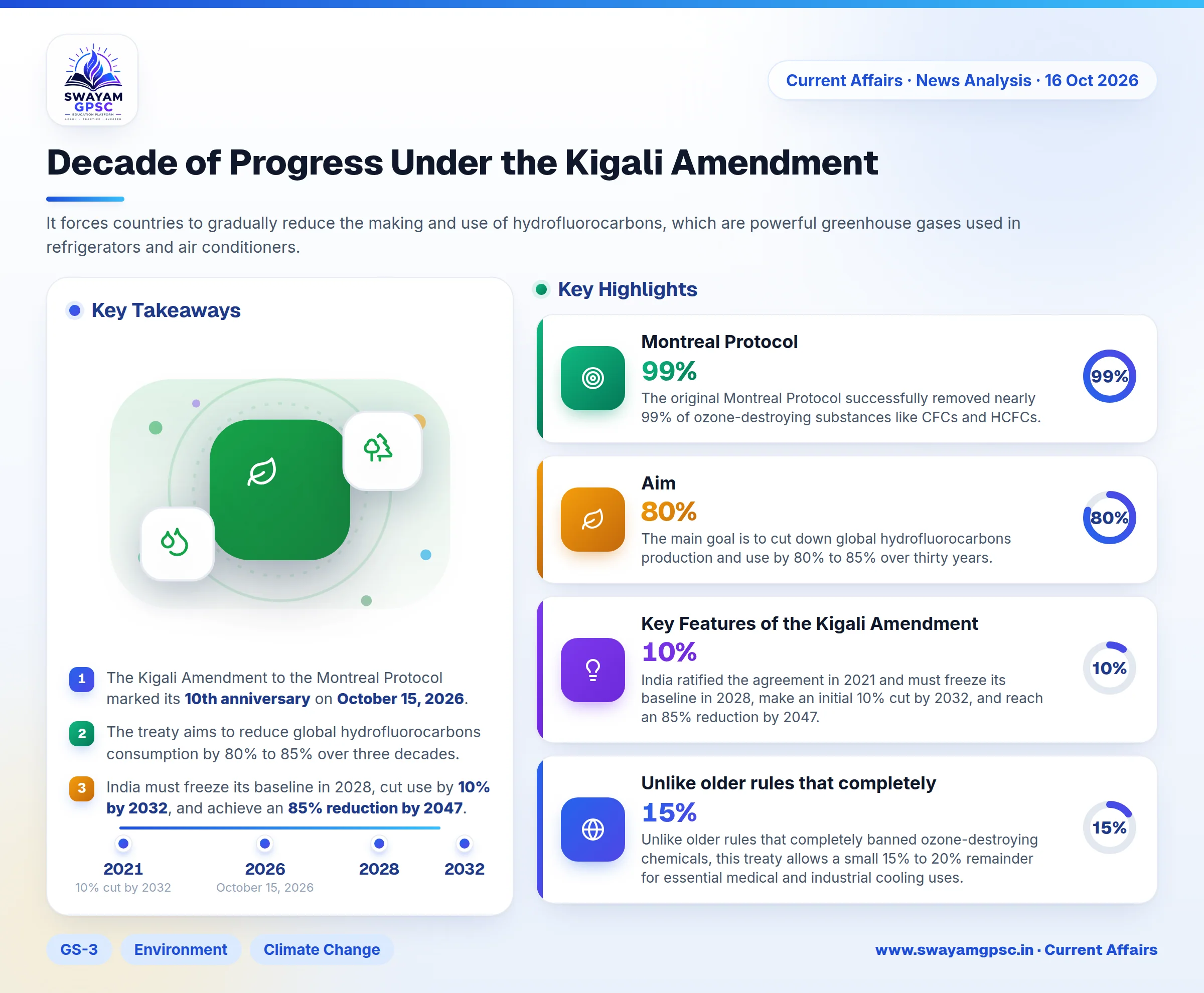
Decade of Progress Under the Kigali Amendment
#GS-3 #Environment #Climate Change #Pollution #Economy #Infrastructure
Key takeaways
- The Kigali Amendment to the Montreal Protocol marked its 10th anniversary on October 15, 2026.
- The treaty aims to reduce global hydrofluorocarbons consumption by 80% to 85% over three decades.
- India must freeze its baseline in 2028, cut use by 10% by 2032, and achieve an 85% reduction by 2047.
- The agreement prevents up to 0.5°C of global temperature rise by 2100.
Why in News
- The Kigali Amendment to the Montreal Protocol recently completed its 10th anniversary on October 15, 2026.
- This milestone brought global attention back to cutting down harmful hydrofluorocarbons to prevent up to 0.5°C of warming by 2100.
About the Kigali Amendment
- The Kigali Amendment is a legally binding international treaty that updates the 1987 Montreal Protocol on Substances that Deplete the Ozone Layer.
- It forces countries to gradually reduce the making and use of hydrofluorocarbons, which are powerful greenhouse gases used in refrigerators and air conditioners.
- The United Nations Environment Programme (UNEP) Ozone Secretariat manages this treaty with financial help from the Multilateral Fund for the Implementation of the Montreal Protocol.
Background
- The original Montreal Protocol successfully removed nearly 99% of ozone-destroying substances like CFCs and HCFCs.
- To replace them, industries started using hydrofluorocarbons because they do not harm the ozone layer in the stratosphere.
- However, hydrofluorocarbons turned out to be dangerous short-lived climate pollutants with global warming potentials thousands of times stronger than carbon dioxide (CO2).
- Countries like the Federated States of Micronesia and Mauritius first proposed this change in 2009.
- Governments officially accepted the amendment on October 15, 2016, in Kigali, Rwanda, and it became active on January 1, 2019.
Aim
- The main goal is to cut down global hydrofluorocarbons production and use by 80% to 85% over thirty years.
- This reduction aims to stop severe climate change and prevent an estimated 0.3°C to 0.5°C of global temperature rise by 2100.
Key Features of the Kigali Amendment
- The treaty uses legally binding rules that divide countries into developed and developing tiers, giving poorer nations more time to switch to safe alternatives.
- India falls under Article 5 Group 2 alongside nations like Pakistan, Iran, and various Gulf states.
- India ratified the agreement in 2021 and must freeze its baseline in 2028, make an initial 10% cut by 2032, and reach an 85% reduction by 2047.
- Unlike older rules that completely banned ozone-destroying chemicals, this treaty allows a small 15% to 20% remainder for essential medical and industrial cooling uses.
- The Multilateral Fund (MLF) gives grants and technology support to help developing countries upgrade factories and train workers.
- By pushing for cooling equipment changes, the treaty also saves energy, which the UNEP and IEA say can double the positive climate results.
Significance
- Stopping up to 0.5°C of warming by 2100 helps the world keep total temperature increases below 1.5°C.
- It helps the India Cooling Action Plan (ICAP) by pushing for energy-efficient cooling, lowering electricity bills, and cutting peak power demand.