Debate on Alcohol Prohibition in India: Legal, Economic, and Social Dimensions
#GS-2 #Indian Polity & Constitution #Constitution #Governance & Social Justice #Health #Current Events #National #GS-3 #Economy #Taxation
Key takeaways
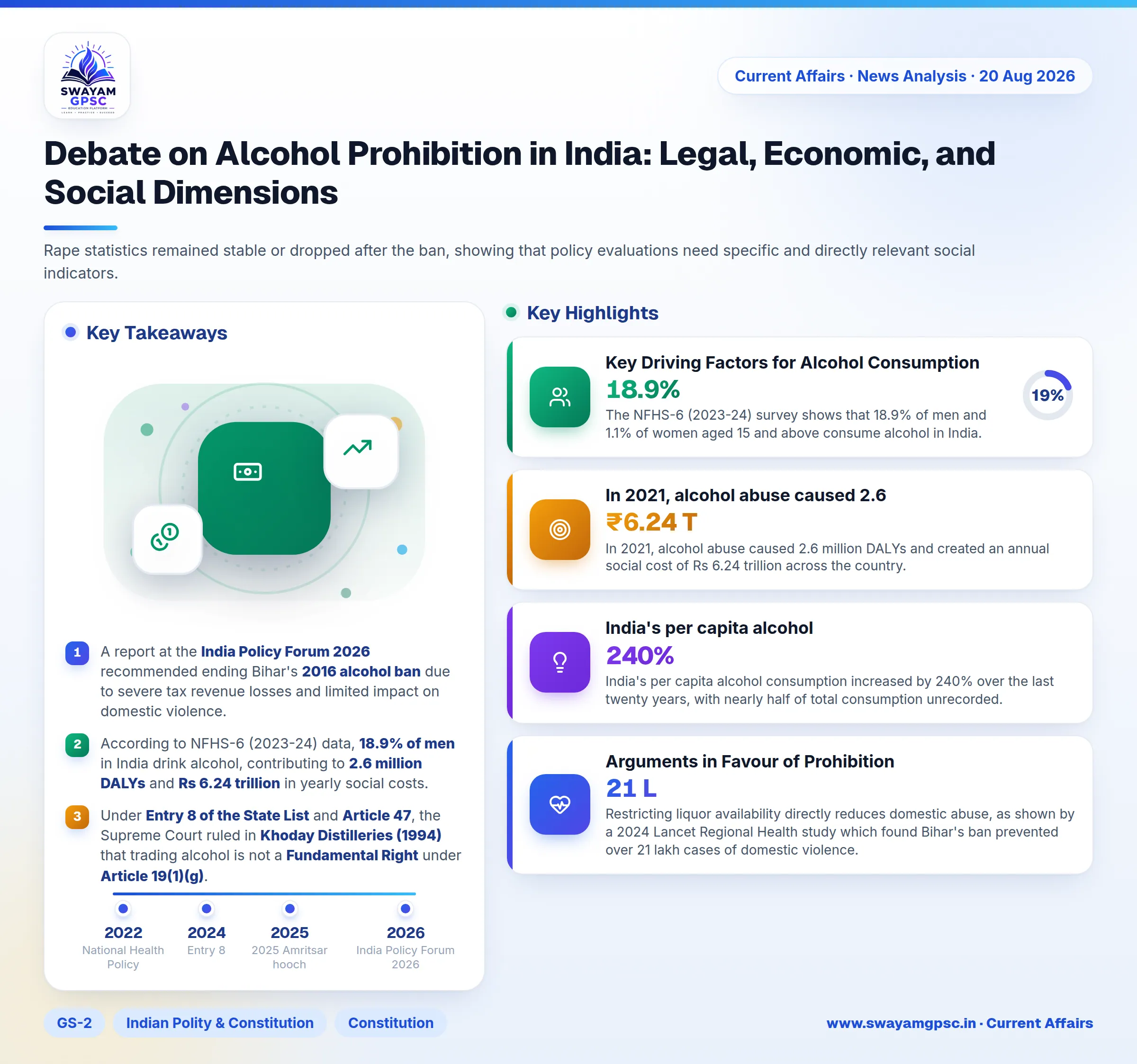
- A report at the India Policy Forum 2026 recommended ending Bihar's 2016 alcohol ban due to severe tax revenue losses and limited impact on domestic violence.
- According to NFHS-6 (2023-24) data, 18.9% of men in India drink alcohol, contributing to 2.6 million DALYs and Rs 6.24 trillion in yearly social costs.
- Under Entry 8 of the State List and Article 47, the Supreme Court ruled in Khoday Distilleries (1994) that trading alcohol is not a Fundamental Right under Article 19(1)(g).
- A 2024 Lancet study found Bihar's prohibition prevented 21 lakh cases of domestic violence, but total bans often trigger dangerous hooch tragedies and strip states of 15% to 25% of tax income.
Why in News
- A recent development report presented at the India Policy Forum 2026 recommended lifting Bihar's 2016 alcohol prohibition policy.
- The report highlighted that the ban generated massive state revenue losses while showing limited success in reducing domestic violence against women.
- Critics argue that using National Crime Records Bureau (NCRB) data is misleading because increased crime reporting reflects better law enforcement rather than higher violence.
- Rape statistics remained stable or dropped after the ban, showing that policy evaluations need specific and directly relevant social indicators.
Summary of Alcohol Regulation
- The Indian Constitution supports alcohol prohibition through Article 47 and Entry 8 of the State List, giving states complete regulatory control.
- Bihar's experience proves that liquor bans can improve public health and lower violence, but they also create black markets, toxic hooch deaths, and heavy revenue losses.
- A successful policy must balance public health goals with financial realities through smart taxation, strict regulation, de-addiction programs, and modern monitoring tools.
Constitutional and Legal Provisions
- Article 47 of the Directive Principles instructs the State to raise public health, nutrition standards, and living conditions as primary duties.
- This article explicitly directs government bodies to work toward prohibiting health-injurious drinks and drugs, except for medical use.
- Under Entry 8 of the State List in the Seventh Schedule, state legislatures hold exclusive authority over the production, sale, transport, and purchase of liquor.
- This constitutional framework allows individual states to choose between complete prohibition, partial restrictions, or state-run liquor monopolies.
- The Supreme Court of India has repeatedly ruled that selling or drinking liquor is not a Fundamental Right under the Constitution.
- In Khoday Distilleries Ltd. v. State of Karnataka (1994), the apex court ruled that citizens have no fundamental right to trade in liquor under Article 19(1)(g).
- In State of Tamil Nadu v. K. Balu (2016), the court banned liquor shops along national highways to protect public safety and reduce road accidents.
- In State of U.P. v. Lalta Prasad Vaish & Sons (2024), the court expanded state regulatory powers under Entry 8 to include industrial and non-potable alcohol.
- The National Action Plan for Drug Demand Reduction (NAPDDR) 2021-22 provides counselling, awareness, and rehabilitation services to fight substance abuse.
- The National Mental Health Policy (2014) explicitly links excessive alcohol consumption to rising mental health issues.
- The National Health Policy (2017) and National Suicide Prevention Strategy 2022 recommend strict public health measures to curb alcohol abuse.
- The National Action Plan for Prevention and Control of Noncommunicable Diseases (NMAP) 2017-2022 advocates for a unified national alcohol strategy.
Key Driving Factors for Alcohol Consumption
- The NFHS-6 (2023-24) survey shows that 18.9% of men and 1.1% of women aged 15 and above consume alcohol in India.
- In 2021, alcohol abuse caused 2.6 million DALYs and created an annual social cost of Rs 6.24 trillion across the country.
- India's per capita alcohol consumption increased by 240% over the last twenty years, with nearly half of total consumption unrecorded.
- Biological factors, stress, urban lifestyle changes, anxiety, and peer pressure heavily drive individual drinking habits.
- Aggressive surrogate advertising, influencer promotion, digital media content, and pre-mixed drinks make alcohol attractive to younger age groups.
- Easy online delivery, dense retail networks, cheap local liquor options, and rising disposable incomes make alcohol widely accessible.
Arguments in Favour of Prohibition
- Restricting liquor availability directly reduces domestic abuse, as shown by a 2024 Lancet Regional Health study which found Bihar's ban prevented over 21 lakh cases of domestic violence.
- Prohibition forces vulnerable families to stop wasting money on alcohol and redirect their savings toward child education, healthy food, and household assets.
- Banning liquor lowers public hospital costs by reducing liver failure, heart problems, and accidental injuries; the 2024 Lancet study noted the ban prevented 18 lakh cases of male obesity.
- Alcohol abuse costs India 1.45% of its GDP every year, meaning social losses far outweigh the tax money gathered from liquor excise duties.
Arguments Against Complete Prohibition
- Total bans do not eliminate consumer demand; instead, they create powerful liquor mafias, corruption, and cross-border smuggling along neighboring state borders.
- Prohibition forces poor citizens toward unsafe home-brewed liquor, leading to mass poisoning tragedies like the 2025 Amritsar hooch incident that killed 21 people through toxic methanol.
- Enforcement remains unequal because wealthy citizens buy smuggled branded alcohol while poor communities face police arrests and legal prosecution.
- State governments lose 15% to 25% of their total tax revenues when they ban liquor, starving key public welfare and healthcare budgets.
- Balancing immediate tax losses against long-term gains in public health creates a tough economic planning challenge for governments.
- Strict criminal laws clog state courts and prisons with thousands of non-violent, impoverished offenders.
- Historical examples like the US Prohibition (1920-1933) and Haryana's ban in the 1990s prove that complete bans fail to curb drinking long-term.
Way Forward
- Governments should apply behavioral nudges such as strict digital age verification, total bans on indirect ads, and graphic health warnings on packaging.
- States should empower local Panchayati Raj Institutions (PRIs) and Self-Help Groups like Kerala's Kudumbashree model to run community counseling centers.
- Authorities can build digital rationing platforms using biometric smart cards to cap weekly alcohol purchases per person.
- State legislatures should mandate that 20% of liquor tax revenue goes directly into dedicated funds for mental health clinics and rehab facilities.
- Policymakers must treat addiction as a public health issue through expanding counseling services, while reserving police action for illegal smuggling networks.
Conclusion
- Achieving the constitutional goals of Article 47 requires long-term public health infrastructure rather than sudden criminal laws.
- Smart regulation protects state tax revenue while steadily reducing the social and economic harms of alcohol addiction.