Cyber-Physical Systems and India's National Mission
#GS-3 #Science & Technology #Artificial Intelligence #ICT #Robotics #Current Events #National
Key takeaways
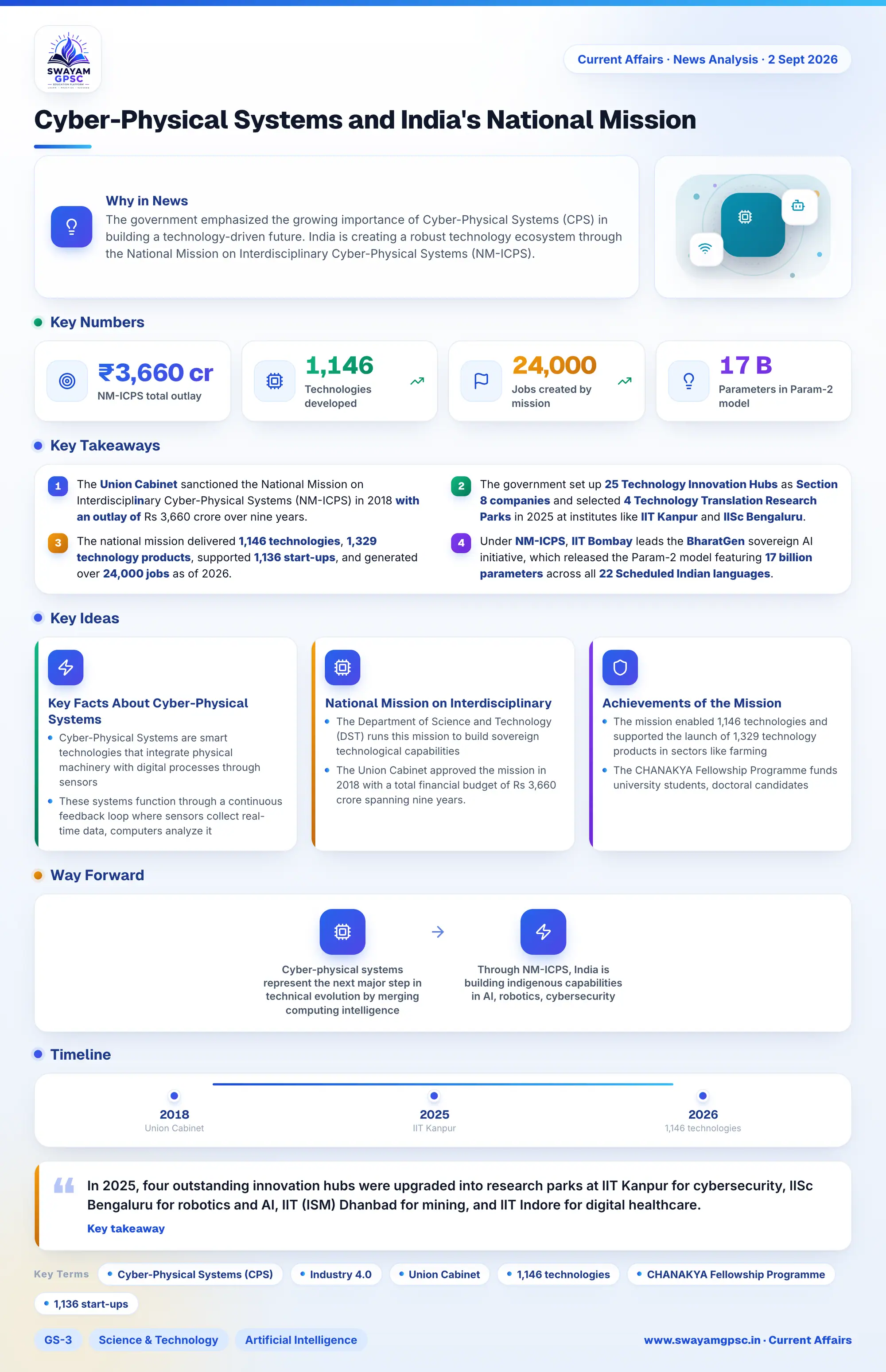
- The Union Cabinet sanctioned the National Mission on Interdisciplinary Cyber-Physical Systems (NM-ICPS) in 2018 with an outlay of Rs 3,660 crore over nine years.
- The government set up 25 Technology Innovation Hubs as Section 8 companies and selected 4 Technology Translation Research Parks in 2025 at institutes like IIT Kanpur and IISc Bengaluru.
- The national mission delivered 1,146 technologies, 1,329 technology products, supported 1,136 start-ups, and generated over 24,000 jobs as of 2026.
- Under NM-ICPS, IIT Bombay leads the BharatGen sovereign AI initiative, which released the Param-2 model featuring 17 billion parameters across all 22 Scheduled Indian languages.
Why in News
- The government emphasized the growing importance of Cyber-Physical Systems (CPS) in building a technology-driven future.
- India is creating a robust technology ecosystem through the National Mission on Interdisciplinary Cyber-Physical Systems (NM-ICPS).
Key Facts About Cyber-Physical Systems
- Cyber-Physical Systems are smart technologies that integrate physical machinery with digital processes through sensors, computing power, communication tools, and actuators.
- These systems function through a continuous feedback loop where sensors collect real-time data, computers analyze it, and actuators perform necessary physical tasks.
- Autonomous vehicles rely on sensors and artificial intelligence to navigate roads safely without needing human intervention.
- Smart factories use connected systems for automated monitoring, operational tuning, and advanced manufacturing under Industry 4.0.
- Intelligent medical equipment continuously monitors vital signs in real time to assist doctors with timely clinical decisions.
- Automated smart buildings dynamically control lighting, room temperature, and energy usage based on current environmental conditions.
- These systems build responsive and interconnected infrastructure across health services, transit networks, and industrial manufacturing.
National Mission on Interdisciplinary Cyber-Physical Systems
- The Department of Science and Technology (DST) runs this mission to build sovereign technological capabilities in advanced cyber-physical fields.
- The Union Cabinet approved the mission in 2018 with a total financial budget of Rs 3,660 crore spanning nine years.
- The mission establishes a national roadmap for research and innovation by bringing together universities, industry leaders, public agencies, and international partners.
- It supports every stage of technology growth including basic scientific research, product design, commercial incubation, and new start-up creation.
- The mission sets up top-tier research centers to foster deep technical expertise and guide policy design across the country.
- It focuses on training skilled technical professionals while building national competencies in emerging technology domains.
Achievements of the Mission
- The mission enabled 1,146 technologies and supported the launch of 1,329 technology products in sectors like farming, medicine, mining, and cybersecurity.
- The CHANAKYA Fellowship Programme funds university students, doctoral candidates, and postdoctoral researchers working on critical technical challenges.
- The mission supported 1,136 start-ups and spin-off companies, which created over 24,000 jobs across the nation.
- India established 200 international collaborations to strengthen its technical footprint in the global technology ecosystem.
Technology Innovation Hubs
- Under the mission, the government created 25 Technology Innovation Hubs (TIHs) registered as non-profit Section 8 companies in premier academic institutes.
- These hubs bridge research and commercial utility by converting laboratory work into products, aiding tech start-ups, and helping government departments solve real problems.
Technology Translation Research Parks
- In 2025, four outstanding innovation hubs were upgraded into research parks at IIT Kanpur for cybersecurity, IISc Bengaluru for robotics and AI, IIT (ISM) Dhanbad for mining, and IIT Indore for digital healthcare.
- These dedicated research parks accelerate the transition of technical inventions from laboratory prototypes to market-ready commercial products.
BharatGen AI Initiative
- Led by IIT Bombay along with an academic consortium, BharatGen develops sovereign artificial intelligence tools tailored to Indian languages and local contexts.
- It creates text, speech, and video models to enable smooth human-machine interactions across India's diverse language landscape.
- The Param-2 foundation model features 17 billion parameters and supports all 22 Scheduled Indian languages.
- The Shrutam model handles speech-to-text processing for 12 Indian languages, while Sooktam offers text-to-speech features across 12 Indian languages.
- The Patram model uses the DocBodh framework to provide easy access to complex Indian documents in regional languages.
- The initiative also created specialized domain models like Ayur Param for traditional medicine, Agri Param for farming, and Legal Param for legal work.
Way Forward
- Cyber-physical systems represent the next major step in technical evolution by merging computing intelligence directly into physical infrastructure.
- Through NM-ICPS, India is building indigenous capabilities in AI, robotics, cybersecurity, and smart networks to power self-reliance under Viksit Bharat.