CVC Annual Report 2025: Key Findings and Anti-Corruption Governance
#GS-2 #Governance & Social Justice #Indian Polity & Constitution #Statutory Bodies #Transparency & Accountability #Central Vigilance Commission #Good Governance
Key takeaways
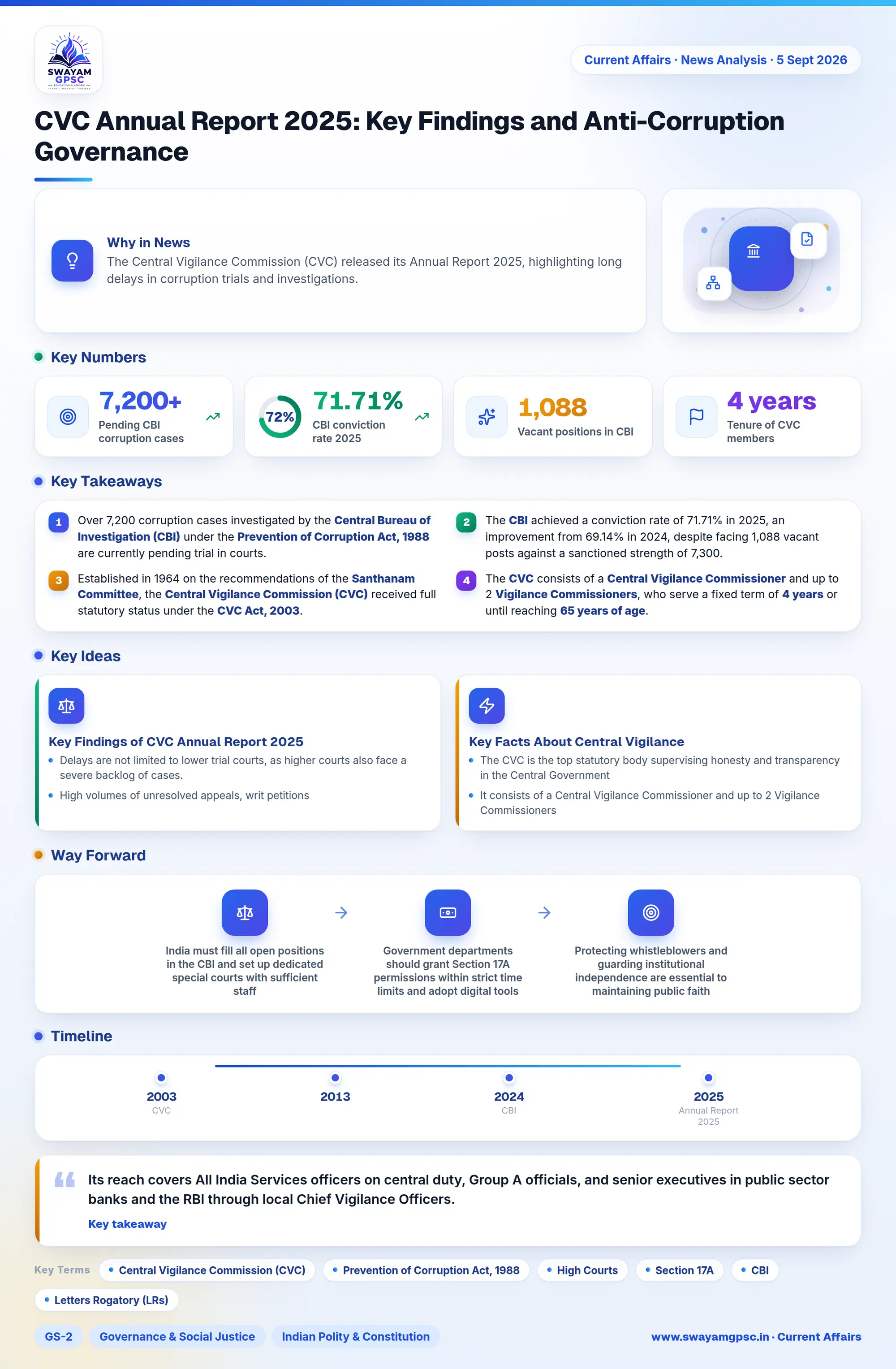
- Over 7,200 corruption cases investigated by the Central Bureau of Investigation (CBI) under the Prevention of Corruption Act, 1988 are currently pending trial in courts.
- The CBI achieved a conviction rate of 71.71% in 2025, an improvement from 69.14% in 2024, despite facing 1,088 vacant posts against a sanctioned strength of 7,300.
- Established in 1964 on the recommendations of the Santhanam Committee, the Central Vigilance Commission (CVC) received full statutory status under the CVC Act, 2003.
- The CVC consists of a Central Vigilance Commissioner and up to 2 Vigilance Commissioners, who serve a fixed term of 4 years or until reaching 65 years of age.
Why in News
- The Central Vigilance Commission (CVC) released its Annual Report 2025, highlighting long delays in corruption trials and investigations.
- More than 7,200 corruption cases investigated by the Central Bureau of Investigation (CBI) under the Prevention of Corruption Act, 1988 are waiting for trial, with hundreds pending for over 20 years.
Key Findings of CVC Annual Report 2025
- Delays are not limited to lower trial courts, as higher courts also face a severe backlog of cases.
- High volumes of unresolved appeals, writ petitions, and revision applications in High Courts and the Supreme Court delay final verdicts.
- Delays in getting government permission under Section 17A of the Prevention of Corruption Act, 1988 hold up investigations against public servants.
- Under Section 17A, police officers must get prior approval from the government before starting any inquiry into official decisions of officers.
- Despite severe staff shortages, the conviction rate of the CBI improved to 71.71% in 2025, up from 69.14% in 2024.
- The CBI has 1,088 vacant posts out of a total sanctioned strength of 7,300, with the executive branch facing the largest shortfall of 672 positions.
- Probing disproportionate assets requires long financial checks, while slow responses to Letters Rogatory (LRs) delay gathering evidence from abroad.
- The CVC continues to dispose of complaints and provide initial advice, leading to major penalty actions against corrupt officials.
Key Facts About Central Vigilance Commission
- The CVC is the top statutory body supervising honesty and transparency in the Central Government, created in 1964 on recommendations of the Santhanam Committee and given statutory power through the CVC Act, 2003.
- It consists of a Central Vigilance Commissioner and up to 2 Vigilance Commissioners, appointed by the President on the advice of a committee comprising the Prime Minister, Union Home Minister, and Leader of Opposition in Lok Sabha.
- Members serve a fixed term of 4 years or until reaching 65 years of age, whichever comes first.
- Their pay and service terms match those of the UPSC Chairman, and all agency expenses are charged to the Consolidated Fund of India without requiring a vote in Parliament.
- The President can remove members for financial insolvency or misconduct, but removal for proved misbehaviour requires an inquiry and confirmation by the Supreme Court.
- The President can issue a final removal order only after the Supreme Court finds the officer guilty following a detailed inquiry.
- Exercising powers equivalent to a civil court, the CVC supervises CBI investigations linked to corruption under the Prevention of Corruption Act, 1988.
- It acts as the primary authority for receiving public grievances under the Public Interest Disclosure and Protection of Informers (PIDPI) Resolution.
- Under the Lokpal and Lokayuktas Act, 2013, the CVC conducts preliminary inquiries referred by the Lokpal against central government employees.
- A committee led by the Central Vigilance Commissioner recommends appointments for senior positions in the Enforcement Directorate (ED) and CBI, excluding the CBI Director.
- Its reach covers All India Services officers on central duty, Group A officials, and senior executives in public sector banks and the RBI through local Chief Vigilance Officers.
Way Forward
- India must fill all open positions in the CBI and set up dedicated special courts with sufficient staff to handle pending cases quickly.
- Government departments should grant Section 17A permissions within strict time limits and adopt digital tools to speed up financial tracking.
- Protecting whistleblowers and guarding institutional independence are essential to maintaining public faith in anti-corruption laws.