Criminalisation of Politics in India and Electoral Reforms
#GS-2 #GS-4 #Transparency & Accountability #Representation of People's Act #Executive #Judgements & Cases #Ethics in Private & Public Relationships #Indian Polity & Constitution #Governance & Social Justice #Ethics
Key takeaways
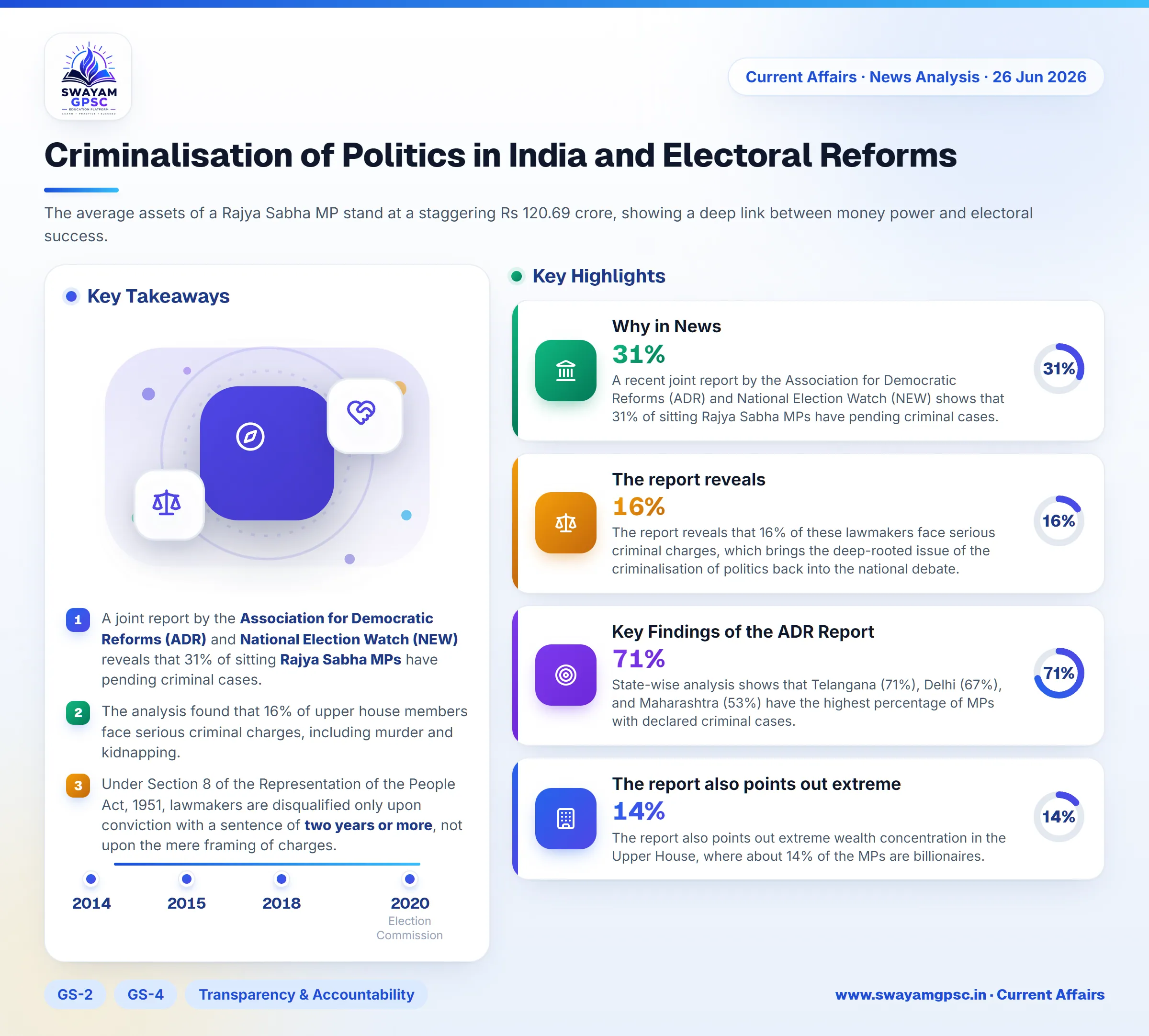
- A joint report by the Association for Democratic Reforms (ADR) and National Election Watch (NEW) reveals that 31% of sitting Rajya Sabha MPs have pending criminal cases.
- The analysis found that 16% of upper house members face serious criminal charges, including murder and kidnapping.
- Under Section 8 of the Representation of the People Act, 1951, lawmakers are disqualified only upon conviction with a sentence of two years or more, not upon the mere framing of charges.
- The Constitution (130th Amendment) Bill, 2025 proposes removing ministers who remain in judicial custody for 30 consecutive days for serious offenses.
- Billionaire members make up 14% of the Rajya Sabha, with average declared assets standing at Rs 120.69 crore.
Why in News
- A recent joint report by the Association for Democratic Reforms (ADR) and National Election Watch (NEW) shows that 31% of sitting Rajya Sabha MPs have pending criminal cases.
- The report reveals that 16% of these lawmakers face serious criminal charges, which brings the deep-rooted issue of the criminalisation of politics back into the national debate.
Key Findings of the ADR Report
- Out of 226 sitting Rajya Sabha MPs analyzed in the report, nearly 31% have declared pending criminal cases against themselves.
- Around 16% of the members face serious criminal charges, which include grave offenses like murder, attempt to murder, kidnapping, and crimes against women.
- The data proves that giving tickets to candidates with criminal histories is a widespread problem that affects almost all major national and regional political parties.
- State-wise analysis shows that Telangana (71%), Delhi (67%), and Maharashtra (53%) have the highest percentage of MPs with declared criminal cases.
- The report also points out extreme wealth concentration in the Upper House, where about 14% of the MPs are billionaires.
- The average assets of a Rajya Sabha MP stand at a staggering Rs 120.69 crore, showing a deep link between money power and electoral success.
- These findings highlight the ongoing criminal-politician-business nexus, a dangerous trend first flagged three decades ago by the Vohra Committee (1993).
- Entering the House of Elders with huge wealth and serious criminal records allows politicians to influence laws to protect their personal interests.
- The Rajya Sabha is meant to represent state interests and offer expert review, but the dominance of money and muscle power completely ruins this constitutional mandate.
What is the Criminalisation of Politics
- Criminalisation of politics means that people with criminal backgrounds, pending cases, or past convictions manage to contest elections and enter legislative bodies.
- This negative trend replaces the rule of law with the rule of money and muscle power, which damages the core values of democracy.
- Political parties focus heavily on winning elections, and data shows that candidates with criminal records have a success rate of roughly 15%, compared to just 4% for clean candidates.
- Criminal candidates use their own black money and resources to fund expensive election campaigns easily.
- The First-Past-The-Post (FPTP) voting system and high election costs force parties to rely on candidates who have black money and muscle power to intimidate opponents.
- Weak public services and poor governance make many voters support local strongmen who offer quick, extra-legal solutions as parallel power centers.
- Under Section 8 of the Representation of the People Act, 1951, a person convicted and sentenced to two years or more in prison is disqualified from contesting and remains barred for six years after release.
- However, the law does not disqualify candidates who only have pending criminal cases, allowing them to contest freely until a court gives a final conviction.
- Because the Indian judicial system has a massive backlog of over 5.6 crore pending cases, politicians can fight trials for decades while winning multiple terms in office.
- Voters often ignore a candidate's criminal background because they prioritize narrow community loyalties based on caste, religion, or language.
- Local strongmen often act like Robin Hood figures who bypass bureaucratic hurdles to help their specific vote banks.
- Political parties lack inner democracy, meaning party bosses often ignore grassroots workers to give tickets to wealthy individuals who can guarantee a win.
- This criminalisation destroys public trust, promotes a culture of impunity, and pushes aside women's empowerment by reducing representation to mere symbolism.
- In Union of India v. Association for Democratic Reforms (2002), the Supreme Court ruled that voters have a fundamental right under Article 19(1)(a) to know the criminal, financial, and educational background of candidates.
- In PUCL v. Union of India (2004), the Supreme Court struck down Section 33B of the Representation of the People Act, 1951, reaffirming the voter's right to know.
- In K. Prabhakaran v. P. Jayarajan (2005), the Supreme Court observed that Section 8(3) aims to stop criminals from entering politics, noting that those who break the law should not make the law.
- In Lily Thomas v. Union of India (2013), the Supreme Court ordered the immediate disqualification of any lawmaker sentenced to two years or more in prison.
- In Manoj Narula v. Union of India (2014), the Court stated that while the Prime Minister has the power to appoint ministers, people facing serious criminal charges should ideally be kept out of the Cabinet.
- In Public Interest Foundation v. Union of India (2018), the Court ruled that only Parliament can disqualify candidates when charges are framed, and ordered parties to widely publicize criminal records.
- In Rambabu Singh Thakur v. Sunil Arora (2020), the Supreme Court told the Election Commission of India to strictly monitor parties and report anyone hiding criminal records.
Challenges
- Political parties prioritize winning elections above ethical values, which gives candidates with criminal backgrounds a massive structural advantage.
- The extreme cost of running election campaigns forces political groups to depend entirely on wealthy candidates and individuals with black money.
- A slow judicial system with millions of pending cases allows accused politicians to delay trials for decades and stay in power.
- Voters often support strongmen because weak local governance forces them to rely on extra-legal fixers for basic support.
- Narrow identity politics based on caste and religion causes voters to overlook criminal records in favor of community representation.
Way Forward
- The N.N. Vohra Committee (1993) recommended setting up a specialized Nodal Agency under the Ministry of Home Affairs to track the financial and operational links of criminal networks.
- The Dinesh Goswami Committee (1990) and Indrajit Gupta Committee (1998) strongly suggested partial state funding of elections in kind to reduce reliance on black money.
- The Second Administrative Reforms Commission (2nd ARC, 2008) recommended amending Section 8 of the RPA to immediately ban individuals facing trial for serious offenses.
- The 244th Law Commission Report (2014) proposed disqualifying candidates as soon as a court frames charges for offenses punishable by five years or more in prison.
- The same Law Commission report suggested creating dedicated fast-track courts to conduct day-to-day trials for politicians facing criminal charges.
- The 255th Law Commission Report (2015) advised strict financial transparency by mandating the disclosure of all political donations and independent audits of party accounts.
- The Election Commission of India wants a lifetime ban on convicted politicians instead of the current six-year restriction.
- Civil society and election authorities must run aggressive awareness campaigns and encourage voters to use the NOTA option to force parties to field clean candidates.
Nolan Principles and Public Life
- The Nolan Principles, or the Seven Principles of Public Life, were recommended by the Nolan Committee established in the United Kingdom in 1994 under Lord Michael Nolan.
- These principles establish a strong ethical framework to promote integrity, transparency, and accountability among public officials.
- The seven core values include Selflessness, Integrity, Objectivity, Accountability, Openness, Honesty, and Leadership.
The Constitution (130th Amendment) Bill, 2025
- The Constitution (130th Amendment) Bill, 2025 proposes amending Articles 75, 164, and 239AA to remove the Prime Minister, Chief Ministers, or ministers if jailed for 30 consecutive days over serious crimes.
- The main goal is to stop the absurd situation of leaders attempting to run governance from jail.
- Critics argue that this bill harms the fundamental presumption of innocence because removal happens through arrest rather than judicial conviction.
- Opponents also fear that tough bail laws could be misused by ruling parties to lock up political opponents for 30 days and destabilize state governments.
Prelims in Focus: Rajya Sabha and ADR Findings
- The analysis by ADR and NEW covered 226 out of 233 sitting Rajya Sabha seats.
- Party-wise breakdown of criminal cases shows 26% for BJP, 41% for Congress, 22% for TMC, 25% for DMK, and 50% for Samajwadi Party.
- Billionaire MPs make up 14% of the Upper House, with average assets reaching Rs 120.69 crore.