Is Corruption the Biggest Threat to India's Future?
#GS-2 #GS-4 #GS-3 #Governance & Social Justice #Indian Polity & Constitution #Ethics #Current Events #Good Governance #Transparency #Accountability #National #Corruption
Why in News
- Students across major Indian cities including Delhi, Amritsar, and Mumbai organized large protests to demand systemic accountability after major paper leaks in entrance tests like NEET-UG.
Understanding Corruption
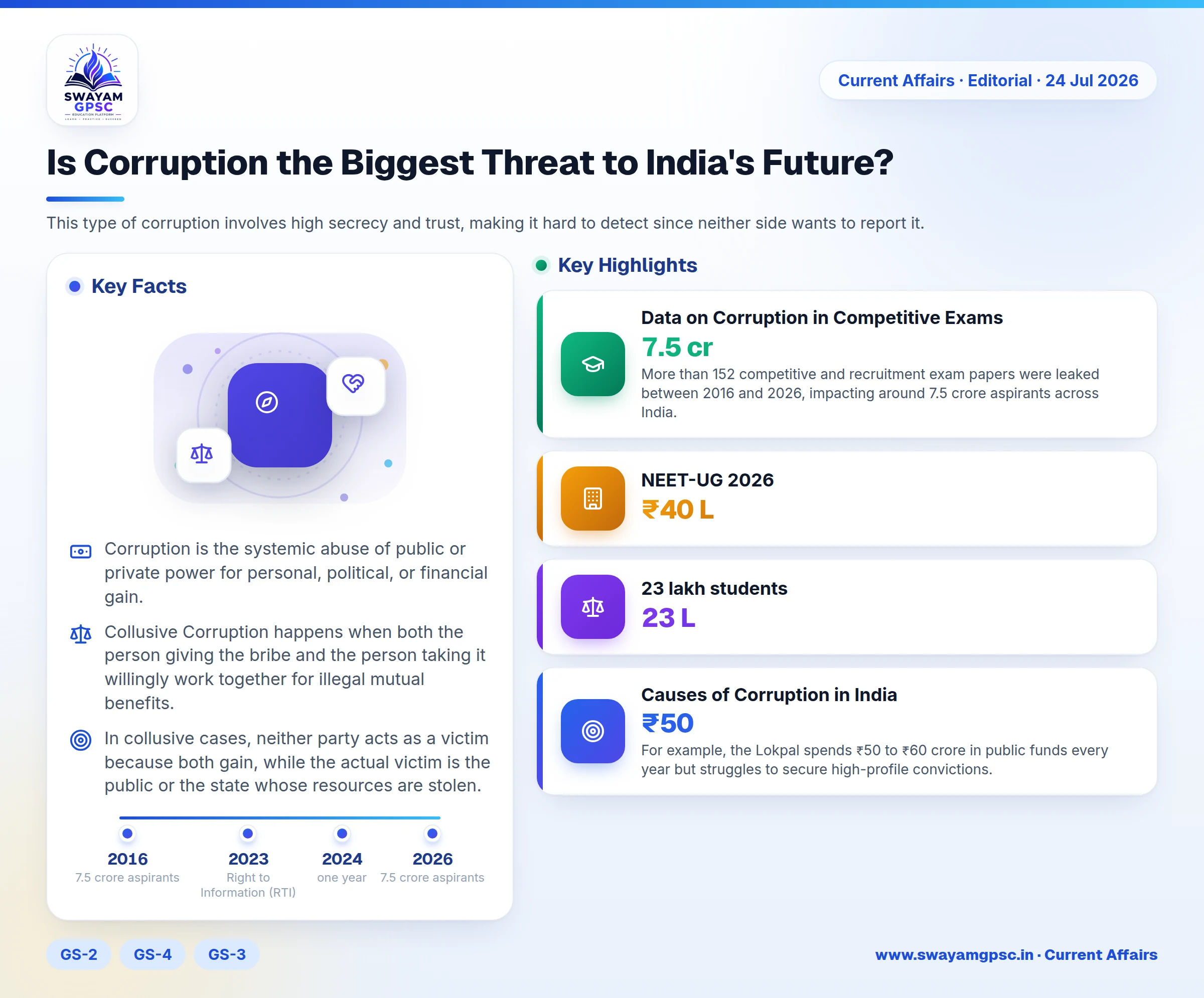
- Corruption is the systemic abuse of public or private power for personal, political, or financial gain.
- From an ethical standpoint, corruption directly breaks the social contract because officials put self-interest above public duty, which destroys institutional credibility and trust.
Classifications of Corruption
- Collusive Corruption happens when both the person giving the bribe and the person taking it willingly work together for illegal mutual benefits.
- In collusive cases, neither party acts as a victim because both gain, while the actual victim is the public or the state whose resources are stolen.
- This type of corruption involves high secrecy and trust, making it hard to detect since neither side wants to report it.
- For example, a private company may bribe a public official to win a multi-crore building contract or skip environmental clearances.
- Coercive Corruption occurs when a public official forces or harasses a citizen into paying money for a service they are legally entitled to receive.
- In this scenario, the citizen is an unwilling victim who faces threats, extortion, or deliberate work delays.
- This practice hurts poor and marginalized citizens the most because of unequal power dynamics.
- Victims have a strong reason to report this wrong behavior if strong whistleblower safety measures exist.
- For instance, a police officer might demand cash to lodge a basic complaint or a clerk might ask for money before releasing pension payments.
Data on Corruption in Competitive Exams
- More than 152 competitive and recruitment exam papers were leaked between 2016 and 2026, impacting around 7.5 crore aspirants across India.
- The conviction rate for organized paper leak syndicates stays near zero, creating an environment with high profits and almost no legal risk for criminals.
- The cancellation and re-examination of NEET-UG 2026 directly affected over 2.27 million medical aspirants, with papers reportedly sold by organized gangs for up to ₹40 lakh.
- A huge gap between demand and supply exists because nearly 23 lakh students compete for only 1 lakh MBBS seats, which creates an illegal exam leak market worth hundreds of crores.
Causes of Corruption in India
- Key anti-corruption agencies face delayed and non-transparent appointments, which severely weakens public oversight.
- For example, the Lokpal spends ₹50 to ₹60 crore in public funds every year but struggles to secure high-profile convictions.
- Changes made to the Right to Information (RTI) Act through the Digital Personal Data Protection (DPDP) Act 2023 have expanded exemptions, allowing officials to hide public information.
- Legal protections like Section 17A of the Prevention of Corruption Act force investigative agencies to seek government permission before probing officials, shielding corrupt staff from fast action.
- Judicial delays lower fear of the law, as corruption trials take an average of over 88 months to reach a final decision.
Impact of Corruption on Future Generations
- Paper leaks replace merit with money, depriving hard-working poor students of fair opportunities and destroying their faith in honest governance.
- Frequent exam cancellations and legal battles create severe stress, fear, and hopelessness among young citizens.
- For instance, several NEET aspirants committed suicide recently because of mental stress caused by exam irregularities and delays.
- When individuals enter medical, engineering, or civil service roles using illegal means, the overall safety and quality of public infrastructure and governance drops.
- Seeing corrupt people operate without punishment makes unethical behavior look normal, which damages societal values and public trust.
Way Forward
- Set up dedicated fast-track courts under the Public Examinations (Prevention of Unfair Means) Act, 2024 to finish trials for exam paper leaks and public corruption within one year.
- Restore transparency by adjusting restrictive sections in the DPDP Act 2023, allowing citizens to access crucial administrative details.
- Turn testing agencies like the National Testing Agency (NTA) into statutory bodies with permanent experts and secure Computer-assisted Testing (CPPT) systems.
- Establish clear, merit-based selection rules for Information Commissioners, the Lokpal, and chiefs of bodies like the CBI and ED to stop political interference.
Conclusion
- Corruption poses a big threat to India's democracy and harms the future of young citizens.
- Rebuilding public confidence requires swift court trials, strong legal protections, and transparent administration so meritocracy can replace favoritism.