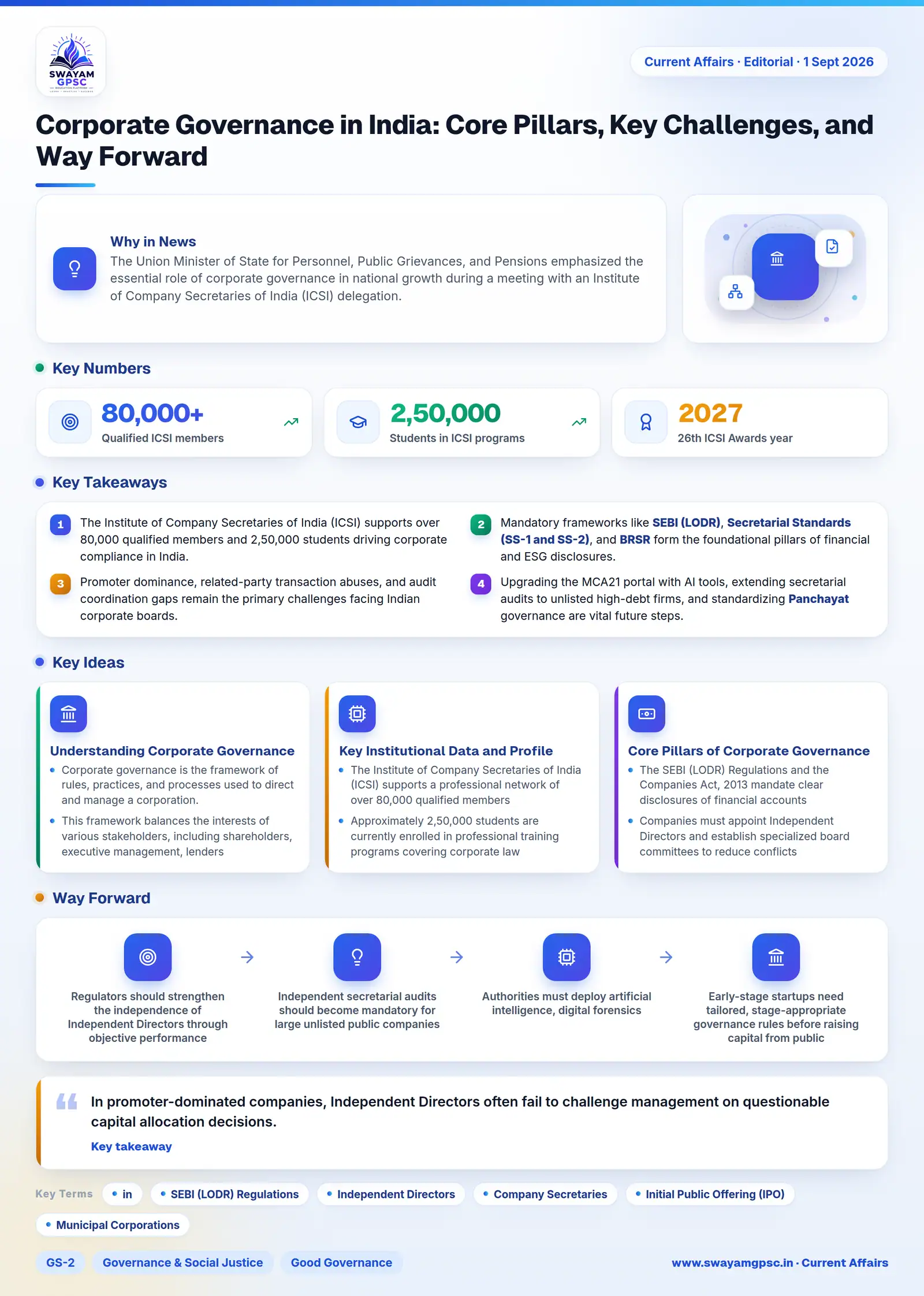
Corporate Governance in India: Core Pillars, Key Challenges, and Way Forward
#GS-2 #Governance & Social Justice #Good Governance #Regulatory Bodies #GS-3 #Economy #GS-4 #Ethics #Accountability #Transparency #Corporate Governance #ICSI
Key takeaways
- The Institute of Company Secretaries of India (ICSI) supports over 80,000 qualified members and 2,50,000 students driving corporate compliance in India.
- Mandatory frameworks like SEBI (LODR), Secretarial Standards (SS-1 and SS-2), and BRSR form the foundational pillars of financial and ESG disclosures.
- Promoter dominance, related-party transaction abuses, and audit coordination gaps remain the primary challenges facing Indian corporate boards.
- Upgrading the MCA21 portal with AI tools, extending secretarial audits to unlisted high-debt firms, and standardizing Panchayat governance are vital future steps.
Why in News
- The Union Minister of State for Personnel, Public Grievances, and Pensions emphasized the essential role of corporate governance in national growth during a meeting with an Institute of Company Secretaries of India (ICSI) delegation.
- The Minister stated that maintaining strong governance practices within corporations directly supports India's overarching development goals.
Understanding Corporate Governance
- Corporate governance is the framework of rules, practices, and processes used to direct and manage a corporation.
- This framework balances the interests of various stakeholders, including shareholders, executive management, lenders, suppliers, customers, government agencies, and the community.
Key Institutional Data and Profile
- The Institute of Company Secretaries of India (ICSI) supports a professional network of over 80,000 qualified members who guide corporate boardrooms.
- Approximately 2,50,000 students are currently enrolled in professional training programs covering corporate law, securities governance, and dispute resolution.
- The upcoming 26th ICSI National Awards for Excellence in Corporate Governance in 2027 will evaluate corporate disclosures, sustainability reporting, CSR impact, and secretarial audit standards.
- ICSI is expanding governance frameworks beyond large listed firms to improve administrative standards in Panchayat and Local-Body Governance through multilingual training manuals.
Core Pillars of Corporate Governance in India
- The SEBI (LODR) Regulations and the Companies Act, 2013 mandate clear disclosures of financial accounts, related-party transactions, and operational risks.
- Companies must appoint Independent Directors and establish specialized board committees to reduce conflicts of interest.
- Small investors receive protection through e-voting mechanisms, postal ballots, and class-action lawsuits under Section 245 of the Companies Act.
- Practicing Company Secretaries perform detailed non-financial audits to certify compliance with statutory laws and Secretarial Standards SS-1 and SS-2.
- Top listed corporations must submit a Business Responsibility and Sustainability Report (BRSR) to integrate non-financial ESG metrics into corporate performance.
Key Challenges in Corporate Governance
- In promoter-dominated companies, Independent Directors often fail to challenge management on questionable capital allocation decisions.
- Controlling promoters sometimes misuse related-party transactions to divert funds to unlisted subsidiaries through complex corporate structures.
- Many organizations treat corporate governance as a mechanical box-checking exercise rather than embedding ethical values into business management.
- Weak coordination between financial auditors and internal compliance officers delays the detection of corporate fraud and accounting errors.
- Fast-growing unlisted startups frequently focus on rapid market expansion while neglecting internal controls, risk management, and formal board oversight.
Way Forward
- Regulators should strengthen the independence of Independent Directors through objective performance evaluations and whistleblower protections.
- Independent secretarial audits should become mandatory for large unlisted public companies, high-debt private firms, and state-owned enterprises.
- Authorities must deploy artificial intelligence, digital forensics, and blockchain tools for real-time tracking of related-party transactions on the MCA21 portal.
- Early-stage startups need tailored, stage-appropriate governance rules before raising capital from public markets through an Initial Public Offering (IPO).
- Local governance bodies like Municipal Corporations and Panchayati Raj Institutions should adopt standardized accounting, auditing, and administrative practices.
Conclusion
- As India progresses toward becoming a developed economy under Viksit Bharat@2047, institutions like ICSI will play a central role in connecting regulatory requirements with ethical entrepreneurship.
- Establishing transparency and accountability across private businesses and public institutions remains essential for long-term economic growth.