Contraceptive Use and Reproductive Agency in India
#GS-2 #Governance & Social Justice #Health #Poverty #Women #Social Justice #Economy #Growth #Current Events #National #Gujarat
Key takeaways
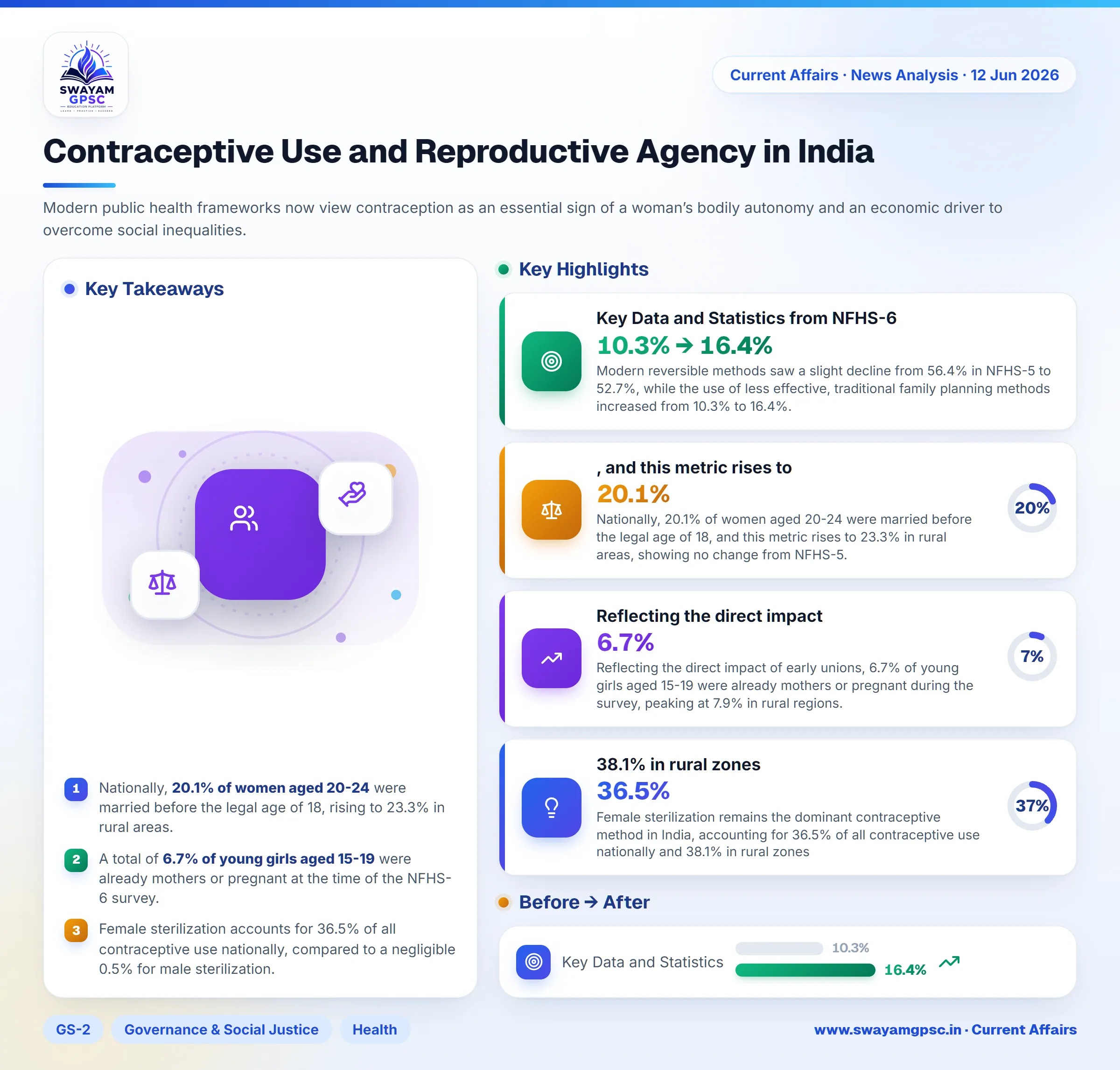
- Nationally, 20.1% of women aged 20-24 were married before the legal age of 18, rising to 23.3% in rural areas.
- A total of 6.7% of young girls aged 15-19 were already mothers or pregnant at the time of the NFHS-6 survey.
- Female sterilization accounts for 36.5% of all contraceptive use nationally, compared to a negligible 0.5% for male sterilization.
- The use of less effective traditional family planning methods increased significantly from 10.3% to 16.4%.
Why in News
- The release of the NFHS-6 (2023-24) data has started important policy discussions on women’s reproductive autonomy in India.
About Contraceptive Use and Reproductive Agency
- Reproductive agency gives women the freedom to safely decide whether, when, and how frequently to bear children, acting as a core pillar of women’s empowerment.
- India's public health history long treated contraception mainly as a tool for population control and demographic target-setting.
- Modern public health frameworks now view contraception as an essential sign of a woman’s bodily autonomy and an economic driver to overcome social inequalities.
Key Data and Statistics from NFHS-6
- Nationally, 20.1% of women aged 20-24 were married before the legal age of 18, and this metric rises to 23.3% in rural areas, showing no change from NFHS-5.
- Reflecting the direct impact of early unions, 6.7% of young girls aged 15-19 were already mothers or pregnant during the survey, peaking at 7.9% in rural regions.
- Female sterilization remains the dominant contraceptive method in India, accounting for 36.5% of all contraceptive use nationally and 38.1% in rural zones, compared to just 0.5% for male sterilization.
- Modern reversible methods saw a slight decline from 56.4% in NFHS-5 to 52.7%, while the use of less effective, traditional family planning methods increased from 10.3% to 16.4%.
The Imperative Need for Strong Reproductive Autonomy
- Early marriage significantly lengthens a woman's reproductive window, while delaying marriage shortens this span to reduce health risks from early pregnancies.
- Young brides face high maternal risks due to low healthcare awareness, making the prevention of early pregnancies crucial to lower severe anemia and maternal mortality.
- Postponing marriage and childbearing allows women to complete secondary education, join the paid workforce, and build financial security.
- Moving away from mass surgical procedures in underfunded rural hospitals prevents post-operative infections and long-term illnesses.
- Correcting the heavy imbalance where women bear nearly all contraceptive responsibilities is essential for building equal partnerships in family planning.
Initiatives and Historical Context
- India set a global benchmark in 1952 by becoming the first country to introduce an official state-sponsored national family planning program.
- The Prohibition of Child Marriage Act (PCMA) was enacted as a strict legal framework to penalize child marriages and protect young girls.
- The introduction of the NFHS framework deployed multi-round national surveys to systematically track health, nutrition, and family planning parameters.
- The expansion of rural health infrastructure built a network of government hospitals and community health centers to provide subsidized reproductive services.
Challenges
- Deeply entrenched social practices mean nearly a quarter of all rural girls are still wed before 18, cutting short their education and career prospects.
- Public health systems often default to permanent tubectomies instead of offering a diverse mix of modern reversible contraceptive methods.
- Rural government hospitals face high patient volumes, under-trained staff, and limited resources that can compromise surgical care quality.
- The drop in sterilization has pushed women toward informal, less reliable traditional methods rather than modern reversible options.
- Deep-rooted cultural biases and a lack of targeted awareness leave male sterilization rates stagnant at a negligible 0.5%.
Way Forward
- Strictly implement the Prohibition of Child Marriage Act and design targeted financial incentives to keep girls in rural secondary schools.
- Shift national healthcare priorities away from permanent sterilization campaigns toward expanding free access to scientific reversible methods like copper-Ts and oral pills.
- Inject dedicated funding into rural government clinics to train frontline staff and guarantee high-quality, patient-centered care.
- Design active community-level public health campaigns to dismantle misconceptions around vasectomies and improve male participation.
- Ensure that every woman accessing public reproductive care receives unbiased counseling on all available temporary and permanent contraceptive options.