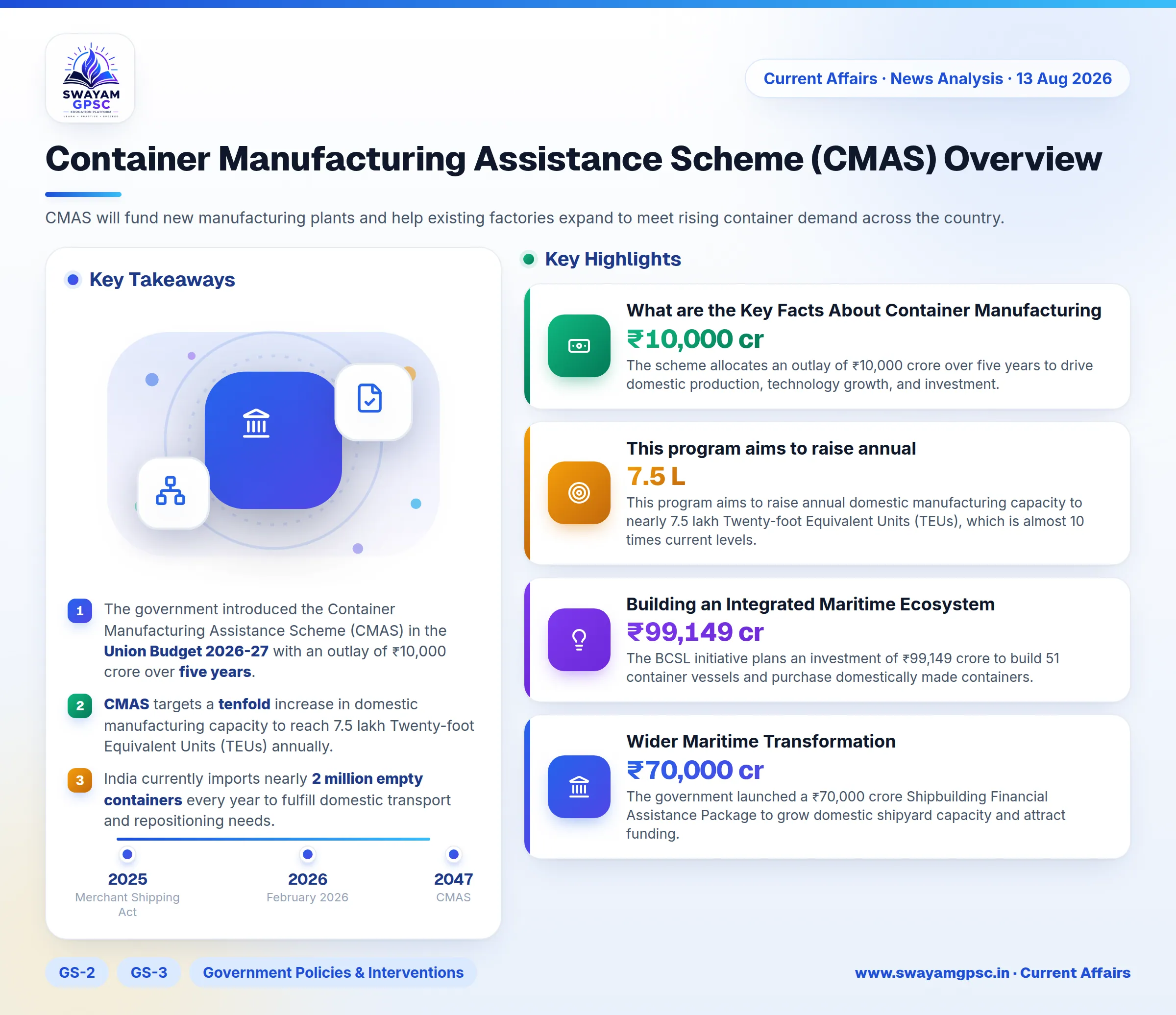
Container Manufacturing Assistance Scheme (CMAS) Overview
#GS-2 #GS-3 #Government Policies & Interventions #Infrastructure #Economy #Governance & Social Justice
Key takeaways
- The government introduced the Container Manufacturing Assistance Scheme (CMAS) in the Union Budget 2026-27 with an outlay of ₹10,000 crore over five years.
- CMAS targets a tenfold increase in domestic manufacturing capacity to reach 7.5 lakh Twenty-foot Equivalent Units (TEUs) annually.
- India currently imports nearly 2 million empty containers every year to fulfill domestic transport and repositioning needs.
- To strengthen maritime logistics, the Ministry of Ports established the Bharat Container Shipping Line (BCSL) with a planned investment of ₹99,149 crore for 51 container vessels.
- The government also introduced a ₹70,000 crore Shipbuilding Financial Assistance Package to expand domestic shipyard capacity.
Why in News
- India's growing trade and manufacturing ambitions require a strong domestic container manufacturing sector to lower reliance on imported containers.
- To address this need, the government proposed the Container Manufacturing Assistance Scheme (CMAS) to boost India's maritime, shipping, and logistics sectors.
What are the Key Facts About Container Manufacturing Assistance Scheme?
- The government announced the Container Manufacturing Assistance Scheme (CMAS) in the Union Budget 2026-27 to build a competitive domestic container industry.
- The scheme allocates an outlay of ₹10,000 crore over five years to drive domestic production, technology growth, and investment.
- CMAS will fund new manufacturing plants and help existing factories expand to meet rising container demand across the country.
- This program aims to raise annual domestic manufacturing capacity to nearly 7.5 lakh Twenty-foot Equivalent Units (TEUs), which is almost 10 times current levels.
- The initiative will unlock major economic opportunities while establishing India as a trusted maker of high-quality shipping containers.
- The scheme offers capital funds for Greenfield projects, expansion grants for Brownfield units, and operational aid to boost market competitiveness.
- It also finances testing facilities, skill training programs, and capacity development across the entire container value chain.
- The main goal is to build a globally competitive container manufacturing network that reduces import reliance and strengthens supply chain security.
- CMAS aligns with major national programs like Make in India, Maritime Amrit Kaal Vision 2047, and multimodal transport expansion plans.
Shipping Containers
- Shipping containers are standardized steel boxes that move cargo easily across ships, trains, and trucks without reloading goods during transport.
- Manufacturers build these containers following international ISO specifications so they fit seamlessly into global transport networks.
- The most common container sizes are 20-foot and 40-foot units, with overall capacity measured in Twenty-foot Equivalent Units (TEUs).
Building an Integrated Maritime Ecosystem
- In February 2026, the Ministry of Ports, Shipping and Waterways signed an agreement to establish the Bharat Container Shipping Line (BCSL).
- BCSL brings together key state entities, including SCI, CONCOR, JNPA, V.O. Chidambaranar Port Authority, and Sagarmala Finance Corporation Limited.
- The BCSL initiative plans an investment of ₹99,149 crore to build 51 container vessels and purchase domestically made containers.
- The PM Gati Shakti platform improves transport links between ports, railways, highways, and industrial hubs to reduce logistics delays.
- The National Logistics Policy focuses on digital tools, smooth processes, and lower transport costs across cargo networks.
- The Sagarmala Programme works alongside CMAS and BCSL to upgrade port infrastructure and handle expanding trade volumes effectively.
Wider Maritime Transformation
- New laws including the Merchant Shipping Act, 2025, Coastal Shipping Act, 2025, and Indian Ports Act, 2025 modernize maritime regulation.
- Digital tools like One Nation One Port Process (ONOP), Maritime Single Window, and e-Samudra streamline port procedures and cut paperwork.
- The government launched a ₹70,000 crore Shipbuilding Financial Assistance Package to grow domestic shipyard capacity and attract funding.
- Combined with CMAS and BCSL, these measures connect shipbuilding, container manufacturing, shipping lines, and ports into one unified network.
- Major projects like Vadhavan Port, Galathea Bay Transshipment Port, Tuna Tekra Terminal, and V.O. Chidambaranar Outer Harbour will boost cargo handling.
- Legal updates, digital portals, and expanded port infrastructure together reduce costs and make regulatory processes predictable for businesses.
- Demonstrating progress, three Indian ports achieved spots among the world top 30 in the Container Port Performance Index 2025.
Recent Progress in Container Manufacturing
- In July 2026, India delivered its first local export-import shipping container to A.P. Moller-Maersk at the Dadri Inland Container Depot in Uttar Pradesh.
- Factory workers made this container under international ISO standards and the International Convention for Safe Containers (CSC) guidelines.
- Showing market trust, Maersk ordered 1,000 additional Made-in-India containers from the DCM Shriram Group.
- These early achievements prove that government backing is producing real commercial results and making India a maritime manufacturing center.
Why Does India Need Domestic Container Manufacturing?
- Sea transport carries about 80% of global trade volume, with container cargo making up nearly two-thirds of total trade value worldwide.
- Geopolitical conflicts and trade route delays frequently cause sharp jumps in freight rates and disrupt international shipping channels.
- Recent global supply disruptions have forced nations to manufacture essential logistics gear locally to protect their own supply lines.
- India's growing industrial output and rising export-import trade require a steady supply of shipping containers across transport routes.
- India currently imports almost 2 million empty containers each year, leaving local businesses exposed to global price spikes and supply shortages.
Way Forward
- The CMAS initiative is a key step toward establishing a competitive maritime equipment manufacturing sector across India.
- By boosting local container output and cutting imports, India can secure its trade lines, create jobs, and become a global logistics hub.