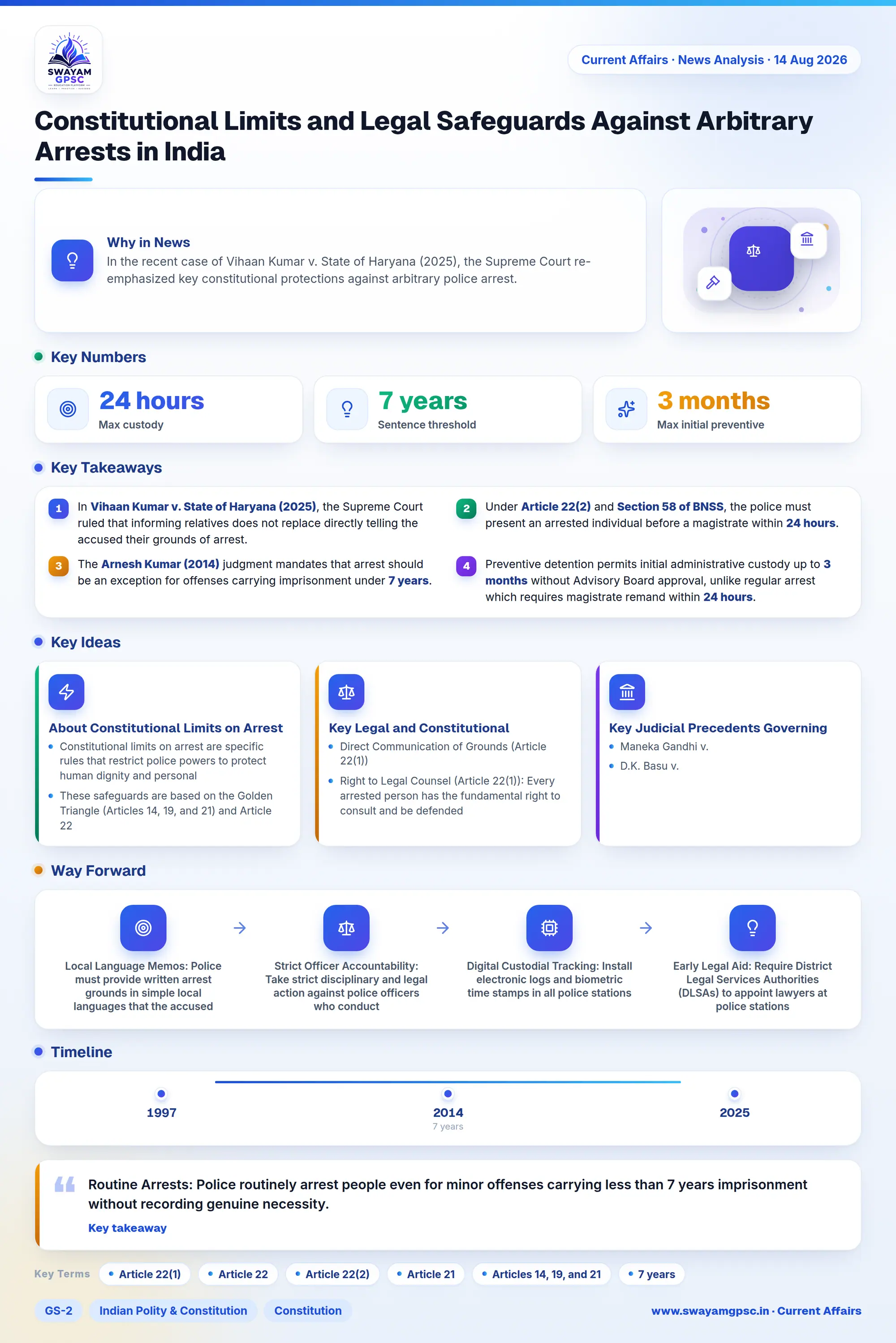
Constitutional Limits and Legal Safeguards Against Arbitrary Arrests in India
#GS-2 #Indian Polity & Constitution #Constitution #Judiciary #Executive #Fundamental Rights #Article 22
Key takeaways
- In Vihaan Kumar v. State of Haryana (2025), the Supreme Court ruled that informing relatives does not replace directly telling the accused their grounds of arrest.
- Under Article 22(2) and Section 58 of BNSS, the police must present an arrested individual before a magistrate within 24 hours.
- The Arnesh Kumar (2014) judgment mandates that arrest should be an exception for offenses carrying imprisonment under 7 years.
- Preventive detention permits initial administrative custody up to 3 months without Advisory Board approval, unlike regular arrest which requires magistrate remand within 24 hours.
Why in News
- In the recent case of Vihaan Kumar v. State of Haryana (2025), the Supreme Court re-emphasized key constitutional protections against arbitrary police arrest.
- The Court ruled that police officers must directly and clearly explain the exact reasons for arrest to the accused person to comply with Article 22(1).
About Constitutional Limits on Arrest
- Constitutional limits on arrest are specific rules that restrict police powers to protect human dignity and personal freedom.
- These safeguards are based on the Golden Triangle (Articles 14, 19, and 21) and Article 22, striking a balance between law enforcement and civil rights.
Key Legal and Constitutional Safeguards on Arrest
- Direct Communication of Grounds (Article 22(1)): Police must clearly explain the exact reasons for arrest directly to the person; informing family members or making vague entries is not sufficient.
- Right to Legal Counsel (Article 22(1)): Every arrested person has the fundamental right to consult and be defended by a lawyer of their own choice without any delay.
- Mandatory 24-Hour Production (Article 22(2) and Section 58 BNSS): Police must present the arrested person before a magistrate within 24 hours, and the arrest memo must record the exact time of arrest.
- Protection of Dignity (Article 21): Custodial torture, physical violence, or humiliating treatment during police custody is strictly prohibited.
- Consequence of Illegal Arrest: If an arrest violates constitutional procedures, the arrest becomes illegal, which automatically makes any further judicial remand invalid.
Key Judicial Precedents Governing Arrests
- Maneka Gandhi v. Union of India (1978): Established that any government action limiting personal liberty must be fair, reasonable, and non-arbitrary under Articles 14, 19, and 21.
- D.K. Basu v. State of West Bengal (1997): Issued strict binding guidelines for police, including visible name tags, written arrest memos, and regular medical checkups.
- Arnesh Kumar v. State of Bihar (2014): Mandated that arrest should not be routine for crimes carrying sentences under 7 years, requiring police to write down clear reasons under Section 41 CrPC (Section 35 BNSS).
- Vihaan Kumar v. State of Haryana (2025): Clarified that telling relatives does not fulfill the duty to inform the accused, and illegal arrests make subsequent custody orders invalid.
Arrest vs Preventive Detention
- Nature and Cause: An arrest happens after an offense is suspected, whereas preventive detention keeps a person in custody to stop potential future crimes.
- Type of Crime: Regular arrest covers cognizable and non-cognizable crimes, while preventive detention is an administrative measure under specific laws without a trial.
- Article 22 Safeguards: Regular arrests offer full rights like legal aid and magistrate review, but key safeguards under Article 22(1) and Article 22(2) do not apply to preventive detention.
- Maximum Custody Period: Police can hold an arrested person for only 24 hours without magistrate permission, while preventive detention allows up to 3 months without Advisory Board approval.
Challenges in Enforcing Arrest Safeguards
- Routine Arrests: Police routinely arrest people even for minor offenses carrying less than 7 years imprisonment without recording genuine necessity.
- Complex Legal Jargon: Police often write the grounds of arrest in complicated legal language that ordinary citizens cannot understand.
- Informal Detentions: Delays in writing down the exact time of arrest on memos lead to illegal unrecorded detentions and custodial abuse.
- Misuse of Preventive Laws: Authorities sometimes use preventive detention laws unnecessarily to avoid following standard criminal trial rules.
Way Forward
- Local Language Memos: Police must provide written arrest grounds in simple local languages that the accused can easily read and understand.
- Strict Officer Accountability: Take strict disciplinary and legal action against police officers who conduct unnecessary routine arrests.
- Digital Custodial Tracking: Install electronic logs and biometric time stamps in all police stations to enforce the 24-hour magistrate presentation rule.
- Early Legal Aid: Require District Legal Services Authorities (DLSAs) to appoint lawyers at police stations before the magistrate grants remand.
Conclusion
- Constitutional limits on arrest are necessary to check police power and guard individual freedom in a democratic nation.
- Strictly enforcing these safeguards ensures that the justice system treats every individual with dignity, fairness, and procedural justice.