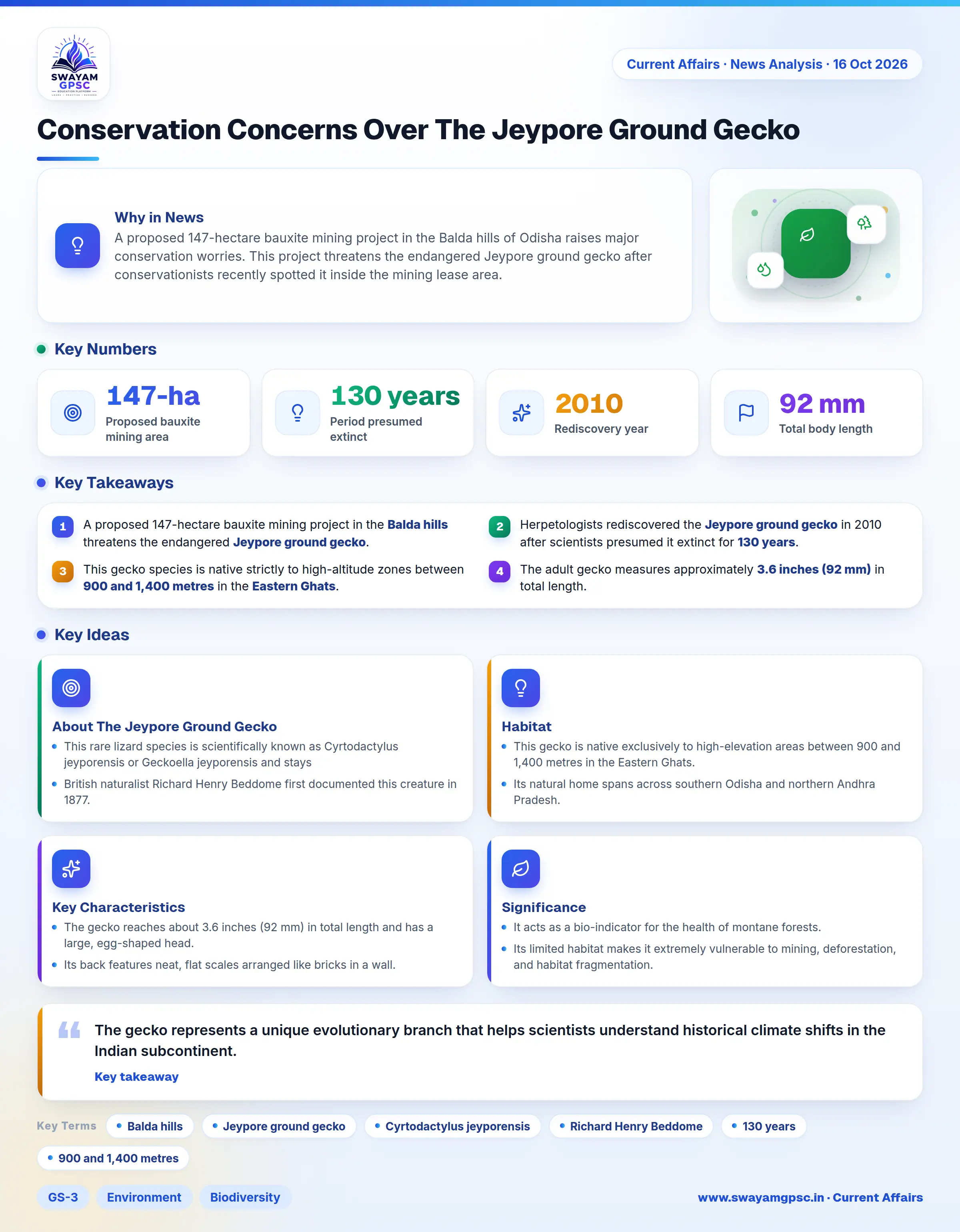
Conservation Concerns Over The Jeypore Ground Gecko
#GS-3 #Environment #Biodiversity #Wildlife #Geography #Resources #Current Events #National #Gujarat
Key takeaways
- A proposed 147-hectare bauxite mining project in the Balda hills threatens the endangered Jeypore ground gecko.
- Herpetologists rediscovered the Jeypore ground gecko in 2010 after scientists presumed it extinct for 130 years.
- This gecko species is native strictly to high-altitude zones between 900 and 1,400 metres in the Eastern Ghats.
- The adult gecko measures approximately 3.6 inches (92 mm) in total length.
Why in News
- A proposed 147-hectare bauxite mining project in the Balda hills of Odisha raises major conservation worries.
- This project threatens the endangered Jeypore ground gecko after conservationists recently spotted it inside the mining lease area.
About The Jeypore Ground Gecko
- This rare lizard species is scientifically known as Cyrtodactylus jeyporensis or Geckoella jeyporensis and stays active mainly at night.
- British naturalist Richard Henry Beddome first documented this creature in 1877.
- Scientists presumed it extinct for 130 years until herpetologists Ishan Agarwal and Aniruddha Datta-Roy rediscovered it in 2010.
Habitat
- This gecko is native exclusively to high-elevation areas between 900 and 1,400 metres in the Eastern Ghats.
- Its natural home spans across southern Odisha and northern Andhra Pradesh.
- It lives on the floors of montane semi-evergreen forests, hiding inside boulder crevices, rock piles, and under decaying leaf litter.
Key Characteristics
- The gecko reaches about 3.6 inches (92 mm) in total length and has a large, egg-shaped head.
- Its back features neat, flat scales arranged like bricks in a wall.
- The body color ranges from light yellowish-brown to orange with bold reddish-brown and black-edged spots.
- It lacks specialized preanal or femoral pores, and its tail is cylindrical and tapering.
- Unlike common wall geckos, this species stays strictly on the ground and hunts at night among leaf litter and rocks.
- Scientists believe it is an ancient wet-zone relict lineage that split from its relatives over 20 million years ago as Peninsular India grew drier.
Significance
- The gecko represents a unique evolutionary branch that helps scientists understand historical climate shifts in the Indian subcontinent.
- It acts as a bio-indicator for the health of montane forests.
- Its limited habitat makes it extremely vulnerable to mining, deforestation, and habitat fragmentation.