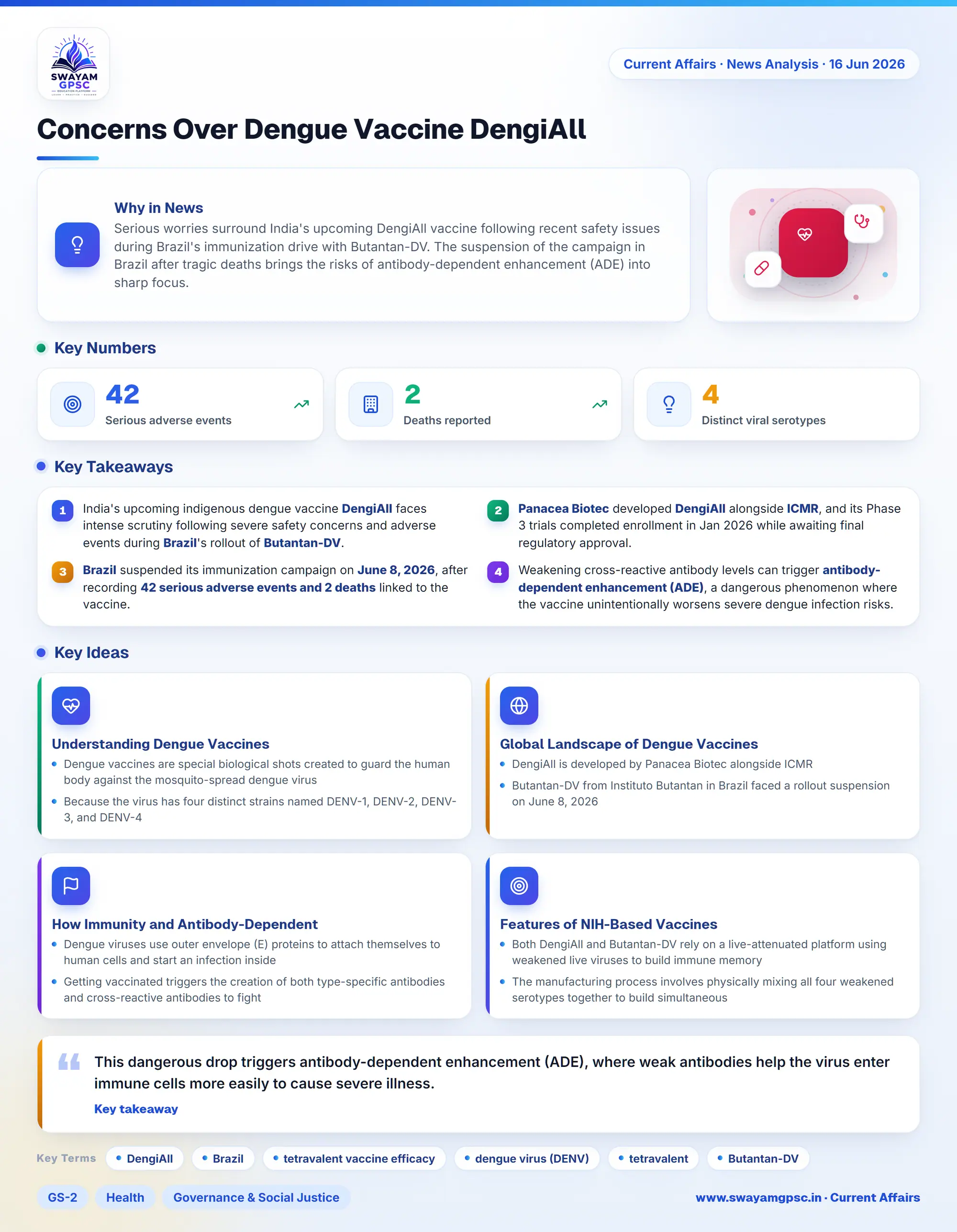
Concerns Over Dengue Vaccine DengiAll
#GS-2 #Health #Governance & Social Justice #Science & Technology #Current Events #National #Gujarat
Key takeaways
- India's upcoming indigenous dengue vaccine DengiAll faces intense scrutiny following severe safety concerns and adverse events during Brazil's rollout of Butantan-DV.
- Panacea Biotec developed DengiAll alongside ICMR, and its Phase 3 trials completed enrollment in Jan 2026 while awaiting final regulatory approval.
- Brazil suspended its immunization campaign on June 8, 2026, after recording 42 serious adverse events and 2 deaths linked to the vaccine.
- Weakening cross-reactive antibody levels can trigger antibody-dependent enhancement (ADE), a dangerous phenomenon where the vaccine unintentionally worsens severe dengue infection risks.
Why in News
- Serious worries surround India's upcoming DengiAll vaccine following recent safety issues during Brazil's immunization drive with Butantan-DV.
- The suspension of the campaign in Brazil after tragic deaths brings the risks of antibody-dependent enhancement (ADE) into sharp focus.
- Medical experts emphasize the urgent need for strict tracking of vaccine safety and comprehensive checks on tetravalent vaccine efficacy.
Understanding Dengue Vaccines
- Dengue vaccines are special biological shots created to guard the human body against the mosquito-spread dengue virus (DENV).
- Because the virus has four distinct strains named DENV-1, DENV-2, DENV-3, and DENV-4, a successful shot must be tetravalent.
- A tetravalent formula must trigger equal and simultaneous immunity against all four viral varieties to be truly effective.
Global Landscape of Dengue Vaccines
- DengiAll is developed by Panacea Biotec alongside ICMR, and its Phase 3 trials completed enrollment in Jan 2026 while awaiting approval.
- Butantan-DV from Instituto Butantan in Brazil faced a rollout suspension on June 8, 2026, following 42 serious adverse events and 2 deaths.
- Qdenga is made by Takeda in Japan, and experts report that its approval from Indian regulators is coming very soon.
- Dengvaxia by Sanofi Pasteur holds the title of the first licensed dengue shot, but it faced suspension in the Philippines after severe late-stage problems.
How Immunity and Antibody-Dependent Enhancement Work
- Dengue viruses use outer envelope (E) proteins to attach themselves to human cells and start an infection inside the body.
- Getting vaccinated triggers the creation of both type-specific antibodies and cross-reactive antibodies to fight future infections.
- Type-specific antibodies focus on one precise serotype and neutralize that exact strain to give strong and lasting protection.
- Cross-reactive antibodies can bind to all four viral strains, but they are often produced in much larger quantities with lower precision.
- When cross-reactive antibody levels drop over time, they become too weak to fully neutralize the incoming virus.
- This dangerous drop triggers antibody-dependent enhancement (ADE), where weak antibodies help the virus enter immune cells more easily to cause severe illness.
Features of NIH-Based Vaccines
- Both DengiAll and Butantan-DV rely on a live-attenuated platform using weakened live viruses to build immune memory safely.
- The manufacturing process involves physically mixing all four weakened serotypes together to build simultaneous immunity against every strain.
- Physical mixing can lead to viral interference, where one strain multiplies faster and suppresses the growth of weaker strains.
- Clinical trials in Brazil lacked active circulation of DENV-3 and DENV-4, leaving real-world protection levels for those strains uncertain.
Prelims in Focus: Live-Attenuated Vaccines
- Live-attenuated vaccines contain a weakened version of a pathogen that can copy itself slightly without making healthy people sick.
- Because they closely copy natural infections, these shots stimulate strong immunity and need fewer booster doses over time.
- Common examples include the MMR shot for measles, mumps, and rubella, along with vaccines for varicella and yellow fever.
- Key limitations include unsuitability for immunocompromised individuals, strict needs for cold-chain storage, and rare risks of turning virulent again.