Climate Risk Insurance in India
#GS-3 #Environment #Climate Change #Environmental Impact Assessment (EIA) #Pollution #Disaster Management #Disaster Preparedness #Agriculture #Infrastructure #Economy
Key takeaways
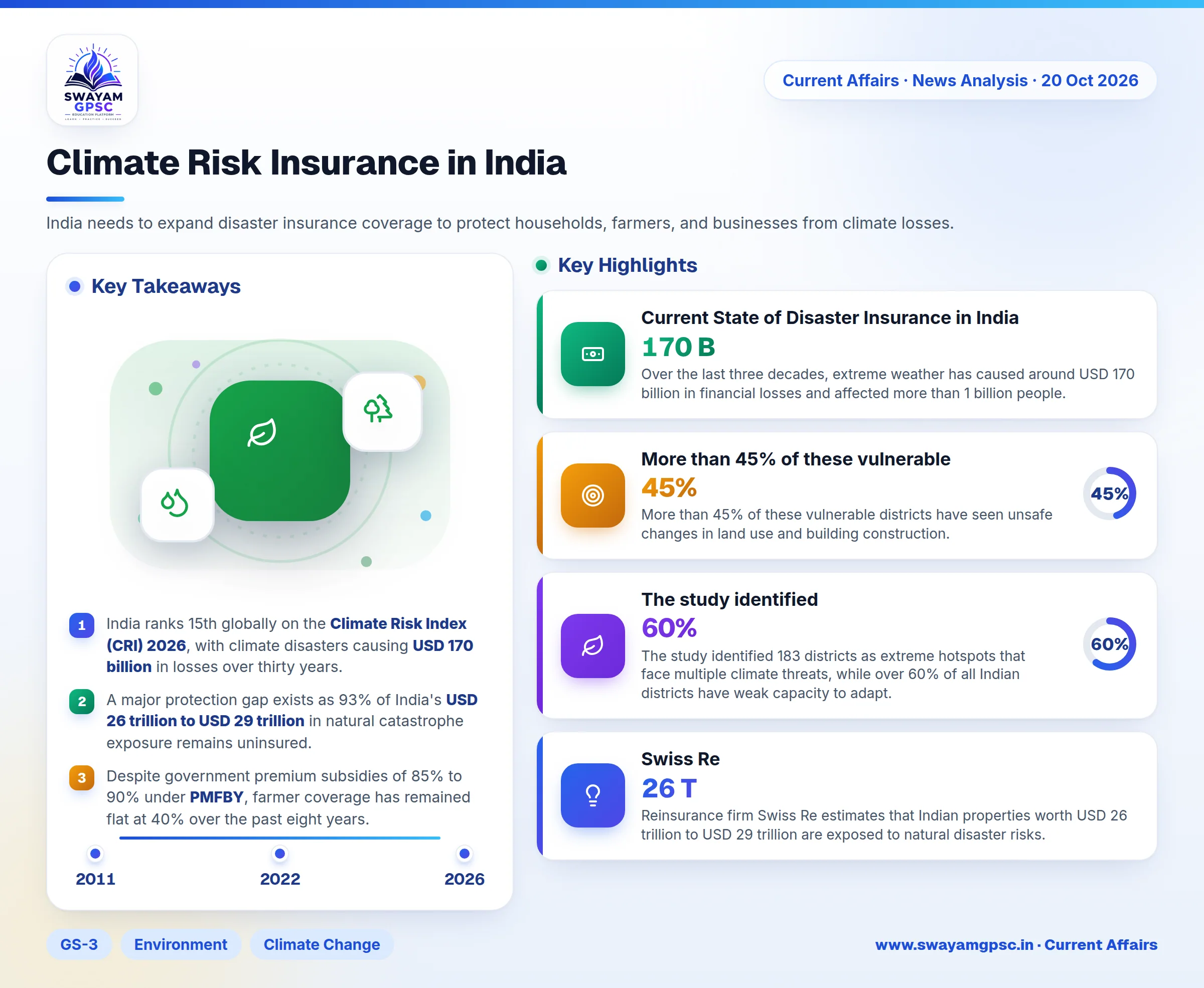
- India ranks 15th globally on the Climate Risk Index (CRI) 2026, with climate disasters causing USD 170 billion in losses over thirty years.
- A major protection gap exists as 93% of India's USD 26 trillion to USD 29 trillion in natural catastrophe exposure remains uninsured.
- Despite government premium subsidies of 85% to 90% under PMFBY, farmer coverage has remained flat at 40% over the past eight years.
- Shifting to parametric insurance can speed up relief by automatically transferring funds via JAM when weather thresholds like 200 mm of rain are crossed.
- Studies show that every USD 1 spent on climate resilience and risk adaptation yields over USD 10.50 in long-term economic benefits.
Why in News
- The 2026 southwest monsoon showed how vulnerable India is to extreme weather conditions.
- A combination of El Niño and regional rainfall shortages occurred along with intense local rainstorms.
- These events highlight the urgent need for climate risk insurance to protect vulnerable families and farmers from financial failure.
Summary
- India needs to expand disaster insurance coverage to protect households, farmers, and businesses from climate losses.
- Using tools like parametric insurance, catastrophe risk pools, premium subsidies, and climate-resilient city planning can strengthen disaster protection.
Current State of Disaster Insurance in India
- According to the Climate Risk Index (CRI) 2026, India ranks 15th among countries most affected by climate change.
- Over the last three decades, extreme weather has caused around USD 170 billion in financial losses and affected more than 1 billion people.
- The Council on Energy, Environment and Water (CEEW) analyzed 640 districts using 2011 Census data to create the Climate Vulnerability Index (CVI).
- The CEEW study found that 463 districts are highly vulnerable to extreme floods, droughts, and cyclones.
- More than 45% of these vulnerable districts have seen unsafe changes in land use and building construction.
- The study identified 183 districts as extreme hotspots that face multiple climate threats, while over 60% of all Indian districts have weak capacity to adapt.
- Reinsurance firm Swiss Re estimates that Indian properties worth USD 26 trillion to USD 29 trillion are exposed to natural disaster risks.
- As of 2022, a massive 93% of this total financial risk remained completely uninsured.
- This domestic insurance gap mirrors a dangerous trend seen across the global economy.
- Climate disasters act as a risk multiplier, leaving 222 million children in India facing both extreme poverty and climate threats.
- Crop insurance remains the primary form of climate protection available to rural communities in India.
- The 16th Finance Commission noted that despite governments paying 85% to 90% of premium costs under Pradhan Mantri Fasal Bima Yojana (PMFBY), farmer coverage has stuck at 40% for eight years.
- Because non-agricultural disaster insurance remains underdeveloped due to low awareness and high costs, citizens and governments bear the entire recovery bill.
- India is creating better catastrophe models to forecast climate impacts down to street levels, but turning this data into affordable public protection remains difficult.
Challenges in Insuring Climate Disasters
- Insurers are shifting from broad regional assessments to hyper-local mapping, which creates a new problem.
- Risk management firm RMSI uses 80,000 simulated flood events across 28 river basins and 19,000 pin codes.
- Identifying specific high-risk neighborhoods causes insurance companies to charge extremely high premiums, making coverage unaffordable for the most vulnerable people.
- Despite sophisticated models from firms like Moody's and Aon, insurers in India lack proper discipline when pricing risks.
- Fierce market competition forces companies to set artificially low prices that ignore long-term climate threats.
- Disasters cause widespread economic damage across multiple sectors at once.
- Crop losses, ruined infrastructure, and broken supply chains act as a heavy tax on poor families and threaten national financial stability.
- Because over 80% of Indians live in districts exposed to climate risks, repeated disasters destroy local economies and hit low-income families hardest.
- India is building high-resolution catastrophe models to evaluate risks at specific pin codes.
- The RMSI India FloodRisk Model covers over 19,000 pin codes and models 80,000 flood events in major river systems.
- The RMSI India Cyclone Hazard Model offers precise 1 km x 1 km risk mapping and advanced storm tracking.
- However, converting these detailed risk scores into affordable insurance plans for the public remains a major challenge.
Measures to Ensure Effective Climate Risk Protection
- Research by the World Resources Institute across 320 adaptation projects in 12 countries shows that every USD 1 invested generates over USD 10.50 in benefits over 10 years.
- The United Nations Development Programme (UNDP) and National Disaster Management Authority (NDMA) are designing a national catastrophe risk insurance pool.
- This pool would spread extreme climate losses across the government, local insurance firms, and international reinsurers to keep prices affordable for everyday citizens.
- India should move toward parametric insurance, which pays out automatically when specific weather limits are crossed.
- For example, if rainfall passes 200 mm in 24 hours or cyclone winds top 150 km/h, money transfers directly to victims without waiting for slow field inspections.
- The government must subsidize disaster insurance premiums for Below Poverty Line (BPL) families and small-scale farmers.
- Commercial real estate in risky coastal areas should pay full market prices, while the state covers risk costs for vulnerable citizens.
- Using the Jan Dhan-Aadhaar-Mobile (JAM) network allows the government to deliver small, affordable disaster insurance products directly to rural workers.
- Cities must enforce strict building rules to prevent construction in floodplains, which naturally reduces damage and lowers insurance prices.
Best Practices in Parametric Insurance
- The African Risk Capacity (ARC) pool combines climate risks across multiple countries to lower premiums and share losses.
- Fiji and Samoa use early weather forecasts to trigger insurance payouts before cyclones hit, helping pay for evacuations and quick preparations.
- Nagaland uses state mitigation funds to buy multi-year parametric coverage against severe landslides and extreme rainfall.
- Rajasthan and Uttar Pradesh use a specialized water balance index to provide automatic loan relief to female farmers during droughts.
Way Forward
- India needs accurate, risk-based climate pricing to stop unsafe development in high-risk zones.
- The country must support this strategy with national risk pools and targeted subsidies so vulnerable families can afford disaster protection.