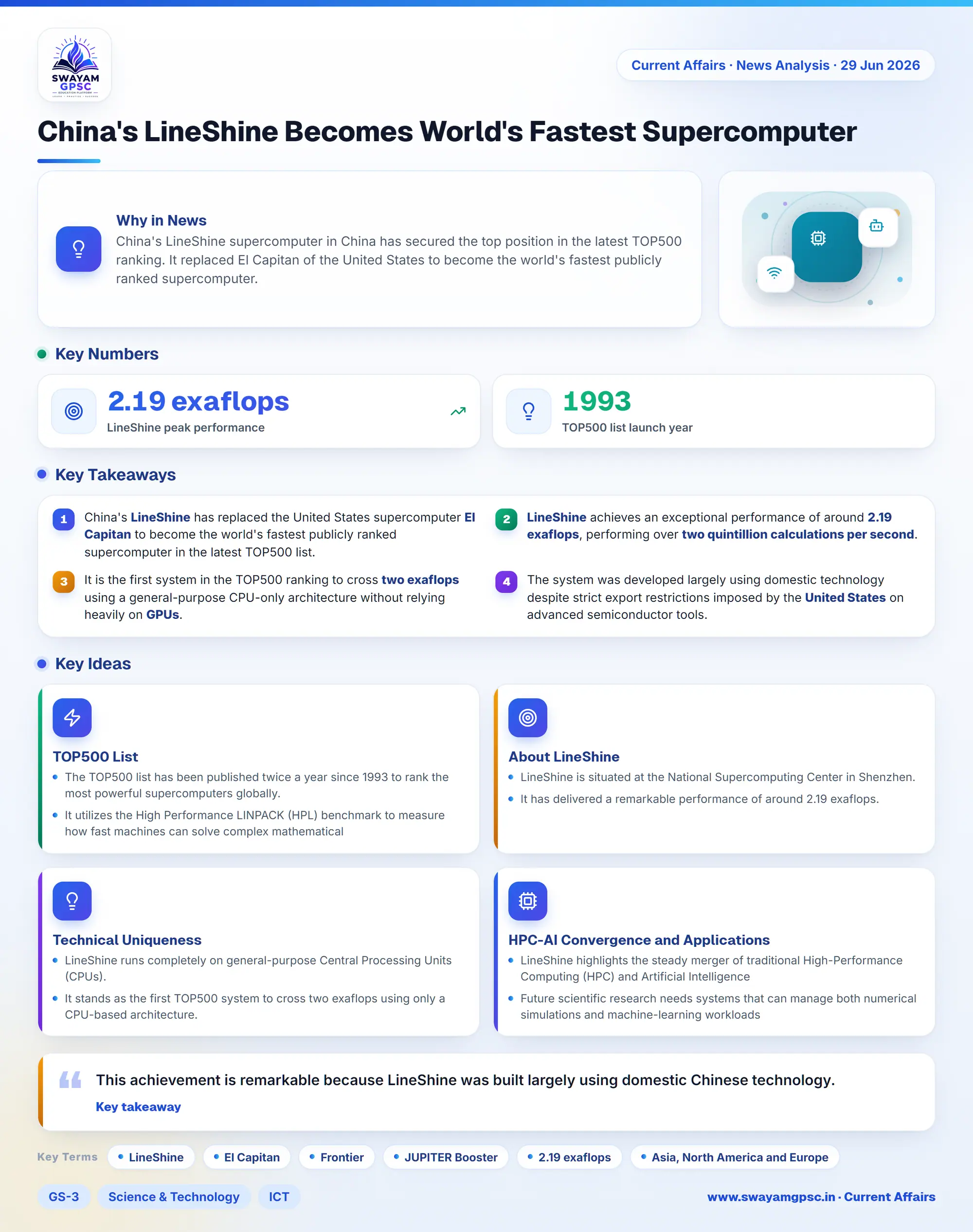
China's LineShine Becomes World's Fastest Supercomputer
#GS-3 #Science & Technology #ICT #Rapid Fire CA #Quick Facts For Prelims #Economy
Key takeaways
- China's LineShine has replaced the United States supercomputer El Capitan to become the world's fastest publicly ranked supercomputer in the latest TOP500 list.
- LineShine achieves an exceptional performance of around 2.19 exaflops, performing over two quintillion calculations per second.
- It is the first system in the TOP500 ranking to cross two exaflops using a general-purpose CPU-only architecture without relying heavily on GPUs.
- The system was developed largely using domestic technology despite strict export restrictions imposed by the United States on advanced semiconductor tools.
Why in News
- China's LineShine supercomputer in China has secured the top position in the latest TOP500 ranking.
- It replaced El Capitan of the United States to become the world's fastest publicly ranked supercomputer.
- Frontier secured the third spot and Aurora took the fourth spot, both belonging to the United States.
- JUPITER Booster from Germany successfully completed the list of the top five supercomputers.
TOP500 List
- The TOP500 list has been published twice a year since 1993 to rank the most powerful supercomputers globally.
- It utilizes the High Performance LINPACK (HPL) benchmark to measure how fast machines can solve complex mathematical problems.
About LineShine
- LineShine is situated at the National Supercomputing Center in Shenzhen.
- It has delivered a remarkable performance of around 2.19 exaflops.
- This performance level means it can execute over two quintillion calculations per second.
- Its launch expands the global exascale club from four systems to five systems.
- This milestone marks the first time that Asia, North America and Europe simultaneously host HPL exaflop-class supercomputers.
Technical Uniqueness
- LineShine runs completely on general-purpose Central Processing Units (CPUs).
- It stands as the first TOP500 system to cross two exaflops using only a CPU-based architecture.
- Unlike many systems focused on Artificial Intelligence (AI), it does not rely heavily on Graphics Processing Units (GPUs).
HPC-AI Convergence and Applications
- LineShine highlights the steady merger of traditional High-Performance Computing (HPC) and Artificial Intelligence (AI).
- Future scientific research needs systems that can manage both numerical simulations and machine-learning workloads smoothly.
- It is deployed for advanced tasks like AI-assisted weather forecasting and rainfall prediction across East Asia.
- It also performs atomic-level simulations of magnetic materials for advanced research.
Significance
- This achievement is remarkable because LineShine was built largely using domestic Chinese technology.
- It succeeded despite strict United States export restrictions on advanced AI chips and semiconductor tools.